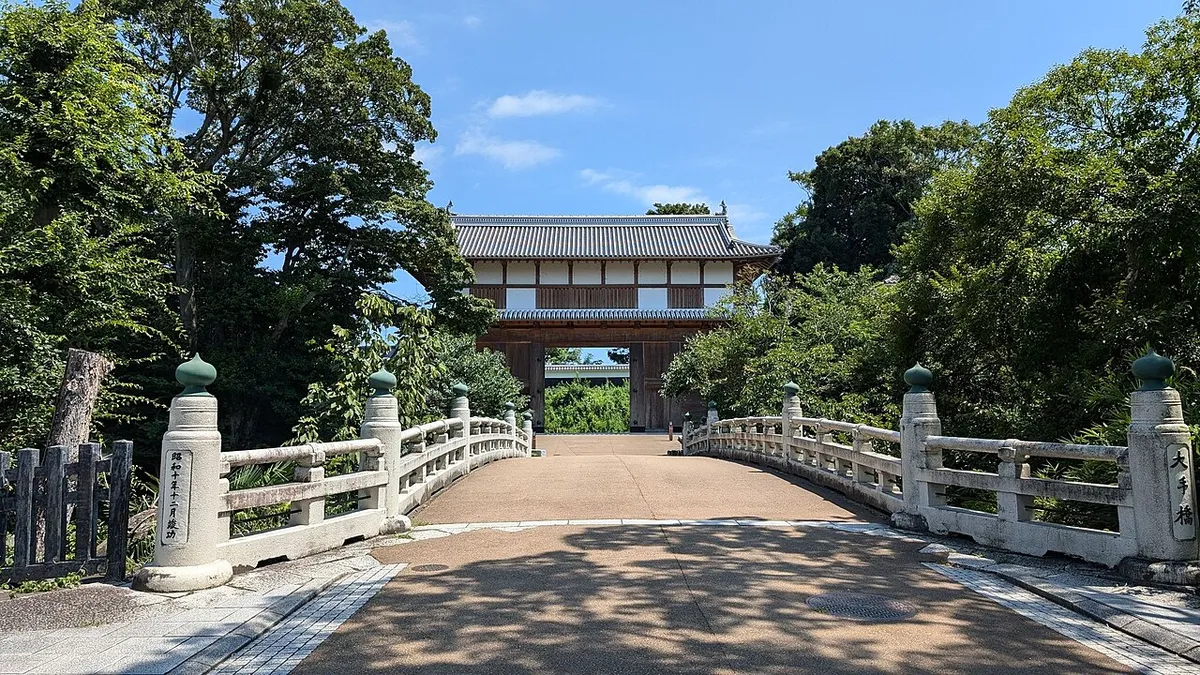
Mito Castle

水戸城·Mito-jo

D Tourism Score 45/100
C Defense Score 68/100

Home of Japan's most famous fictitious traveler and the intellectual dynasty that helped end the shogunate — a castle of ideas more than stone.

#14 — 100 Famous Castles Ruins
Mito Castle (水戸城)
Photo:Souka Kinmei/Wikimedia Commons/CC0

Quick Facts

Quick Facts

Admission
Free Free
Hours
00:00 – 24:00
Nearest Station
Mito Station (JR Joban Line / JR Mito Line)
Walk from Station
15 min walk
Time Needed
45 minutes castle, 30 minutes Kodokan, 1 hour Kairakuen Garden

Castle grounds and Yakui Gate are free to visit. The adjacent Kodokan (Mito domain school) charges ¥200 adults. The Second Bailey (Ninomaru) is now occupied by schools and not generally open to the public.

Defense Overview

Defense Overview

Why Mito Castle was hard to attack

This castle is hard to attack because attackers have to work through successive outer spaces before the core instead of getting a direct run at the core.

An attacker would not simply arrive at the center on open flat ground. They would have to cross water barriers or moat lines, approach through at least some constrained entry space, and face more defensive depth after the first line.

Overall score

68/100

Estimated range

62–74

Confidence

B

Usable estimate with some inference

This is a site-original comparison score for learning and comparison, not a reconstruction of one historical battle.

Radar view

Terrain 11/20 Entrance 13/20 Internal 17/20 Siege 15/20 Oversight 12/20
How this estimate was built+

This estimate combines broad terrain, approach, layout, and route-control signals. It is meant to explain the castle's defensive logic in plain English, not reconstruct a single historical attack.

Terrain Advantage

How much the terrain itself seems to help: height, slope, ridges, cliffs, water edges, and limited approach directions.

11/20

Entrance Defense

How awkward and dangerous the first entry looks: gates, bridge or moat crossings, chokepoints, and forced turns.

13/20

Internal Complexity

How hard it seems to keep pushing after entry: layered baileys, depth, compartmentalization, and repeated defensive lines.

17/20

Siege Endurance

A rough sense of long-hold potential: moats, water access, space, storage plausibility, and defensive staying power.

15/20

Strategic Oversight

How much the castle appears to command nearby roads, plains, rivers, basins, harbors, or town approaches.

12/20

Why Visit

Mito Castle is primarily for visitors interested in late Edo intellectual and political history — the Mito school's influence on the Meiji Restoration, the Dai Nihon Shi project, and the Kodokan domain school. The newly completed Yakui Gate (2020) adds a welcome physical focal point to what is otherwise an atmospheric but fragmentary ruins site. Combine with Kairakuen Garden for one of Japan's best plum blossom experiences (February–March).

Highlights

1

Mito Tokugawa: Keepers of Orthodoxy

Mito Castle was the seat of the Mito branch of the Tokugawa family — one of the three great Tokugawa branch families (gosanke) that could provide a successor to the shogunate. The Mito Tokugawa were famous not for military power but for intellectual leadership: they produced the Mito school of Neo-Confucian thought, the massive historical compilation 'Dai Nihon Shi,' and the political philosophy that helped drive the Meiji Restoration. The castle was the center of Japan's intellectual life in the late Edo period.
2

Yakui Gate: 2020 Reconstruction

After decades of absence, Mito Castle received a major boost in 2020 with the completion of the Yakui Gate — a wooden reconstruction of one of the castle's original gates, built using traditional construction methods. The gate stands on the original stone foundation and gives visitors the first tangible castle structure at the site in over 150 years.

3

Kodokan: Japan's Largest Domain School

Adjacent to the castle grounds, the Kodokan was established by Tokugawa Nariaki in 1841 as the Mito domain's school — one of the finest and largest domain educational institutions in Japan. The surviving buildings (a designated Important Cultural Property) teach both Confucian learning and military arts, reflecting the Mito Tokugawa's unique fusion of intellectual and martial culture.

Structure Details

Visitor tip

The primary attraction at Mito Castle today is the newly reconstructed Yakui Gate (2020) and the nearby Kodokan school complex. The main castle hill is partly occupied by a middle school — the most accessible areas are around the gate and the deep moat sections between compounds. Budget 45 minutes for the castle, then add 30 minutes for the Kodokan.

Castle type

Flatland castle

Flatland castle — built on a natural low ridge above the Naka River and its marshy floodplain, with the river providing natural defense on the north

Layout type

Linked compound layout

Compound style — three main compounds (Sannomaru, Ninomaru, Honmaru) arranged in a line along the ridge

Main tower

Ruins — no original structures survive except the Yakui Gate (reconstructed 2020). The main tower (goten tower) and all other buildings were lost in WWII bombing and postwar demolition.

Stone walls

Natural stone stacking

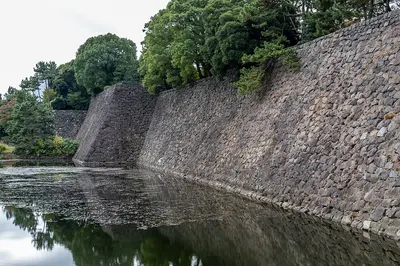
Stone walls survive in limited sections, primarily around the Honmaru (main compound) and gate area. The castle's primary defensive feature was its earthwork construction — massive earthen embankments rather than stone walls dominated most of the site.

Moats

A deep dry moat (karabori) system separated the castle compounds from each other and from the surrounding town. The deep moats between the Sannomaru, Ninomaru, and Honmaru compounds survive in part and give a strong sense of the castle's layered defenses.

Key defensive features

Naka River North Cliff

The northern face of the castle ridge drops steeply to the Naka River floodplain — a natural cliff defense that made approach from the north essentially impossible. The river itself provided an additional barrier.

Deep Compound-Separating Moats

The dry moats between the castle's three main compounds are deep and wide, meaning an attacker who forced one compound would still face a significant obstacle before reaching the next. These moats are among the best-surviving features of the original castle.

Linear Ridge Defense

The castle's linear layout along the ridge meant it could only be attacked from two directions (east or west) — the cliff and river eliminated the other approaches. This channeled any attacking force into predictable corridors.

The Story of Mito Castle

Originally built 1293 / Mito clan (early fortification)
Current form 1602 / Tokugawa Yorifusa
    1293

    An early fortification is built on the ridge above the Naka River by the Mito clan, exploiting the natural defensive advantages of the location.

    1602

    Tokugawa Yorifusa, eleventh son of Tokugawa Ieyasu, is assigned Mito domain. He expands the castle significantly, establishing it as the seat of the Mito Tokugawa branch family.

    1657

    Tokugawa Mitsukuni (Mito Komon) begins the Dai Nihon Shi — a massive historical compilation of Japanese history that would take 250 years to complete. The Mito domain school becomes a major center of intellectual activity.

    1841

    Tokugawa Nariaki establishes the Kodokan domain school, one of the largest and most distinguished in Japan, teaching both Confucian learning and military arts — a reflection of the Mito school's 'sonnojoi' (revere the Emperor, expel the barbarians) philosophy.

    1945

    Allied bombing raids on Mito destroy most of the castle's surviving structures. The main tower and several gates are lost. Only the stone walls and earthworks remain largely intact.

    2020

    The Yakui Gate is completed after meticulous wooden reconstruction on the original stone foundation — the first new castle structure at Mito in generations, and a significant milestone in the castle's slow restoration.

In Pop Culture

TV

Mito Komon (long-running TV series)

The fictional adventures of Tokugawa Mitsukuni (Mito Komon) traveling incognito across Japan have been dramatized in one of Japanese television's longest-running and most beloved series — giving the Mito Tokugawa name extraordinary popular recognition.

Did You Know?

  • Tokugawa Mitsukuni ('Mito Komon') is one of the most recognizable figures in Japanese popular culture — his TV adventures have run for decades, and his image (elderly gentleman with a distinctive walking style) is instantly familiar across Japan, even to people with no interest in history.
  • The Dai Nihon Shi, the massive historical compilation begun by Mitsukuni in 1657, was not completed until 1906 — spanning 250 years of scholarship and 397 volumes. It influenced the intellectual justification for imperial restoration in the 19th century.
  • Mito Castle never had a traditional tenshu (main tower) in the classic sense — the main tower structure was a 'goten tower' (palace tower) combining residential and defensive functions, different from the purely military tenshu of other castles.
  • Mito's Kairakuen Garden, one of Japan's three famous traditional gardens alongside Kenrokuen (Kanazawa) and Korakuen (Okayama), is a 15-minute walk from the castle. Its famous plum trees (around 3,000 trees, 100 varieties) bloom in February–March, bringing huge crowds to the city.

Score Breakdown

Tourism Score

D 45/100
  • Accessibility 12 /20
  • Foreign-Friendly 7 /20
  • Historical Value 12 /20
  • Visual Impact 7 /20
  • Facilities 7 /20

Defense Score

C 68/100
  • Terrain Advantage 11 /20
  • Entrance Defense 13 /20
  • Internal Complexity 17 /20
  • Siege Endurance 15 /20
  • Strategic Oversight 12 /20

Planning Your Visit

Best Time to Visit

February to March for Kairakuen Garden's famous plum blossoms — this transforms Mito into a major tourist destination for a few weeks. Otherwise, visit in mild spring or autumn.

Time Needed

45 minutes castle, 30 minutes Kodokan, 1 hour Kairakuen Garden

Insider Tip

The deep dry moats between the Sannomaru and Ninomaru compounds are the most atmospheric surviving feature of the castle — walk along the moat edges rather than just visiting the gate. The view down into the 10-meter-deep moat gives a visceral sense of the castle's defensive layering that the flat, open compounds above cannot convey.

Map

Getting There

Nearest station: Mito Station (JR Joban Line / JR Mito Line)
Walk from station: 15 min walk
Parking: Municipal parking available near the castle area.
Accessible with a JR Pass

Admission

Free

Castle grounds and Yakui Gate are free to visit. The adjacent Kodokan (Mito domain school) charges ¥200 adults. The Second Bailey (Ninomaru) is now occupied by schools and not generally open to the public.

Opening Hours

Open00:00 – 24:00

The Yakui Gate exterior is accessible at all times. Interior may have restricted hours. The Kodokan is open 09:00–17:00, closed Monday.

Facilities

  • – English guides
  • – Audio guide
  • ✓ Wheelchair access
  • ✓ Restrooms
  • – Gift shop
  • ✓ Food nearby

Nearby Castles

Featured in collections

FAQ

Frequently Asked Questions

How do I get to Mito Castle?

The nearest station is Mito Station (JR Joban Line / JR Mito Line). From there it is about 15 minutes on foot.

How much does Mito Castle cost to enter?

Mito Castle is free to enter.

Is Mito Castle worth visiting?

Mito Castle is primarily for visitors interested in late Edo intellectual and political history — the Mito school's influence on the Meiji Restoration, the Dai Nihon Shi project, and the Kodokan domain school. The newly completed Yakui Gate (2020) adds a welcome physical focal point to what is otherwise an atmospheric but fragmentary ruins site. Combine with Kairakuen Garden for one of Japan's best plum blossom experiences (February–March).

What are the opening hours of Mito Castle?

00:00 to 24:00.

How long should I spend at Mito Castle?

Plan for about 45 minutes castle, 30 minutes Kodokan, 1 hour Kairakuen Garden, depending on how closely you want to explore the grounds.