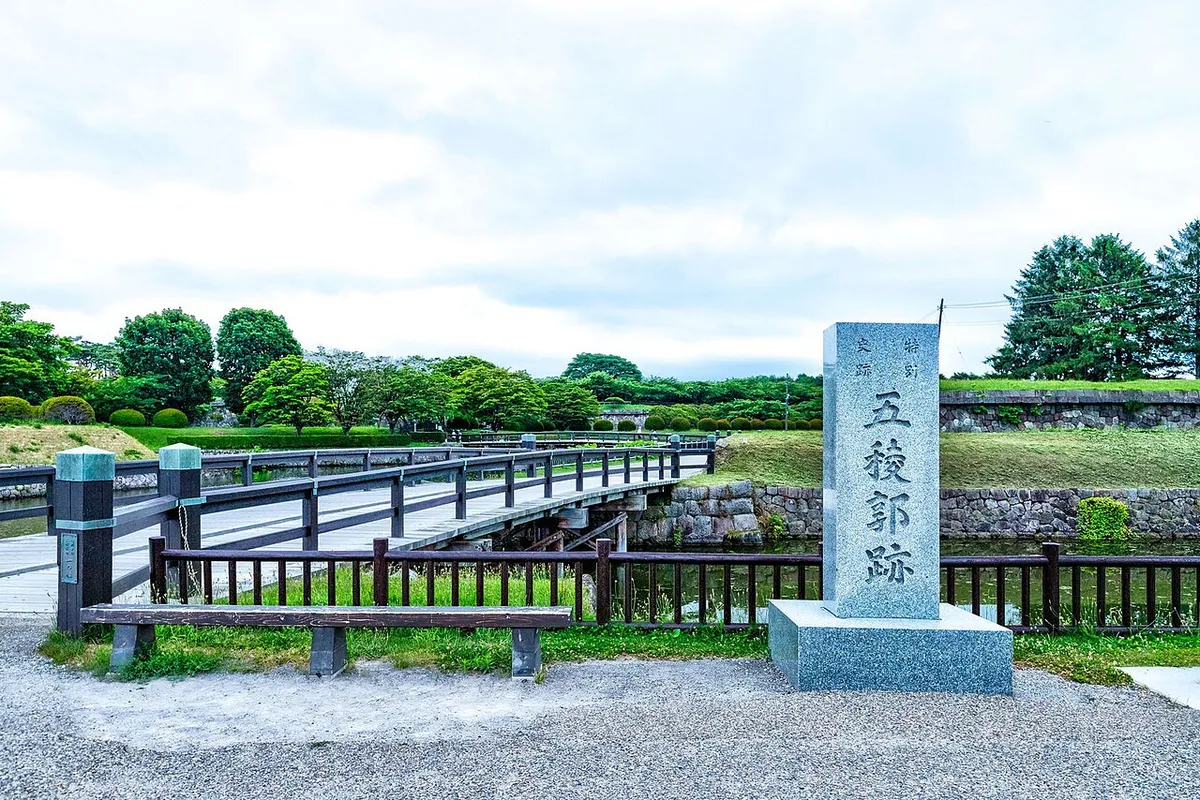
Goryokaku

五稜郭·Goryokaku

B Tourism Score 75/100
C Defense Score 60/100

Japan's only star fort — a Western military import that became the stage for the Shogunate's final defeat — is best understood from 107 meters above.

#2 — 100 Famous Castles Ruins
Goryokaku (五稜郭)
Photo:くろふね/Wikimedia Commons/CC BY 4.0

Quick Facts

Quick Facts

Admission
¥1,200

¥600

Hours
09:00 – 18:00

Last entry 17:40

Nearest Station
Goryokaku-koen-mae (Hakodate City Tram)
Walk from Station
15 min walk

Bus also available

Time Needed
2–3 hours (tower + fort walk + bugyosho)

Admission is for the Goryokaku Tower (museum/observation), NOT the star fort grounds themselves — the fort park is free to enter at ground level. Tower admission gives aerial views of the star shape.

Defense Overview

Defense Overview

Why Goryokaku was hard to attack

This castle is hard to attack because attackers have to work across water barriers before pressing inward instead of getting a direct run at the core.

An attacker would not simply arrive at the center on open flat ground. They would have to cross water barriers or moat lines and push through successive outer areas before the core.

Overall score

60/100

Estimated range

54–66

Confidence

B

Usable estimate with some inference

This is a site-original comparison score for learning and comparison, not a reconstruction of one historical battle.

Radar view

Terrain 10/20 Entrance 11/20 Internal 15/20 Siege 13/20 Oversight 11/20
How this estimate was built+

This estimate combines broad terrain, approach, layout, and route-control signals. It is meant to explain the castle's defensive logic in plain English, not reconstruct a single historical attack.

Terrain Advantage

How much the terrain itself seems to help: height, slope, ridges, cliffs, water edges, and limited approach directions.

10/20

Entrance Defense

How awkward and dangerous the first entry looks: gates, bridge or moat crossings, chokepoints, and forced turns.

11/20

Internal Complexity

How hard it seems to keep pushing after entry: layered baileys, depth, compartmentalization, and repeated defensive lines.

15/20

Siege Endurance

A rough sense of long-hold potential: moats, water access, space, storage plausibility, and defensive staying power.

13/20

Strategic Oversight

How much the castle appears to command nearby roads, plains, rivers, basins, harbors, or town approaches.

11/20

Why Visit

Goryokaku is genuinely unlike any other site in Japanese castle history — it is not a Japanese castle at all, but a European-style star fort built by Japanese engineers from French manuals. The geometric star shape visible from the Goryokaku Tower is one of the most satisfying aerial views in Japan, and the history is arguably more dramatic than most castle sites: this is where the Tokugawa Shogunate made its final stand and surrendered in 1869, ending 260 years of rule. The cherry blossom season is extraordinary if you can time it right.

Highlights

1

Japan's Only Star-Shaped Western Fortress

Goryokaku is completely unlike any other castle in Japan — a five-pointed star fort (the name literally means 'five-pointed enclosure') based on European bastion fortification principles, where each projecting point covers the others' walls with overlapping fields of fire. Nothing remotely like it exists anywhere else in Japanese history. Built in 1864 by engineers who studied French military manuals, it represents Japan's urgent scramble to modernize defenses as Western warships appeared off the coast.
2

The Tower View That Makes Everything Click

At ground level, the moats and earthworks of Goryokaku feel like a pleasant park. Climb the Goryokaku Tower and suddenly the entire geometric logic snaps into focus — a perfect five-pointed star, its earthen bastions stretching symmetrically outward, the inner compound ringed by water. The aerial view is one of the most satisfying geometric spectacles in Japan, and no photograph fully prepares you for seeing it in person from above.

3

The Last Stand of the Shogunate

Goryokaku was the site of the final battle of the Boshin War — the conflict that ended the Tokugawa Shogunate and brought about the Meiji Restoration. In 1869, a force of Shogunate loyalists under Enomoto Takeaki made their last stand here against imperial government forces. The siege lasted several weeks before Enomoto surrendered, ending over 260 years of Tokugawa rule. No other castle was the direct site of the Shogunate's final defeat.

4

Cherry Blossoms Inside a Star

In late April, the interior of the star fort fills with cherry blossoms — over 1,600 trees blooming within the geometric earthworks. The combination of pink blossoms, precise star-shaped earthen walls, and the reflection in the surrounding moat creates one of Hokkaido's most celebrated spring scenes. The Goryokaku Tower provides a perfect elevated view of the blossoms filling the star shape.

Structure Details

Visitor tip

The fort grounds at ground level are simply a lovely park — you need the Goryokaku Tower for the defining experience. Buy the tower admission, go up, and spend 15 minutes just looking at the star shape from above. Then descend and walk the moat perimeter on foot to appreciate the scale. The earthen bastions you can walk along were designed to absorb cannon fire. The 2010 reconstructed bugyosho (magistrate's office) inside the fort is worth visiting for the Boshin War exhibits.

Castle type

Flatland castle

Flatland castle — built on level ground with engineered earthworks rather than natural terrain for defense

Layout type

Concentric layout

Enclosure style — the star-shaped bastion design encloses a central compound; this approximates the Western trace italienne fortification rather than traditional Japanese castle layouts

Main tower

No original tenshu — the central government office (bugyosho) building was the main structure, not a tower keep. A replica of the bugyosho was reconstructed within the fort in 2010. The Goryokaku Tower nearby is a modern observation tower (not original).

Stone walls

Earthen walls

The defensive walls are earthen embankments (dobei) shaped into the five-pointed star form. The earth absorbs cannon shot (unlike stone, which shatters), and the angled bastions ensure no wall section can be attacked without other bastions providing flanking fire. A wide water moat surrounds the entire star perimeter.

Moats

A wide rectangular outer moat surrounds the star fort perimeter. The combination of moat and earthen bastions creates a formidable Western-style barrier, though the defenses proved insufficient against the professional Meiji imperial army in 1869.

Key defensive features

Star Bastion Geometry (Trace Italienne)

The five-pointed star shape eliminates blind spots — each angled bastion point can direct fire along the face of adjacent bastions, meaning attackers approaching any wall segment are exposed to flanking fire from the projecting points on either side. This design, perfected in Europe in the 16th century, was specifically developed to defeat cannon fire and massed infantry assault.

Earth-Absorbing Walls

Unlike stone walls that shatter under cannon fire and create lethal shrapnel, the earthen embankments absorb cannon shot without breaking. A ball fired at the walls simply buries itself in earth. This made the design inherently more resistant to the artillery of the era than any stone castle in Japan.

Demi-Lune Outer Defense

A half-moon outwork (demi-lune) was placed in front of the main entrance, providing an additional defensive layer at the most vulnerable point. This feature is purely European in origin and has no equivalent in traditional Japanese castle design.

The Story of Goryokaku

Originally built 1864 / Takeda Ayasaburo (design); Edo Shogunate
Current form 1864 / Edo Shogunate
    1853

    Commodore Perry's Black Ships arrive off Uraga, forcing Japan to open to foreign trade. The Shogunate recognizes its coastal defenses are inadequate and begins studying Western fortification methods urgently, including the French trace italienne star fort design.

    1857

    Construction of Goryokaku begins in Hakodate, chosen because Hakodate harbor had been designated an open treaty port and required modern defense. Engineer Takeda Ayasaburo designs the star fort based on French military manuals.

    1864

    Goryokaku is completed after seven years of construction — Japan's first Western-style fortification and the only star fort built in Japan. The Hakodate magistracy (bugyosho) moves inside the fort, making it both an administrative center and military installation.

    1868

    The Boshin War begins as Shogunate forces clash with imperial government troops across Japan. Shogunate admiral Enomoto Takeaki sails north with a fleet of warships and an army of loyalists, seizing Hokkaido as a last holdout.

    1869

    Imperial government forces besiege Goryokaku. After capturing the surrounding heights and bombarding the fort, Enomoto Takeaki surrenders in May 1869 — the final capitulation of the Tokugawa Shogunate. The Meiji era truly begins here.

    1914

    The Meiji government demolishes the remaining buildings inside the fort and converts Goryokaku into a public park — one of Japan's first Western-style public parks, still used today.

    2010

    A replica of the original bugyosho (magistrate's office) is reconstructed inside the fort using historical records, providing a permanent exhibition space on the fort's history and the Boshin War's final chapter.

In Pop Culture

Film

Goryokaku (1960 film)

A 1960 Toho film dramatizing the Boshin War's final battle at Goryokaku, helping establish the site's association with the dramatic last stand of the Shogunate in popular consciousness.

game

Hakuoki (Hakuoki: Shinsengumi Kitan)

The popular otome game and anime franchise climaxes at Goryokaku, drawing a devoted fanbase of visitors — particularly young women — to the site for its romantic Shinsengumi associations.

Did You Know?

  • Goryokaku is the only star-shaped (trace italienne) fortification ever built in Japan. The design was based on French military engineering textbooks, studied urgently by Shogunate engineers after Perry's arrival made the inadequacy of Japanese coastal defenses obvious.
  • The fort was barely completed before it became the site of Japan's most dramatic last stand — the Shogunate finished Goryokaku in 1864 and it was besieged and surrendered only five years later in 1869, having served as a functional military installation for just five years.
  • The name 'Goryokaku' is a direct translation: 'go' (five) + 'ryoku' (angle/point) + 'kaku' (enclosure) = 'five-pointed enclosure.' The name describes the shape with complete precision.
  • Cherry blossom season at Goryokaku is the most crowded period in all of Hakodate — over 1,600 cherry trees bloom inside the star fort in late April (typically 1–2 weeks later than Honshu due to Hokkaido's climate), creating a spectacular combination of geometric earthworks and pink blossoms.

Score Breakdown

Tourism Score

B 75/100
  • Accessibility 14 /20
  • Foreign-Friendly 16 /20
  • Historical Value 16 /20
  • Visual Impact 18 /20
  • Facilities 11 /20

Defense Score

C 60/100
  • Terrain Advantage 10 /20
  • Entrance Defense 11 /20
  • Internal Complexity 15 /20
  • Siege Endurance 13 /20
  • Strategic Oversight 11 /20

Planning Your Visit

Best Time to Visit

Late April for cherry blossoms inside the star fort (Hokkaido timing — typically 1–2 weeks after Honshu). Clear days year-round for the tower aerial view. The fort is atmospheric in snow in winter.

Time Needed

2–3 hours (tower + fort walk + bugyosho)

Insider Tip

Buy the Goryokaku Tower admission even if you are budget-conscious — the ground-level park experience misses the entire point. The star shape is invisible from ground level; you need elevation for the defining experience. From the tower's upper observation deck, spend time just tracing the geometry of the bastions and working out how the flanking fire system would have functioned. The bugyosho replica inside has unexpectedly good Boshin War exhibits in English.

Map

Getting There

Nearest station: Goryokaku-koen-mae (Hakodate City Tram)
Walk from station: 15 min walk
Bus: Bus services from Hakodate Station. Hakodate is accessible by Shinkansen (Hokkaido Shinkansen to Shin-Hakodate-Hokuto, then local train).
Parking: Paid parking available near the park entrance.
Accessible with a JR Pass

Admission

Adult¥1,200
Child¥600

Admission is for the Goryokaku Tower (museum/observation), NOT the star fort grounds themselves — the fort park is free to enter at ground level. Tower admission gives aerial views of the star shape.

Opening Hours

Open09:00 – 18:00
Last entry17:40

Tower hours vary: 09:00–18:00 (April–October), 09:00–17:00 (November–March). Fort park is open at all hours year-round.

Facilities

  • ✓ English guides
  • – Audio guide
  • ✓ Wheelchair access
  • ✓ Restrooms
  • ✓ Gift shop
  • ✓ Food nearby

Nearby Castles

Featured in collections

FAQ

Frequently Asked Questions

How do I get to Goryokaku?

The nearest station is Goryokaku-koen-mae (Hakodate City Tram). From there it is about 15 minutes on foot. Bus services from Hakodate Station. Hakodate is accessible by Shinkansen (Hokkaido Shinkansen to Shin-Hakodate-Hokuto, then local train).

How much does Goryokaku cost to enter?

Adult admission is ¥1,200 and child admission is ¥600.

Is Goryokaku worth visiting?

Goryokaku is genuinely unlike any other site in Japanese castle history — it is not a Japanese castle at all, but a European-style star fort built by Japanese engineers from French manuals. The geometric star shape visible from the Goryokaku Tower is one of the most satisfying aerial views in Japan, and the history is arguably more dramatic than most castle sites: this is where the Tokugawa Shogunate made its final stand and surrendered in 1869, ending 260 years of rule. The cherry blossom season is extraordinary if you can time it right.

What are the opening hours of Goryokaku?

09:00 to 18:00, last entry 17:40.

How long should I spend at Goryokaku?

Plan for about 2–3 hours (tower + fort walk + bugyosho), depending on how closely you want to explore the grounds.