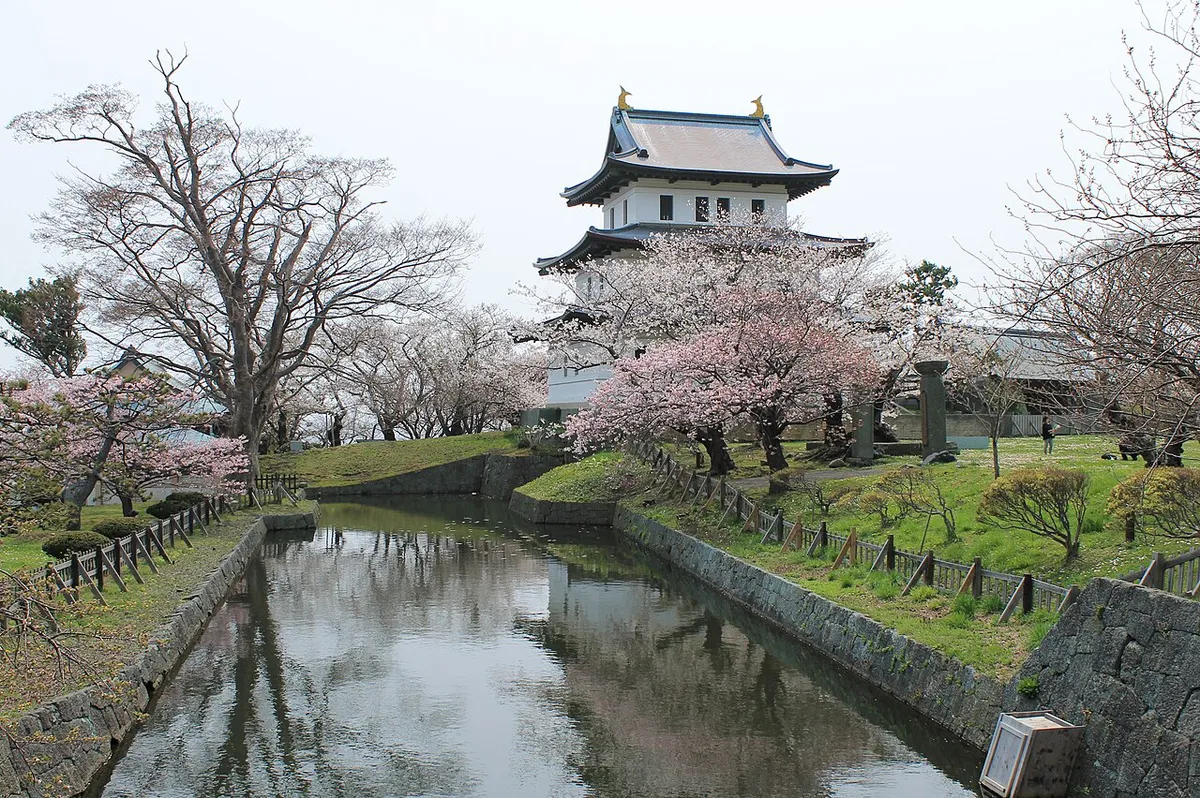
Matsumae Castle

松前城·Matsumae-jo

D Tourism Score 42/100
C Defense Score 65/100

Japan's northernmost castle and its last — Matsumae is an extreme destination with unique historical status, best experienced buried in cherry blossoms.

#3 — 100 Famous Castles Reconstructed
Matsumae Castle (松前城)
Photo:pakku/Wikimedia Commons/CC BY 3.0

Quick Facts

Quick Facts

Admission
¥360

¥240

Hours
09:00 – 17:00

Last entry 16:30

Nearest Station
Kikonai Station (Hokkaido Shinkansen / JR Kaikyo Line), then 90-min bus
Walk from Station
10 min walk

Bus also available

Time Needed
1.5–2 hours (castle and park)

Children under elementary school age free. Fee applies to the reconstructed castle museum.

Defense Overview

Defense Overview

Why Matsumae Castle was hard to attack

This castle is hard to attack because attackers have to work across water barriers before pressing inward instead of getting a direct run at the core.

An attacker would not simply arrive at the center on open flat ground. They would have to cross water barriers or moat lines, approach through at least some constrained entry space, and push through successive outer areas before the core.

Overall score

65/100

Estimated range

59–71

Confidence

A

Strong multi-source support

This is a site-original comparison score for learning and comparison, not a reconstruction of one historical battle.

Radar view

Terrain 11/20 Entrance 13/20 Internal 16/20 Siege 14/20 Oversight 11/20
How this estimate was built+

This estimate combines broad terrain, approach, layout, and route-control signals. It is meant to explain the castle's defensive logic in plain English, not reconstruct a single historical attack.

Terrain Advantage

How much the terrain itself seems to help: height, slope, ridges, cliffs, water edges, and limited approach directions.

11/20

Entrance Defense

How awkward and dangerous the first entry looks: gates, bridge or moat crossings, chokepoints, and forced turns.

13/20

Internal Complexity

How hard it seems to keep pushing after entry: layered baileys, depth, compartmentalization, and repeated defensive lines.

16/20

Siege Endurance

A rough sense of long-hold potential: moats, water access, space, storage plausibility, and defensive staying power.

14/20

Strategic Oversight

How much the castle appears to command nearby roads, plains, rivers, basins, harbors, or town approaches.

11/20

Why Visit

Matsumae demands justification for its considerable remoteness, and the justification is twofold: historical uniqueness (the last traditional castle built in Japan, the northernmost) and cherry blossoms (10,000 trees, 250+ varieties, one of Hokkaido's most celebrated spring destinations). The castle tower itself is a concrete rebuild with modest exhibits, but the original stone walls, the surviving Romon gate, and the extraordinary cherry blossom park make the journey worthwhile for dedicated visitors. Combine with Goryokaku in Hakodate (90 minutes by car) for a complete Hokkaido castle experience.

Highlights

1

Japan's Northernmost Castle — and Its Last

Matsumae Castle holds two unique records in Japanese castle history: it is the northernmost Japanese-style castle ever built, and it was the last traditional castle constructed in Japan before the practice ended with the Meiji Restoration. Completed in 1854 — just one year after Perry's Black Ships — it represents the final expression of a castle-building tradition that stretched back 500 years, built even as that tradition was about to become permanently obsolete.
2

The Only Castle in Hokkaido Until 1864

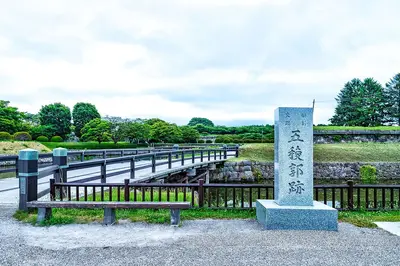
Matsumae was the sole Japanese-style castle in all of Hokkaido until Goryokaku was completed in 1864. This reflects the reality that most of Hokkaido remained effectively outside Japanese feudal control during the Edo period — Matsumae domain was the single outpost of the castle-and-samurai system at the edge of the Japanese world, governing trade with the Ainu people and watching the northern seas.

3

Cherry Blossom Treasure

Despite its extreme remoteness, Matsumae is one of Hokkaido's most celebrated cherry blossom destinations. The castle grounds contain over 10,000 cherry trees of more than 250 varieties — including rare cultivars found nowhere else. Matsumae Park's cherry blossom season (late April to early May) draws visitors from across Hokkaido, with the reconstructed black castle tower framed by blossoms as the signature image.

Structure Details

Visitor tip

Matsumae requires genuine commitment — it is very remote by Japanese standards, with no direct rail access. The reward is a historically unique site: the last traditional castle built in Japan, set in Hokkaido's most famous cherry blossom park. Come in late April to early May for the cherry blossoms if at all possible. The original stone walls and surviving Romon gate are more interesting than the concrete tower.

Castle type

Flatland castle

Flatland castle — built on gently elevated ground near the sea, on the southwestern tip of Hokkaido

Layout type

Linked compound layout

Compound style — main tower connected to subsidiary structures

Main tower

Concrete reconstruction (1961) — the original 1854 tower burned in a fire in 1949. The current tower is a concrete replica built twelve years after the fire, used as a castle history museum.

16m3 floors, 1 below

Stone walls

Natural stone stacking

The stone walls and some structural elements from the original 1854 construction survive. The original tenshu (main tower) gate — the Romon — is a designated Important Cultural Property and is one of the few surviving original components, preserving the architectural style of the last traditional castle build.

Moats

Original moats partially survive around the castle grounds, though in reduced form compared to the Edo-period extent.

Key defensive features

Sea-Approach Position

Matsumae Castle was positioned on a coastal promontory overlooking the Tsugaru Strait, with the primary defensive purpose of monitoring and controlling sea traffic between Honshu and Hokkaido rather than defending against land-based threats from the interior.

Northern Frontier Function

The castle served as the administrative and military center for controlling the Matsumae domain's monopoly on trade with the Ainu — its strategic value was commercial and political as much as purely military.

The Story of Matsumae Castle

Originally built 1606 / Matsumae Yoshihiro (fortified residence); final castle 1854
Current form 1854 / Matsumae clan
    1606

    Matsumae Yoshihiro establishes a fortified residence on the site, marking the beginning of the Matsumae domain — Japan's northernmost feudal domain, with a unique charter to monopolize trade with the Ainu people of Hokkaido.

    1800

    Russian activities in Sakhalin and the Kuril Islands increase alarm at the Shogunate about northern border security. Matsumae's strategic importance as the gateway to Hokkaido grows sharply.

    1854

    The current castle is completed — the last traditional Japanese-style castle built in Japan. Completed just one year after Perry's arrival forced Japan open, it is almost immediately obsolete as a military design, unable to withstand Western artillery.

    1868

    During the Boshin War, Shogunate loyalist forces under Enomoto Takeaki capture Matsumae Castle from the imperial-aligned Matsumae clan. The castle briefly becomes a battleground in the northern theater of the Boshin War before the Shogunate forces move on to Goryokaku.

    1949

    The original 1854 main tower burns to the ground in a fire — one of the most significant losses in post-WWII castle preservation. The fire destroys Japan's last traditionally-built castle tower just 95 years after its completion.

    1961

    A concrete reconstruction of the main tower is built, housing a castle history museum. The original stone walls, stone steps, and Romon gate survive as genuine historical artifacts from 1854.

Did You Know?

  • Matsumae Castle was the last traditional Japanese-style castle (with a tenshu tower) ever constructed — completed in 1854, just as Western military technology was making the design permanently obsolete. The original tower survived only 95 years before burning in 1949.
  • The Matsumae domain had a unique position in the Edo-period feudal order: unlike all other domains, its income was not measured in rice (koku) but in the value of Ainu trade — fish, sea mammals, and other northern products. It was the only domain in Japan measured in non-rice income.
  • Matsumae Park contains over 10,000 cherry trees of more than 250 varieties, making it one of the most botanically diverse cherry blossom collections in Japan. Some cultivars are exclusive to Matsumae. The season runs typically from late April to early May — weeks later than the cherry blossom front on Honshu.
  • The Romon gate (main tower gate) from the 1854 original castle is a designated Important Cultural Property and one of the only surviving original structural elements. It is architecturally significant as a document of late Edo-period castle gate design.

Score Breakdown

Tourism Score

D 42/100
  • Accessibility 3 /20
  • Foreign-Friendly 5 /20
  • Historical Value 14 /20
  • Visual Impact 11 /20
  • Facilities 9 /20

Defense Score

C 65/100
  • Terrain Advantage 11 /20
  • Entrance Defense 13 /20
  • Internal Complexity 16 /20
  • Siege Endurance 14 /20
  • Strategic Oversight 11 /20

Planning Your Visit

Best Time to Visit

Late April to early May for cherry blossoms — the defining reason to visit. The castle closes from December through March due to snow.

Time Needed

1.5–2 hours (castle and park)

Insider Tip

The Romon gate (to the right of the main tower) is the most historically significant surviving structure — an original artifact from 1854, the year the castle was completed. Most visitors walk past it in favor of the tower. Also note the original stone walls, which are genuine 1854 construction. The concrete tower is the least interesting element of the site.

Map

Getting There

Nearest station: Kikonai Station (Hokkaido Shinkansen / JR Kaikyo Line), then 90-min bus
Walk from station: 10 min walk
Bus: Bus from Kikonai Station to Matsumae takes approximately 90 minutes. Very remote — car is strongly recommended for visitors. No direct rail access to Matsumae town.
Parking: Free parking available at the castle.

Admission

Adult¥360
Child¥240

Children under elementary school age free. Fee applies to the reconstructed castle museum.

Opening Hours

Open09:00 – 17:00
Last entry16:30

Seasonal operation: open April 10 – December 10 only. Closed mid-December through early April.

Facilities

  • – English guides
  • – Audio guide
  • – Wheelchair access
  • ✓ Restrooms
  • ✓ Gift shop
  • – Food nearby

Nearby Castles

Featured in collections

FAQ

Frequently Asked Questions

How do I get to Matsumae Castle?

The nearest station is Kikonai Station (Hokkaido Shinkansen / JR Kaikyo Line), then 90-min bus. From there it is about 10 minutes on foot. Bus from Kikonai Station to Matsumae takes approximately 90 minutes. Very remote — car is strongly recommended for visitors. No direct rail access to Matsumae town.

How much does Matsumae Castle cost to enter?

Adult admission is ¥360 and child admission is ¥240.

Is Matsumae Castle worth visiting?

Matsumae demands justification for its considerable remoteness, and the justification is twofold: historical uniqueness (the last traditional castle built in Japan, the northernmost) and cherry blossoms (10,000 trees, 250+ varieties, one of Hokkaido's most celebrated spring destinations). The castle tower itself is a concrete rebuild with modest exhibits, but the original stone walls, the surviving Romon gate, and the extraordinary cherry blossom park make the journey worthwhile for dedicated visitors. Combine with Goryokaku in Hakodate (90 minutes by car) for a complete Hokkaido castle experience.

What are the opening hours of Matsumae Castle?

09:00 to 17:00, last entry 16:30.

How long should I spend at Matsumae Castle?

Plan for about 1.5–2 hours (castle and park), depending on how closely you want to explore the grounds.