Himeji Castle

姫路城·Himeji-jo

A+ Tourism Score 92/100
B Defense Score 79/100

The undisputed king of Japanese castles — the only one that has never been captured, never burned, and never rebuilt.

#59 — 100 Famous Castles Surviving
Himeji Castle (姫路城)
Photo:DimiTalen/Wikimedia Commons/CC0

Quick Facts

Quick Facts

Admission
¥2,500

¥0

Hours
09:00 – 17:00

Last entry 16:00

Nearest Station
Himeji Station (JR Sanyo Main Line / Sanyo Shinkansen)
Walk from Station
20 min walk

Bus also available

Time Needed
3-4 hours

Admission increased to ¥2,500 for non-Himeji residents from March 1, 2026. Visitors under 18 free. Combined ticket with Koko-en Garden ¥2,600.

Defense Overview

Defense Overview

Why Himeji Castle was hard to attack

Himeji is hard to attack because attackers are not given a direct run at the core and instead have to keep pushing through a controlled, turning route.

An attacker would be slowed, redirected, and compressed through moat crossings, gates, and layered enclosures before ever reaching the elevated center. Even getting through one line would still leave more defensive depth ahead.

Overall score

79/100

Estimated range

73–85

Confidence

A

Strong multi-source support

This is a site-original comparison score for learning and comparison, not a reconstruction of one historical battle.

Radar view

Terrain 16/20 Entrance 17/20 Internal 17/20 Siege 15/20 Oversight 14/20
How this estimate was built+

This estimate treats Himeji as a layered hilltop fortress whose main strength comes from making attackers advance through a controlled, turning route instead of a direct rush to the center.

Terrain Advantage

How much the terrain itself seems to help: height, slope, ridges, cliffs, water edges, and limited approach directions.

16/20

Entrance Defense

How awkward and dangerous the first entry looks: gates, bridge or moat crossings, chokepoints, and forced turns.

17/20

Internal Complexity

How hard it seems to keep pushing after entry: layered baileys, depth, compartmentalization, and repeated defensive lines.

17/20

Siege Endurance

A rough sense of long-hold potential: moats, water access, space, storage plausibility, and defensive staying power.

15/20

Strategic Oversight

How much the castle appears to command nearby roads, plains, rivers, basins, harbors, or town approaches.

14/20

Why Visit

Himeji is the single best castle experience in Japan, period. The main tower is completely original, the defensive layout is the most complex ever built, and the sheer visual drama of the white towers rising above the city is unlike anything else in the country. Budget more time than you think you need — the grounds are vast and every corner reveals another clever defensive trick.

Highlights

1

The White Heron That Never Fell

Himeji Castle is nicknamed 'Hakuro-jo' (White Heron Castle) for its dazzling white plaster walls. Unlike most Japanese castles that were destroyed in wars or fires, Himeji survived completely intact — it has never once been captured or burned in its entire 400-year history. What you see today is the real thing, not a replica.
2

A Maze Designed to Kill Invaders

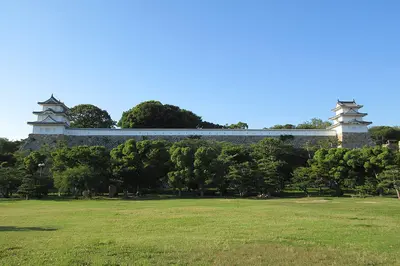
The castle's approach seems straightforward but is actually a labyrinth of spiraling paths, dead-end corridors, and gates that force attackers to double back. Defenders could rain down arrows and stones from every angle. Walking through the grounds today, you can feel how disorienting and deadly it would have been for an enemy army.

3

Japan's First UNESCO World Heritage Castle

In 1993, Himeji became the first castle in Japan to receive UNESCO World Heritage status — the same year as the historic temples of Kyoto. It's recognized not just as a beautiful building but as an outstanding example of Japanese wooden architecture and military engineering, preserved in exceptional condition.

4

83 Buildings, One Masterpiece

The main tower is the showstopper, but the entire castle complex contains 83 surviving buildings connected by stone walls and covered corridors. Explore beyond the main keep to discover hidden secondary towers, turrets with arrow loops, and walls riddled with portholes shaped for firing guns and arrows.

Structure Details

Visitor tip

Start at the large wooden main gate (Otemon), then follow the winding path up to the main tower. Inside the tower, you'll climb steep wooden staircases through six floors to the top — wear shoes you can slip on and off easily, as you'll remove them to enter. The views from the top floor are spectacular.

Castle type

Hill castle

Hill-top flatland castle (built on a low hill surrounded by flat terrain)

Layout type

Linked compound layout

Compound style — multiple towers connected by covered corridors

Main tower

Original wooden tenshu (main keep) — one of only 12 surviving in Japan

46.4m6 floors, 1 below

Stone walls

Natural stone stacking

The stone walls (ishigaki) rise dramatically from the ground, with a flared 'fan' shape (musha-gaeshi) at the base that curves outward to deflect attackers trying to climb them. Some walls reach 30 meters tall.

Moats

Triple moat system (inner, middle, and outer moats) surrounded the castle in its heyday. The inner moat still surrounds the main compound today.

Key defensive features

Spiraling Approach Path (Masugata)

The path from the castle gate to the main tower winds back and forth, never giving attackers a straight run. Each turn is overlooked by walls and towers — a fatal killing ground for any enemy trying to charge through.

Loopholes (Sama)

The walls are dotted with hundreds of triangular, circular, and rectangular holes — not decoration, but firing ports for archers and musketeers. The different shapes were optimized for different weapons.

Stone-Drop Openings (Ishiotoshi)

Trapdoors in the overhanging sections of the walls allowed defenders to drop boulders or pour boiling water on attackers trying to scale the walls directly below.

West Bailey (Nishi-no-maru)

A sprawling secondary compound on the western side with its own long covered corridor ('Hyakken Roka'), which could shelter defenders moving between positions under fire. It also housed the legendary Lady Sen, granddaughter of Tokugawa Ieyasu.

The Story of Himeji Castle

Originally built 1333 / Akamatsu Norimura
Current form 1609 / Ikeda Terumasa
National Treasure
UNESCO World Heritage 1993
    1333

    Akamatsu Norimura builds a fort on Himeyama Hill — a small wooden stockade, nothing like the white towers that stand today.

    1580

    Toyotomi Hideyoshi takes control of the castle and begins major construction, building a three-story tower as he prepares for his campaign to unify Japan.

    1600

    After the Battle of Sekigahara, Tokugawa Ieyasu gives Himeji to his son-in-law Ikeda Terumasa as a reward for loyalty. Ikeda immediately begins the most ambitious expansion in the castle's history.

    1609

    The iconic white main tower is completed. Ikeda's redesign transforms Himeji into the largest and most sophisticated castle in Japan — a statement of Tokugawa power visible for miles around.

    1868

    The Meiji government considers demolishing Himeji as part of its campaign to modernize Japan and erase symbols of feudal power. An army officer purchases the entire castle complex for just 23 yen and preserves it.

    1945

    Allied bombing raids destroy much of the city of Himeji, but the castle miraculously survives — an incendiary bomb that lands inside the castle fails to detonate.

    1993

    UNESCO designates Himeji Castle a World Heritage Site, the first castle in Japan to receive this honor, cementing its status as a national icon and drawing international visitors from around the world.

In Pop Culture

Film

You Only Live Twice

The 1967 James Bond film used Himeji as the exterior of a ninja training castle. Sean Connery trained here on screen.

Film

Kagemusha

Akira Kurosawa's 1980 epic used Himeji extensively as a stand-in for various samurai-era fortresses.

TV

Shogun (2024 TV series)

The acclaimed FX/Hulu series filmed scenes at Himeji to evoke feudal Japan's grandeur.

Did You Know?

  • The castle contains a room called the 'suicide room' — a small chamber where the lord and his family could make their final stand and take their own lives rather than be captured. It was never used.
  • During the major 2009–2015 restoration, the entire main tower was enclosed in a giant scaffold 'cocoon' — visitors could pay to watch restorers at work through observation windows.
  • The white plaster coating isn't just decorative — it's fireproofing. The walls are coated in multiple layers of lime plaster, which resists fire and also repels water, keeping the wooden structure beneath dry and preserved.
  • There are over 1,000 loopholes (firing ports) across the entire castle complex — a staggering number that gives a sense of how the entire structure was designed as one giant weapon.

Score Breakdown

Tourism Score

A+ 92/100
  • Accessibility 18 /20
  • Foreign-Friendly 19 /20
  • Historical Value 20 /20
  • Visual Impact 20 /20
  • Facilities 15 /20

Defense Score

B 79/100
  • Terrain Advantage 16 /20
  • Entrance Defense 17 /20
  • Internal Complexity 17 /20
  • Siege Endurance 15 /20
  • Strategic Oversight 14 /20

Planning Your Visit

Best Time to Visit

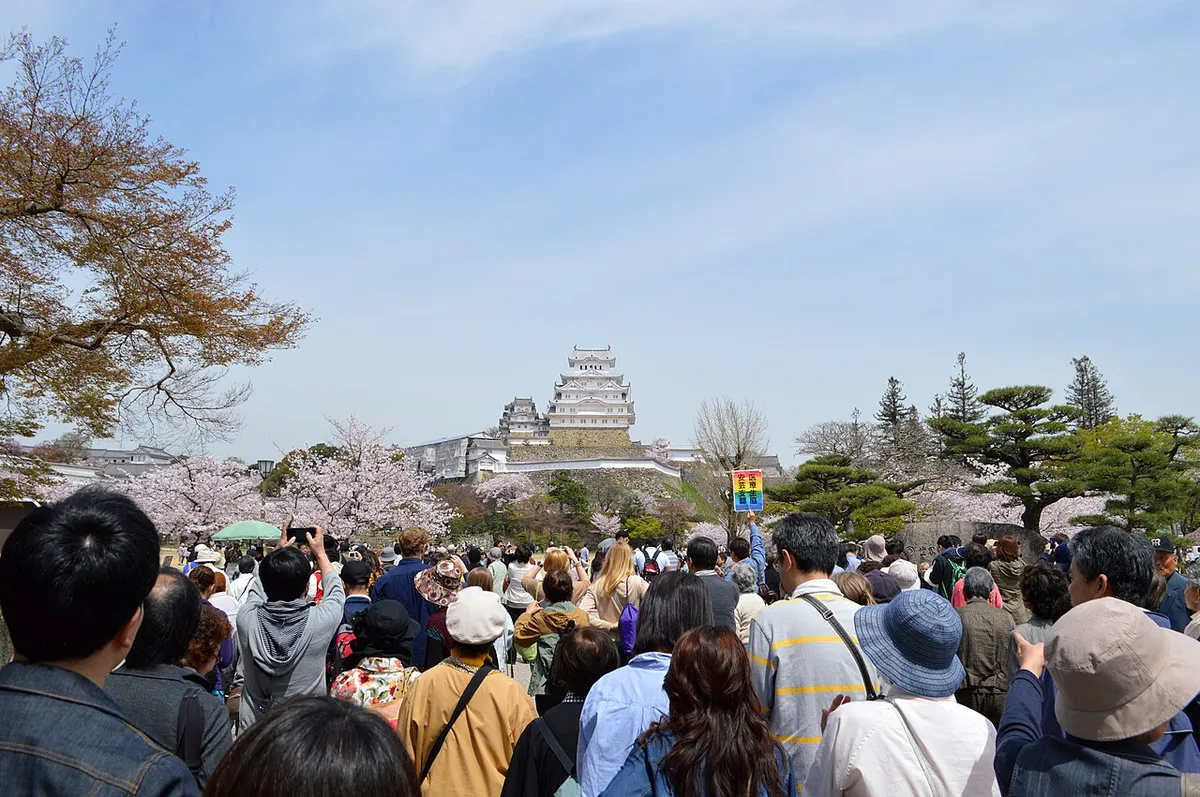
Cherry blossom season (late March to early April) is iconic — the castle above pink blossoms is one of Japan's most photographed views. For thinner crowds, visit on a weekday or in autumn (October–November) when the foliage adds warm color. Avoid Golden Week (late April to early May) if possible.

Time Needed

3-4 hours

Insider Tip

Walk to the Sannomaru Square (the large open area in front of the castle) around sunset — the white tower turns gold in the late light. Also, don't skip the West Bailey (Nishi-no-maru): the long covered corridor is largely ignored by tourists but gives you an amazing perspective on the castle's scale.

Map

Getting There

Nearest station: Himeji Station (JR Sanyo Main Line / Sanyo Shinkansen)
Walk from station: 20 min walk
Bus: Loop bus 'Himeji Castle Loop Bus' stops at the castle. ¥100 per ride.
Parking: Otemae parking lot nearby. ¥150/30 min. Can fill up on busy weekends.
Accessible with a JR Pass

Admission

Adult¥2,500
ChildFree

Admission increased to ¥2,500 for non-Himeji residents from March 1, 2026. Visitors under 18 free. Combined ticket with Koko-en Garden ¥2,600.

Opening Hours

Open09:00 – 17:00
Last entry16:00

Extended to 18:00 (last entry 17:00) from late April to late August. Closed December 29–30.

Facilities

  • ✓ English guides
  • ✓ Audio guide
  • – Wheelchair access
  • ✓ Restrooms
  • ✓ Gift shop
  • ✓ Food nearby

Audio guide languages: English, Japanese, Chinese, Korean, French, German, Spanish

Nearby Castles

Featured in collections

FAQ

Frequently Asked Questions

How do I get to Himeji Castle?

The nearest station is Himeji Station (JR Sanyo Main Line / Sanyo Shinkansen). From there it is about 20 minutes on foot. Loop bus 'Himeji Castle Loop Bus' stops at the castle. ¥100 per ride.

How much does Himeji Castle cost to enter?

Adult admission is ¥2,500 and child admission is ¥0.

Is Himeji Castle worth visiting?

Himeji is the single best castle experience in Japan, period. The main tower is completely original, the defensive layout is the most complex ever built, and the sheer visual drama of the white towers rising above the city is unlike anything else in the country. Budget more time than you think you need — the grounds are vast and every corner reveals another clever defensive trick.

What are the opening hours of Himeji Castle?

09:00 to 17:00, last entry 16:00.

How long should I spend at Himeji Castle?

Plan for about 3-4 hours, depending on how closely you want to explore the grounds.