Osaka Castle

大阪城·Osaka-jo

A Tourism Score 88/100
C Defense Score 66/100

Japan's most famous castle story wrapped in a 1931 concrete tower — the history is spectacular, even if the building isn't original.

#54 — 100 Famous Castles Reconstructed
Osaka Castle (大阪城)
Photo:lienyuan lee/Wikimedia Commons/CC BY 3.0

Quick Facts

Quick Facts

Admission
¥1,200

¥0

Hours
09:00 – 17:00

Last entry 16:30

Nearest Station
Osakajo-koen Station (JR Osaka Loop Line) or Tanimachi 4-chome Station (Subway)
Walk from Station
10 min walk
Time Needed
2-3 hours

Admission increased to ¥1,200 from April 2025. High school/college students ¥600. Children (junior high and under) free. Castle grounds (park) are always free; fee is for the main tower museum.

Defense Overview

Defense Overview

Why Osaka Castle was hard to attack

This castle is hard to attack because attackers have to work through successive outer spaces before the core instead of getting a direct run at the core.

An attacker would not simply arrive at the center on open flat ground. They would have to cross water barriers or moat lines, approach through at least some constrained entry space, and face more defensive depth after the first line.

Overall score

66/100

Estimated range

60–72

Confidence

A

Strong multi-source support

This is a site-original comparison score for learning and comparison, not a reconstruction of one historical battle.

Radar view

Terrain 11/20 Entrance 13/20 Internal 16/20 Siege 15/20 Oversight 11/20
How this estimate was built+

This estimate combines broad terrain, approach, layout, and route-control signals. It is meant to explain the castle's defensive logic in plain English, not reconstruct a single historical attack.

Terrain Advantage

How much the terrain itself seems to help: height, slope, ridges, cliffs, water edges, and limited approach directions.

11/20

Entrance Defense

How awkward and dangerous the first entry looks: gates, bridge or moat crossings, chokepoints, and forced turns.

13/20

Internal Complexity

How hard it seems to keep pushing after entry: layered baileys, depth, compartmentalization, and repeated defensive lines.

16/20

Siege Endurance

A rough sense of long-hold potential: moats, water access, space, storage plausibility, and defensive staying power.

15/20

Strategic Oversight

How much the castle appears to command nearby roads, plains, rivers, basins, harbors, or town approaches.

11/20
Why Visit

Osaka Castle's history — the rise of a peasant who became ruler of Japan, his clan's destruction, and four centuries of rebuilding — is one of the most dramatic stories in Japanese history. The museum inside the tower tells this story brilliantly. And the massive stone walls and moats of the original castle survive in remarkable condition, providing a genuinely awe-inspiring experience even for visitors who know the tower is a replica.

Highlights

1

Toyotomi's Dream, Tokugawa's Trophy

Osaka Castle was built by Toyotomi Hideyoshi, the man who unified Japan after a century of civil war — then used by the Tokugawa shogunate as a symbol of their conquest after they destroyed Hideyoshi's family and took power in 1615. The castle's turbulent history mirrors Japan's own violent path to unification.

2

A Park the Size of a Neighborhood

The castle sits inside Osaka Castle Park, a massive green space in the middle of one of Japan's densest cities. Even if you don't pay to enter the tower, exploring the grounds — the massive stone walls, surviving gates, and moats — is completely free and deeply impressive.

3

The Gold-Leafed Tower

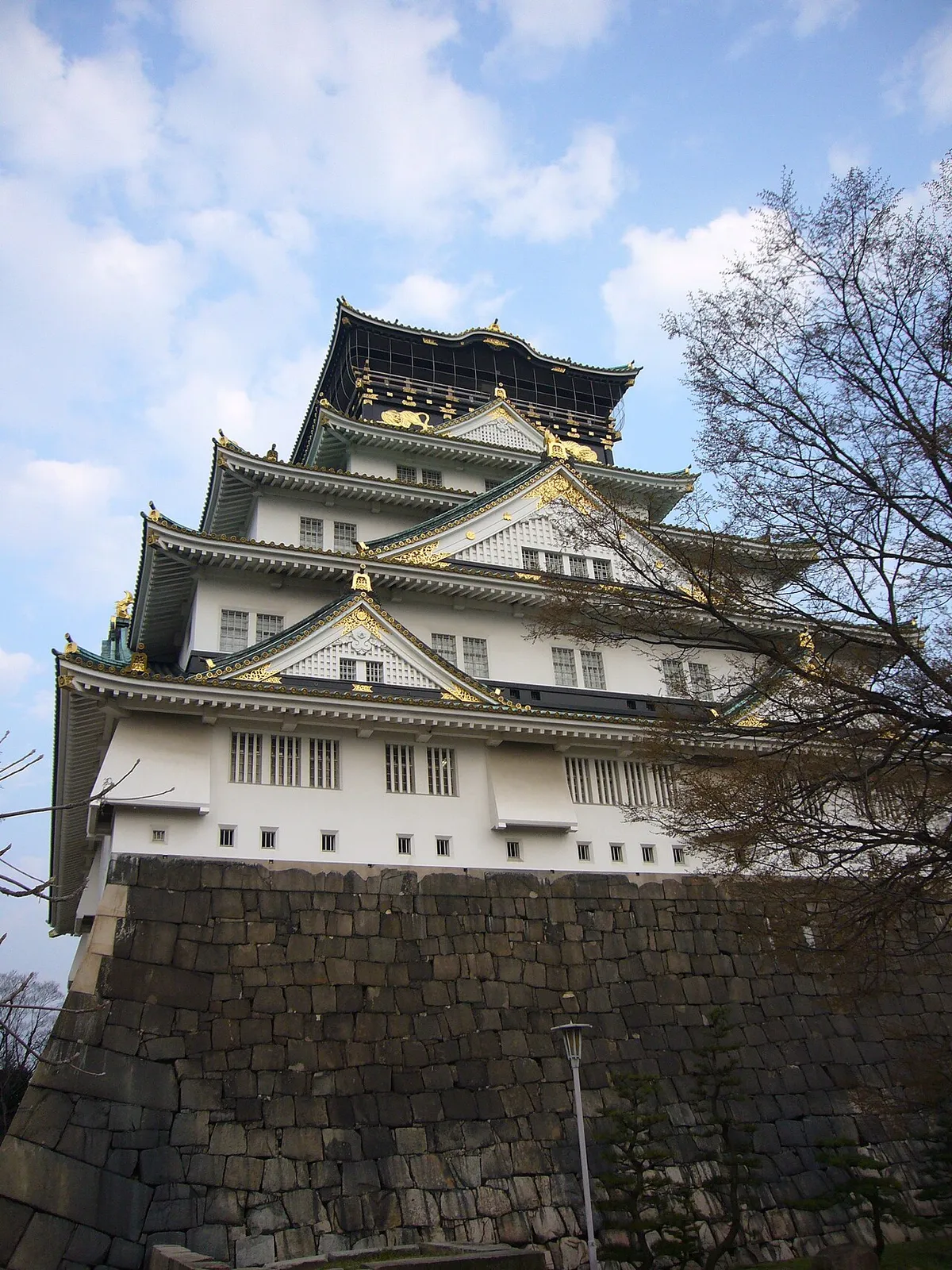
The main tower is covered in decorative black and gold motifs — a deliberate design choice by Hideyoshi to project his immense wealth and power. The current reconstruction faithfully reproduces this flamboyant aesthetic, making it one of the most visually striking castle towers in Japan.

Structure Details

Visitor tip

The tower interior is a modern museum with elevators — this is actually one of the most accessible castle towers in Japan. The museum covers the history of Toyotomi Hideyoshi and Osaka in engaging detail. The top-floor observation deck offers panoramic views of the city. Plan to spend time outside too — the stone walls alone are worth an hour of exploration.

Castle type

Flatland castle

Flatland castle — built on flat terrain, relying on water defenses rather than natural elevation

Layout type

Concentric layout

Enclosure style — concentric rings of moats and walls surrounding the central tower

Main tower

Concrete reconstruction (1931) — the current tower is a modern reinforced concrete building constructed in 1931, rebuilt again internally in 1997. The original towers were destroyed in the Osaka Summer Campaign of 1615 and again by fire in 1665.

54.8m8 floors, 2 below

Stone walls

Fitted cut-stone masonry

Osaka Castle's stone walls are among the most massive in Japan. The enormous stones in the inner compound — some weighing over 100 tons — were transported from quarries across the Seto Inland Sea, a logistics feat that demonstrated Hideyoshi's extraordinary power to command resources.

Moats

An extensive double-moat system survives around the main compound. The inner moat is wide and deep; the outer moat encloses the entire castle park area. Water defenses compensated for the flat terrain.

Key defensive features

Colossal Stone Walls

The stone walls of the inner compound reach 20–30 meters in height. The stones are so precisely fitted that grass cannot grow in the joints, and they have survived earthquakes for over 400 years.

Takotsubo (Octopus-Trap Pits)

Excavations have found deep pits dug in the outer areas — designed to trap and isolate enemy soldiers who breached the outer defenses, allowing defenders to pick them off.

Wide Water Moats

The double moat system made direct assault extremely difficult, as attackers had to cross open water under fire before even reaching the walls.

The Story of Osaka Castle

Originally built 1583 / Toyotomi Hideyoshi
Current form 1931 / Osaka City Government
    1583

    Toyotomi Hideyoshi begins construction of what he intends to be the greatest castle in Japan — a statement that he, a man born a peasant, now rules the entire country. Tens of thousands of laborers work on the project simultaneously.

    1597

    Construction of the expanded castle complex completes. Hideyoshi's castle is larger and more lavish than anything Japan has ever seen, featuring gold-leaf decorations and towering stone walls.

    1615

    The Tokugawa army, led by Ieyasu, besieges Osaka Castle in the 'Summer Campaign.' Hideyoshi's son Hideyori and his mother commit suicide as the castle falls and burns. The Toyotomi clan is exterminated. Tokugawa control over Japan is now absolute.

    1620

    The Tokugawa shogunate rebuilds Osaka Castle from scratch, deliberately making it different from Hideyoshi's version to erase his memory. This new castle stands until 1665, when lightning strikes the tower and burns it down.

    1868

    The castle is damaged again during the fighting of the Meiji Restoration. The main tower is demolished, leaving only the stone walls and ancillary structures standing for over 60 years.

    1931

    Osaka City raises public funds to construct a new main tower over the surviving Tokugawa-era stone walls. The concrete tower is designed to echo Hideyoshi's original aesthetic, including the black and gold exterior.

    1997

    The interior is completely renovated and transformed into a modern museum, with elevator access and interactive exhibits. Annual visitors exceed 2 million, making it one of Japan's most-visited attractions.

In Pop Culture

TV

Osaka Castle appears in countless Japanese historical dramas (taiga dramas)

NHK's annual taiga dramas set in the Sengoku and Edo periods frequently feature Osaka Castle, particularly episodes covering Toyotomi Hideyoshi or the Osaka campaigns.

Did You Know?

  • The largest stone in the castle walls, called 'Takoishi' (Octopus Stone), is 5.5 meters tall, 11.7 meters wide, and weighs an estimated 130 tons — it was transported by ship from Okayama Prefecture.
  • Hideyoshi built the castle so quickly by conscripting labor from every major lord in Japan, essentially forcing his political rivals to help build the symbol of his own supremacy.
  • The current concrete tower sits on the Tokugawa-era stone foundations, not Hideyoshi's. If you look carefully at the walls, you can see that the stone style changes at a certain height — below is 400-year-old Tokugawa masonry, above is 1931 reinforced concrete.
  • During World War II, the castle grounds served as a major army arsenal. The area was heavily bombed, but the main tower (already concrete) survived.

Score Breakdown

Tourism Score

A 88/100
  • Accessibility 20 /20
  • Foreign-Friendly 19 /20
  • Historical Value 17 /20
  • Visual Impact 18 /20
  • Facilities 14 /20

Defense Score

C 66/100
  • Terrain Advantage 11 /20
  • Entrance Defense 13 /20
  • Internal Complexity 16 /20
  • Siege Endurance 15 /20
  • Strategic Oversight 11 /20

Planning Your Visit

Best Time to Visit

Cherry blossom season transforms the surrounding park into one of Osaka's best hanami spots — arrive early morning to beat the crowds. The castle is also beautifully illuminated on some evenings in autumn.

Time Needed

2-3 hours

Insider Tip

Skip the main tower line (it can be 60+ minutes on weekends) and spend that time exploring the outer grounds instead. The Sakuramon Gate, the surviving turrets, and the incredible stone walls around the inner compound are all free to see and largely ignored by the tour groups pouring into the tower.

Map

Getting There

Nearest station: Osakajo-koen Station (JR Osaka Loop Line) or Tanimachi 4-chome Station (Subway)
Walk from station: 10 min walk
Parking: Osaka Castle Park has paid parking lots. Not recommended due to traffic; train is far easier.
Accessible with a JR Pass

Admission

Adult¥1,200
ChildFree

Admission increased to ¥1,200 from April 2025. High school/college students ¥600. Children (junior high and under) free. Castle grounds (park) are always free; fee is for the main tower museum.

Opening Hours

Open09:00 – 17:00
Last entry16:30

Extended hours during cherry blossom season and special events. Closed Mondays (or following day if Monday is a national holiday). Closed December 28–January 1.

Facilities

  • ✓ English guides
  • ✓ Audio guide
  • ✓ Wheelchair access
  • ✓ Restrooms
  • ✓ Gift shop
  • ✓ Food nearby

Audio guide languages: English, Japanese, Chinese, Korean

Nearby Castles

Featured in collections

FAQ

Frequently Asked Questions

How do I get to Osaka Castle?

The nearest station is Osakajo-koen Station (JR Osaka Loop Line) or Tanimachi 4-chome Station (Subway). From there it is about 10 minutes on foot.

How much does Osaka Castle cost to enter?

Adult admission is ¥1,200 and child admission is ¥0.

Is Osaka Castle worth visiting?

Osaka Castle's history — the rise of a peasant who became ruler of Japan, his clan's destruction, and four centuries of rebuilding — is one of the most dramatic stories in Japanese history. The museum inside the tower tells this story brilliantly. And the massive stone walls and moats of the original castle survive in remarkable condition, providing a genuinely awe-inspiring experience even for visitors who know the tower is a replica.

What are the opening hours of Osaka Castle?

09:00 to 17:00, last entry 16:30.

How long should I spend at Osaka Castle?

Plan for about 2-3 hours, depending on how closely you want to explore the grounds.