Yuzuki Castle

湯築城·Yuzuki-jo

F Tourism Score 42/100
D Defense Score 56/100

The castle that sits invisible beside Japan's most famous hot spring — Yuzuki's 250-year history is walked past by thousands of Dogo Onsen visitors who never know it exists.

#102 — Continued 100 Castles Ruins
Yuzuki Castle (湯築城)
Photo:Reggaeman/Wikimedia Commons/CC BY-SA 3.0

Quick Facts

Quick Facts

Admission
Free Free
Hours
09:00 – 17:30

Last entry 17:00

Nearest Station
Dogo-onsen tram stop (Iyotetsu Dogo Onsen Line from Matsuyama)
Walk from Station
3 min walk

Bus also available

Time Needed
30–45 minutes (ruins + museum)

The castle ruins park (Dogo Park) is free. The small historical museum within the park charges ¥100 for adults.

Defense Overview

Defense Overview

Why Yuzuki Castle was hard to attack

This castle is hard to attack because attackers have to work across water barriers before pressing inward instead of getting a direct run at the core.

An attacker would not simply arrive at the center on open flat ground. They would have to cross water barriers or moat lines and push through successive outer areas before the core.

Overall score

56/100

Estimated range

50–62

Confidence

B

Usable estimate with some inference

This is a site-original comparison score for learning and comparison, not a reconstruction of one historical battle.

Radar view

Terrain 10/20 Entrance 10/20 Internal 14/20 Siege 12/20 Oversight 10/20
How this estimate was built+

This estimate combines broad terrain, approach, layout, and route-control signals. It is meant to explain the castle's defensive logic in plain English, not reconstruct a single historical attack.

Terrain Advantage

How much the terrain itself seems to help: height, slope, ridges, cliffs, water edges, and limited approach directions.

10/20

Entrance Defense

How awkward and dangerous the first entry looks: gates, bridge or moat crossings, chokepoints, and forced turns.

10/20

Internal Complexity

How hard it seems to keep pushing after entry: layered baileys, depth, compartmentalization, and repeated defensive lines.

14/20

Siege Endurance

A rough sense of long-hold potential: moats, water access, space, storage plausibility, and defensive staying power.

12/20

Strategic Oversight

How much the castle appears to command nearby roads, plains, rivers, basins, harbors, or town approaches.

10/20

Why Visit

Yuzuki Castle offers something rare: a well-excavated Muromachi-period earthwork castle showing construction methods before stone walls became standard. It pairs perfectly with a Dogo Onsen visit — spend 30 minutes at the castle ruins first, then bathe at the legendary onsen a three-minute walk away.

Highlights

1

Rival to Matsuyama — The Kono Clan's 200-Year Stronghold

Yuzuki Castle was the base of the Kono clan, who controlled Iyo Province (modern Ehime) for over 200 years through the Muromachi period. The Kono were major maritime lords who dominated the Seto Inland Sea trade routes, and Yuzuki was their administrative and military headquarters — until they were finally destroyed by Chosokabe Motochika of Tosa in the 1580s.
2

Next to Japan's Most Famous Hot Spring

Yuzuki Castle ruins occupy Dogo Park, which sits immediately adjacent to Dogo Onsen — the legendary hot spring said to be the oldest in Japan and one of the inspirations for the bathhouse in Hayao Miyazaki's 'Spirited Away.' Almost every visitor to Dogo Onsen passes within walking distance of the castle ruins without knowing they exist, making Yuzuki one of Japan's most undervisited historically significant sites.

3

Rare Double-Moat Earthwork Ruins

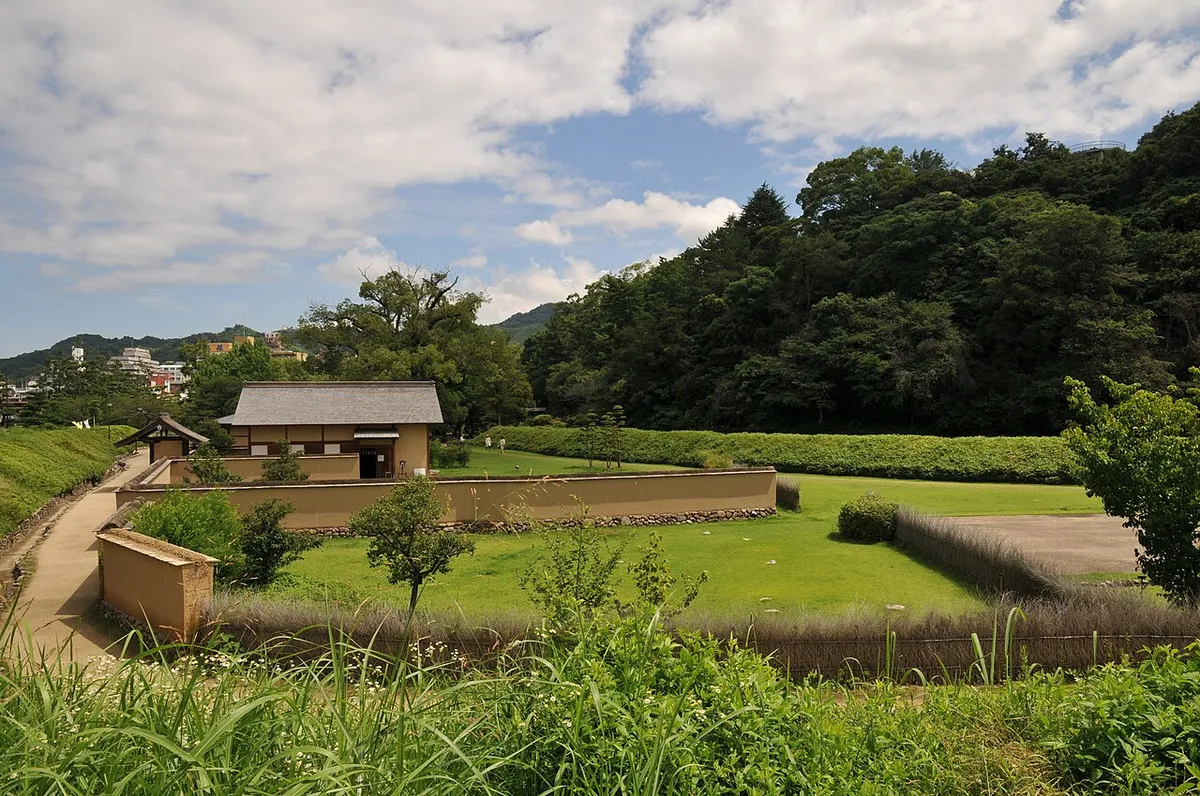
Yuzuki Castle is notable for its well-preserved earthwork structure — two concentric moats with earthen embankments survive clearly in the landscape. The castle had no stone walls (it predates the widespread adoption of stone castle construction), so it represents an earlier phase of Japanese castle building. Partially reconstructed earthworks and a model of the original castle help visitors understand the layout.

Structure Details

Visitor tip

Yuzuki Castle is best visited as part of a Dogo Onsen day — spend a morning at the castle ruins (Dogo Park), then bathe at Dogo Onsen Honkan. Look for the reconstructed inner moat and earthen embankment sections. The small museum (¥100) has models and artifacts from the excavations.

Castle type

Flatland castle

Flatland castle (built on a low hill at the edge of the Matsuyama plain, adjacent to the Dogo Onsen hot spring area)

Layout type

Concentric layout

Ring-style — inner and outer compounds arranged in concentric rings surrounded by moats

Main tower

No tenshu ever built — Yuzuki predates the main tower era of Japanese castle construction. The castle consisted of earthwork compounds and moats without stone walls or towers.

Stone walls

Earthen walls

The castle's defenses consisted entirely of earthen embankments (dorui) and moats — there were no stone walls. The double-moat earthwork system survives remarkably well for a castle of this age.

Moats

Two concentric moats — inner and outer — separated by earthen embankments. The moats are partially visible and preserved in Dogo Park.

Key defensive features

Double Moat and Embankment System

Two rings of moats separated by earthen banks forced attackers to cross water twice before reaching the inner compound. Without stone walls, the castle relied on depth of water obstacles and the difficulty of crossing multiple moated rings under fire.

Dogo Onsen Area — Difficult Approach Terrain

The castle was built in an area where hot spring activity created soft, wet terrain. The proximity to the hot spring also gave defenders a reliable water source.

The Story of Yuzuki Castle

Originally built 1335 / Kono Michishige
Current form 1400 / Kono clan (expanded over generations)
    1335

    Kono Michishige constructs Yuzuki Castle on the low hill at the edge of the Dogo plain — exploiting the hot spring terrain and establishing the Kono clan's administrative center for Iyo Province.

    1400

    The Kono clan reaches its peak power, controlling Iyo Province and dominating Seto Inland Sea trade routes with a powerful maritime fleet.

    1585

    Chosokabe Motochika of Tosa completes his conquest of Shikoku, destroying the Kono clan and abandoning Yuzuki Castle.

    1603

    Kato Yoshiaki builds Matsuyama Castle on the mountain dominating the plain. Yuzuki is fully abandoned and its function permanently transferred.

    1953

    Archaeological excavations begin at the Yuzuki Castle site (Dogo Park), revealing the double-moat earthwork system in remarkable detail. The site is designated a national historic site.

In Pop Culture

Film

Sen to Chihiro no Kamikakushi (Spirited Away)

Dogo Onsen Honkan, immediately adjacent to the castle ruins, is cited as one of the inspirations for the bathhouse in Miyazaki's 2001 masterpiece.

Did You Know?

  • Almost every visitor who bathes at Dogo Onsen walks within 200 meters of Yuzuki Castle ruins without knowing they exist, making it one of Japan's most dramatically undervisited historic sites.
  • Yuzuki Castle has no stone walls — built entirely of earthen embankments and moats, representing the Muromachi-period construction method before stone ishigaki walls became standard.
  • The Kono clan who built and held Yuzuki Castle for 250 years were among the most powerful maritime lords in Japanese history — their fleet controlled the Seto Inland Sea.
  • When excavators dug the Yuzuki site in the 1950s–1990s, they found the double-moat system so well preserved beneath the park surface that it became a nationally significant example of Muromachi-period earthwork castle construction.

Score Breakdown

Tourism Score

F 42/100
  • Accessibility 14 /20
  • Foreign-Friendly 7 /20
  • Historical Value 10 /20
  • Visual Impact 7 /20
  • Facilities 4 /20

Defense Score

D 56/100
  • Terrain Advantage 10 /20
  • Entrance Defense 10 /20
  • Internal Complexity 14 /20
  • Siege Endurance 12 /20
  • Strategic Oversight 10 /20

Planning Your Visit

Best Time to Visit

Spring for cherry blossoms in Dogo Park. Year-round as an addition to Dogo Onsen.

Time Needed

30–45 minutes (ruins + museum)

Insider Tip

The castle ruins are almost completely ignored by Dogo Onsen visitors, which means you will likely have the park to yourself while the onsen is packed. Visit the small museum first to see the scale model, then walk the moat circuit.

Map

Getting There

Nearest station: Dogo-onsen tram stop (Iyotetsu Dogo Onsen Line from Matsuyama)
Walk from station: 3 min walk
Bus: Adjacent to Dogo Onsen — the most famous hot spring in Shikoku. Take the historic streetcar from Matsuyama city center to Dogo-onsen stop.
Parking: Paid parking available at Dogo Onsen area.

Admission

Free

The castle ruins park (Dogo Park) is free. The small historical museum within the park charges ¥100 for adults.

Opening Hours

Open09:00 – 17:30
Last entry17:00

Closed Mondays (or the following day if Monday is a holiday) and December 29–January 1. Extended hours in summer.

Facilities

  • – English guides
  • – Audio guide
  • ✓ Wheelchair access
  • ✓ Restrooms
  • – Gift shop
  • ✓ Food nearby

Nearby Castles

Featured in collections

FAQ

Frequently Asked Questions

How do I get to Yuzuki Castle?

The nearest station is Dogo-onsen tram stop (Iyotetsu Dogo Onsen Line from Matsuyama). From there it is about 3 minutes on foot. Adjacent to Dogo Onsen — the most famous hot spring in Shikoku. Take the historic streetcar from Matsuyama city center to Dogo-onsen stop.

How much does Yuzuki Castle cost to enter?

Yuzuki Castle is free to enter.

Is Yuzuki Castle worth visiting?

Yuzuki Castle offers something rare: a well-excavated Muromachi-period earthwork castle showing construction methods before stone walls became standard. It pairs perfectly with a Dogo Onsen visit — spend 30 minutes at the castle ruins first, then bathe at the legendary onsen a three-minute walk away.

What are the opening hours of Yuzuki Castle?

09:00 to 17:30, last entry 17:00.

How long should I spend at Yuzuki Castle?

Plan for about 30–45 minutes (ruins + museum), depending on how closely you want to explore the grounds.