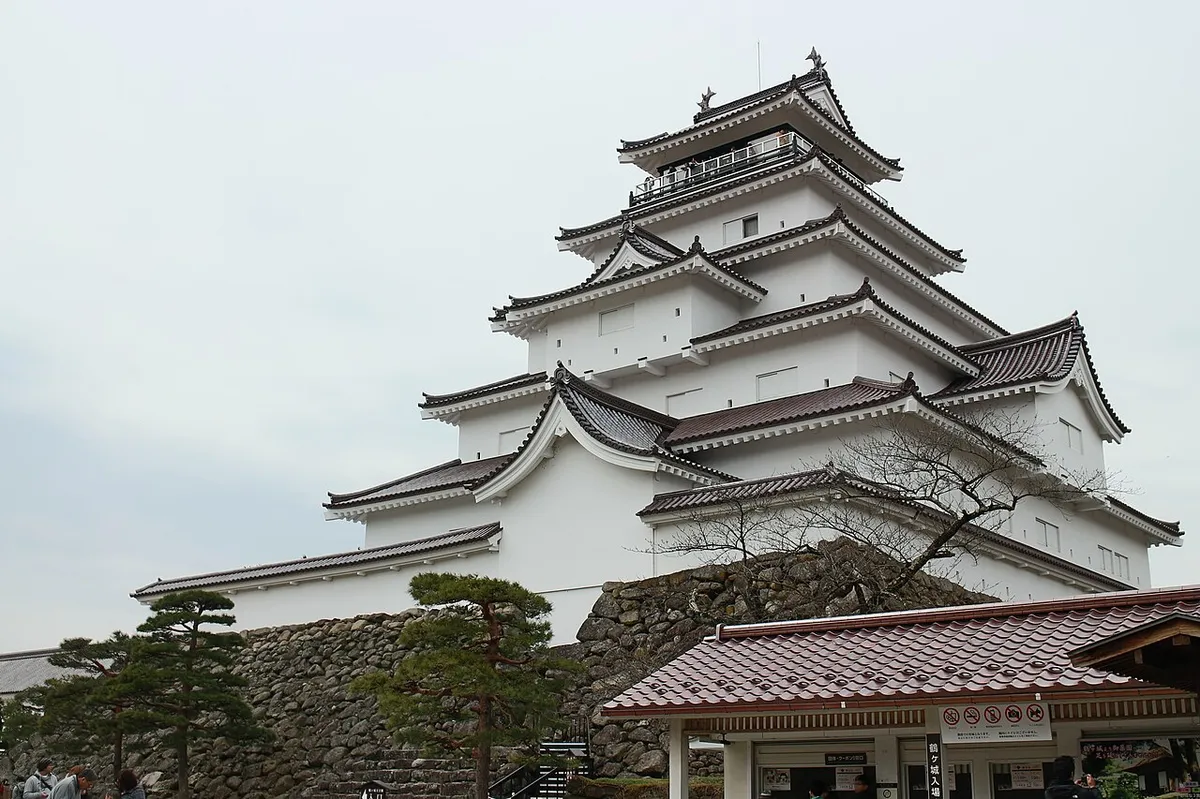
Aizu-Wakamatsu Castle

会津若松城·Aizu-Wakamatsu-jo

B Tourism Score 72/100
B Defense Score 76/100

The castle where samurai Japan ended — Aizu-Wakamatsu carries the weight of the Byakkotai tragedy and the Boshin War's last stand, making it Japan's most emotionally resonant castle site.

#12 — 100 Famous Castles Reconstructed
Aizu-Wakamatsu Castle (会津若松城)
Photo:Suicasmo/Wikimedia Commons/CC BY-SA 4.0

Quick Facts

Quick Facts

Admission
¥410

¥150

Hours
08:30 – 17:00

Last entry 16:30

Nearest Station
Aizu-Wakamatsu Station (JR Banetsu West Line / Aizu Railway)
Walk from Station
30 min walk

Bus also available

Time Needed
2-3 hours for castle; allow additional time for Iimori Hill (Byakkotai site, 15 min by bus)

Combined ticket with Rinkaku Tea House available. Children (elementary school age and under) free.

Defense Overview

Defense Overview

Why Aizu-Wakamatsu Castle was hard to attack

This castle is hard to attack because it combines a raised core with defended outer space with a controlled route inward.

An attacker would not get a simple direct approach to the center. They would have to cross water barriers or moat lines, approach through at least some constrained entry space, and face more defensive depth after the first line.

Overall score

76/100

Estimated range

70–82

Confidence

A

Strong multi-source support

This is a site-original comparison score for learning and comparison, not a reconstruction of one historical battle.

Radar view

Terrain 16/20 Entrance 16/20 Internal 16/20 Siege 15/20 Oversight 13/20
How this estimate was built+

This estimate combines broad terrain, approach, layout, and route-control signals. It is meant to explain the castle's defensive logic in plain English, not reconstruct a single historical attack.

Terrain Advantage

How much the terrain itself seems to help: height, slope, ridges, cliffs, water edges, and limited approach directions.

16/20

Entrance Defense

How awkward and dangerous the first entry looks: gates, bridge or moat crossings, chokepoints, and forced turns.

16/20

Internal Complexity

How hard it seems to keep pushing after entry: layered baileys, depth, compartmentalization, and repeated defensive lines.

16/20

Siege Endurance

A rough sense of long-hold potential: moats, water access, space, storage plausibility, and defensive staying power.

15/20

Strategic Oversight

How much the castle appears to command nearby roads, plains, rivers, basins, harbors, or town approaches.

13/20

Why Visit

Aizu-Wakamatsu Castle is essential for anyone interested in the end of the samurai era. The Byakkotai story — teenage warriors dying in a misunderstanding, loyal to a world that was already ending — is profoundly moving, and the castle is the anchor of a larger historical landscape that includes Iimori Hill and Nisshinkan (the domain school). The red-tiled reconstruction is distinctive, and the museum interior covers the Boshin War era with real depth.

Highlights

1

The Byakkotai: White Tiger Force and the Last Stand

In the Boshin War of 1868, as Meiji imperial forces closed in on the castle, nineteen teenage samurai of the Byakkotai (White Tiger Force) climbed Iimori Hill and looked out over the burning city. Believing the castle had already fallen, they committed ritual suicide (seppuku) together. The castle had not fallen — it survived a month-long siege. The tragedy of the Byakkotai is one of Japan's most poignant stories of loyalty, honor, and the brutal end of the samurai era.
2

The Castle That Held for a Month

During the 1868 Boshin War, Aizu-Wakamatsu Castle withstood a month-long siege by the modernized Meiji forces before finally surrendering. The garrison of around 3,000 — including women and children of the castle town — held off a larger, better-equipped army through determined resistance. The castle became a symbol of samurai loyalty and the tragedy of the old order's end.

3

Red Roof Tiles — A Castle Like No Other

Aizu-Wakamatsu Castle is the only castle in Japan with red ceramic roof tiles — the distinctive russet-red roofline stands out immediately from any distance. The red tiles were used in the 1965 reconstruction and are now the castle's most visually distinctive feature, visible from across the Aizu Basin.

Structure Details

Visitor tip

The tower interior contains a well-organized museum covering the Aizu domain's history and the Boshin War in detail. The Byakkotai story is explained through exhibits, models, and artifacts. The red roof tiles are the castle's most distinctive visual feature — visible from across the city. Allow time to walk the castle grounds, where surviving stone walls and moat sections give a sense of the castle's defensive scale.

Castle type

Hill castle

Flatland castle — built on a low natural rise in the Aizu Basin, one of Japan's most isolated inland basins

Layout type

Concentric layout

Enclosure style — multiple concentric compounds with moats and walls, designed for sustained defense

Main tower

Concrete reconstruction (1965) with distinctive red roof tiles — the original tower was demolished in 1874 by the Meiji government as punishment for the domain's resistance. The reconstruction features the unique red tiles that now define the castle's appearance.

33m5 floors, 2 below

Stone walls

Fitted cut-stone masonry

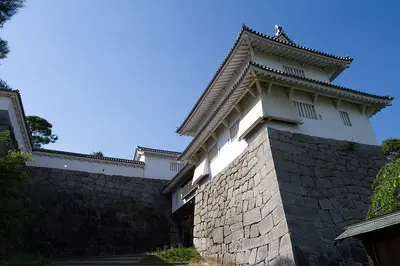
The stone walls of Aizu-Wakamatsu are substantial and well-preserved, incorporating surviving original stonework alongside restored sections. The walls demonstrate the castle's design for sustained resistance rather than just deterrence.

Moats

Parts of the original moat system survive, including the inner moat around the main compound. The multiple moat rings were integral to the castle's capacity to withstand the month-long 1868 siege.

Key defensive features

Multiple Compound Defense

The castle's layered compound system allowed the garrison to retreat and regroup within successive defensive perimeters, contributing to the month-long resistance in 1868 even as outer compounds were lost.

Thick Inner Walls and Gates

The inner compound walls and gate systems were designed to withstand prolonged bombardment — tested and proven in the 1868 siege, during which the main tower reportedly took over 400 cannon hits while remaining structurally intact.

Extensive Stone Wall System

The surviving stone walls provided cover for defenders and made direct assault on the compounds difficult, forcing attackers to rely on bombardment rather than direct infantry assault.

The Story of Aizu-Wakamatsu Castle

Originally built 1384 / Ashina Naomori
Current form 1965 / Aizu-Wakamatsu City
    1384

    Ashina Naomori builds the original fort at Kurokawa (present-day Aizu-Wakamatsu), beginning the long history of fortification in the Aizu Basin.

    1593

    Gamo Ujisato, a Christian convert and skilled castle builder, completely rebuilds the castle in the latest style and renames it 'Tsuruga-jo' (Crane Castle) — the name still used locally today.

    1627

    The Hoshina (later Matsudaira) clan takes over Aizu domain. They will rule for over two centuries, developing a domain culture of intense samurai loyalty and Confucian values that shapes the Byakkotai tragedy 240 years later.

    1868

    The Boshin War reaches Aizu. The castle garrison, including women and children, withstands a month-long siege by Meiji imperial forces. The Byakkotai tragedy occurs on Iimori Hill. The castle surrenders after running out of options.

    1874

    As punishment for the domain's resistance in the Boshin War, the Meiji government orders the demolition of Aizu-Wakamatsu Castle. The main tower is torn down — a deliberate act of political erasure.

    1965

    Aizu-Wakamatsu City reconstructs the main tower in concrete, featuring the distinctive red roof tiles that now define the castle's appearance. The reconstruction becomes a symbol of Aizu's recovery and identity.

In Pop Culture

manga_anime

Rurouni Kenshin

The Aizu domain and its samurai culture heavily influenced the character of Saito Hajime and other Shinsengumi-related characters in the popular manga/anime series, set partly in the Boshin War era.

TV

Numerous NHK Taiga dramas

The Boshin War and the Byakkotai story have been dramatized in multiple NHK taiga dramas, most notably 'Yae no Sakura' (2013), which focused on Yamamoto Yaeko — a woman defender of Aizu Castle who became a pioneer of modern education after the war.

Did You Know?

  • The main tower reportedly took over 400 direct cannon hits during the 1868 siege without collapsing — a testament to its original construction quality, even if the current tower is a 1965 concrete reproduction.
  • The Byakkotai (White Tiger Force) was one of six military units organized by the Aizu domain for the Boshin War. It consisted entirely of samurai sons aged 16–17. Of the nineteen who died on Iimori Hill, one actually survived — Iinuma Sadakichi lived to old age, carrying the weight of being the sole survivor.
  • Aizu-Wakamatsu Castle is locally called 'Tsuruga-jo' (Crane Castle) — the 'Aizu-Wakamatsu Castle' name is the formal designation. If you ask locals, they will use the 'Tsuruga' name.
  • Germany donated a monument to the Byakkotai at Iimori Hill in 1928, during the Weimar Republic era — an expression of German admiration for the samurai loyalty ethos. The monument still stands, though it was temporarily removed during WWII due to Nazi Germany's different politics.

Score Breakdown

Tourism Score

B 72/100
  • Accessibility 14 /20
  • Foreign-Friendly 12 /20
  • Historical Value 19 /20
  • Visual Impact 15 /20
  • Facilities 12 /20

Defense Score

B 76/100
  • Terrain Advantage 16 /20
  • Entrance Defense 16 /20
  • Internal Complexity 16 /20
  • Siege Endurance 15 /20
  • Strategic Oversight 13 /20

Planning Your Visit

Best Time to Visit

Cherry blossoms in late April are spectacular against the red-roofed tower. Autumn (late October to mid-November) for foliage. Winter snow transforms the red-roofed tower and white walls into a striking scene. Aizu winters are cold and snowy — dress appropriately.

Time Needed

2-3 hours for castle; allow additional time for Iimori Hill (Byakkotai site, 15 min by bus)

Insider Tip

After the castle, visit Iimori Hill — the site where the Byakkotai made their final decision. A short cable car (one of Japan's smallest) ascends the hill, where you can see both the graves of the Byakkotai and the view they saw: the castle in the distance, which they mistakenly believed had already fallen. The emotional impact of standing in that exact spot and looking toward the castle is something no museum exhibit can replicate.

Map

Getting There

Nearest station: Aizu-Wakamatsu Station (JR Banetsu West Line / Aizu Railway)
Walk from station: 30 min walk
Bus: Haikara-san loop bus from Aizu-Wakamatsu Station stops at the castle (¥210 per ride or day pass available). Very convenient.
Parking: Free parking available near the castle. Car access straightforward.
Accessible with a JR Pass

Admission

Adult¥410
Child¥150

Combined ticket with Rinkaku Tea House available. Children (elementary school age and under) free.

Opening Hours

Open08:30 – 17:00
Last entry16:30

Open year-round. May close in heavy snow or extreme winter conditions. Tower interior closes in bad weather.

Facilities

  • – English guides
  • ✓ Audio guide
  • ✓ Wheelchair access
  • ✓ Restrooms
  • ✓ Gift shop
  • ✓ Food nearby

Audio guide languages: English, Japanese, Chinese, Korean

Nearby Castles

Featured in collections

FAQ

Frequently Asked Questions

How do I get to Aizu-Wakamatsu Castle?

The nearest station is Aizu-Wakamatsu Station (JR Banetsu West Line / Aizu Railway). From there it is about 30 minutes on foot. Haikara-san loop bus from Aizu-Wakamatsu Station stops at the castle (¥210 per ride or day pass available). Very convenient.

How much does Aizu-Wakamatsu Castle cost to enter?

Adult admission is ¥410 and child admission is ¥150.

Is Aizu-Wakamatsu Castle worth visiting?

Aizu-Wakamatsu Castle is essential for anyone interested in the end of the samurai era. The Byakkotai story — teenage warriors dying in a misunderstanding, loyal to a world that was already ending — is profoundly moving, and the castle is the anchor of a larger historical landscape that includes Iimori Hill and Nisshinkan (the domain school). The red-tiled reconstruction is distinctive, and the museum interior covers the Boshin War era with real depth.

What are the opening hours of Aizu-Wakamatsu Castle?

08:30 to 17:00, last entry 16:30.

How long should I spend at Aizu-Wakamatsu Castle?

Plan for about 2-3 hours for castle; allow additional time for Iimori Hill (Byakkotai site, 15 min by bus), depending on how closely you want to explore the grounds.