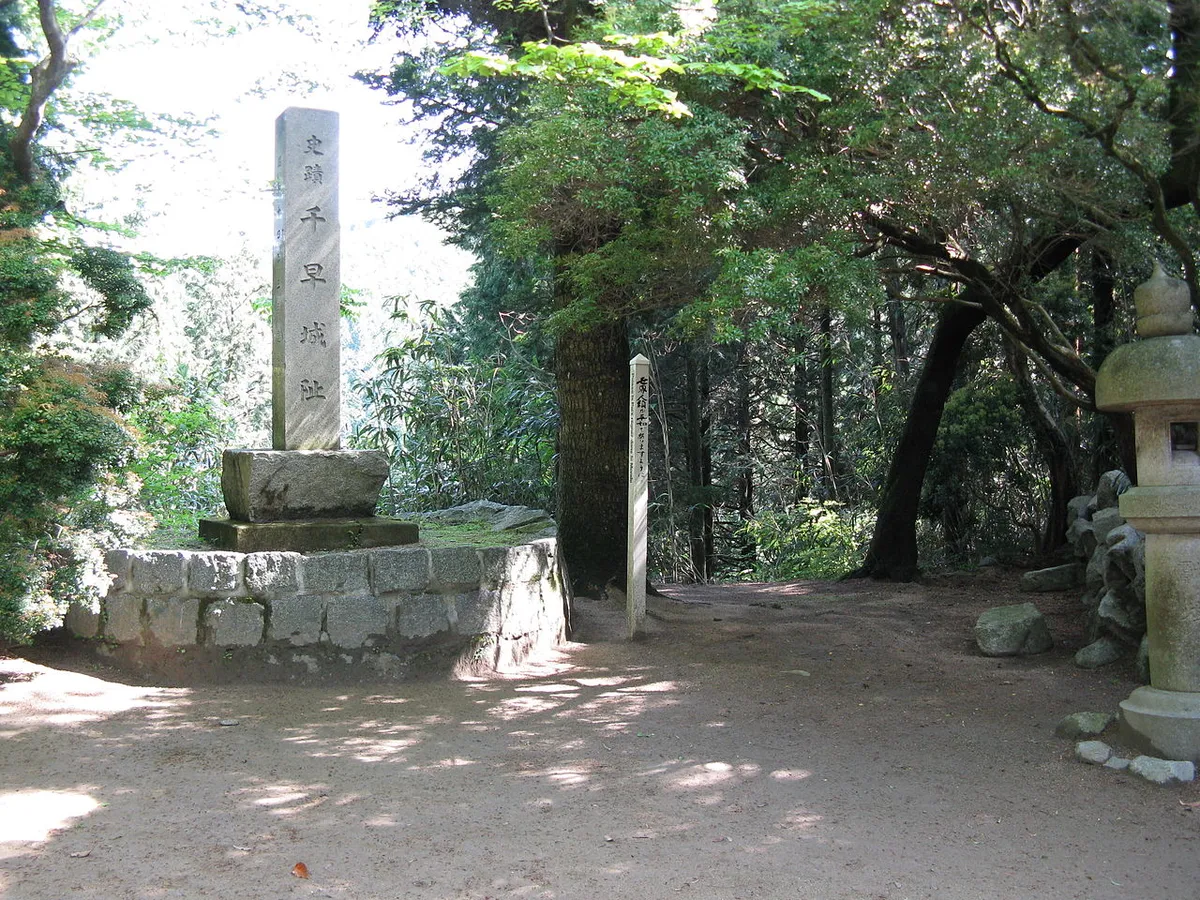
Chihaya Castle

千早城·Chihaya-jo

F Tourism Score 30/100
A Defense Score 83/100

Japan's most legendary siege defense — the mountain castle where one genius held an empire at bay, and where you still feel the terrain that made it possible.

#52 — 100 Famous Castles Ruins
Chihaya Castle (千早城)
Photo:KENPEI/Wikimedia Commons/CC BY-SA 3.0

Quick Facts

Quick Facts

Admission
Free Free
Hours
00:00 – 23:59
Nearest Station
Chihayaguchi Station (Kintetsu Nagano Line) then 1-hour hike
Walk from Station
60 min walk
Time Needed
3–4 hours including the 1-hour hike each way and time at the shrine/ruins

Castle ruins (now shrine grounds) are free to access. The Chihayaakasaka Village Museum nearby charges a small fee for exhibits on Kusunoki Masashige and the castle siege.

Defense Overview

Defense Overview

Why Chihaya Castle was hard to attack

This castle is hard to attack because it uses high ground and difficult natural access to deny attackers an easy approach.

An attacker would first have to fight the site itself before reaching the main defenses. They would have to cross water barriers or moat lines, pass tighter turns and chokepoints, and push through successive outer areas before the core.

Overall score

83/100

Estimated range

77–89

Confidence

B

Usable estimate with some inference

This is a site-original comparison score for learning and comparison, not a reconstruction of one historical battle.

Radar view

Terrain 20/20 Entrance 20/20 Internal 13/20 Siege 14/20 Oversight 16/20
How this estimate was built+

This estimate combines broad terrain, approach, layout, and route-control signals. It is meant to explain the castle's defensive logic in plain English, not reconstruct a single historical attack.

Terrain Advantage

How much the terrain itself seems to help: height, slope, ridges, cliffs, water edges, and limited approach directions.

20/20

Entrance Defense

How awkward and dangerous the first entry looks: gates, bridge or moat crossings, chokepoints, and forced turns.

20/20

Internal Complexity

How hard it seems to keep pushing after entry: layered baileys, depth, compartmentalization, and repeated defensive lines.

13/20

Siege Endurance

A rough sense of long-hold potential: moats, water access, space, storage plausibility, and defensive staying power.

14/20

Strategic Oversight

How much the castle appears to command nearby roads, plains, rivers, basins, harbors, or town approaches.

16/20

Why Visit

Chihaya is not a castle in any conventional sense — there's no tower, no admission fee, essentially no physical remains. What Chihaya offers is the physical experience of the terrain that made the 1333 siege defense possible, and the chance to stand where one of Japanese history's most celebrated warriors held out for months against an overwhelming force. The one-hour uphill hike is the experience: it puts the defense in your legs, not just your head. For visitors who know the Kusunoki Masashige story and want to understand why Chihaya was so defensible, this is an unforgettable half-day. For visitors who don't know the story, read it first — the castle has nothing to offer without the context.

Highlights

1

One Thousand Defenders Against One Million Attackers

In 1333, Kusunoki Masashige held Chihaya Castle with approximately 1,000 men against a Kamakura shogunate army that medieval chronicles described as one million strong (modern historians estimate 100,000–300,000). For months, Masashige used the mountain terrain, traps, tricks, and psychological warfare to prevent the vastly superior army from taking the castle — buying time for Emperor Go-Daigo's restoration. The defense of Chihaya is Japan's most celebrated feat of defensive warfare.
2

Dummy Warriors and Falling Logs

Kusunoki Masashige's defense of Chihaya became legendary for its inventive tactics: he deployed dummy warrior figures to draw arrow fire, rolled boulders and logs down the steep approach paths onto packed attackers, used fire attacks at night to cause chaos, and organized sorties when the besieging army least expected them. His methods of compensating for numerical inferiority through intelligence and terrain mastery were studied by Japanese military thinkers for centuries.

3

Now a Shinto Shrine

Chihaya Castle was never a large or elaborate fortification — its strength came entirely from the mountain terrain and the genius of its defender. Today the castle site is occupied by Chihaya Shrine (Chihaya Jinja), dedicated to Kusunoki Masashige himself. The castle ruins are minimal, but the location — on a ridge of Mt. Kongo, reached by a steep forest trail — gives an immediate physical understanding of why this was so difficult to take. Standing here, 700 meters above sea level, looking down at the approach paths, the defense is obvious.

Structure Details

Visitor tip

Chihaya is a pilgrimage for history enthusiasts rather than a conventional tourist site. There are essentially no physical remains — the shrine occupies the site, and the earthworks are minimal. What you get instead is the physical experience of the approach: climbing the steep forest trail for an hour, feeling the terrain's steepness in your legs, and arriving at the ridge to look down at the path you just climbed. That physical experience makes the 1333 siege immediately comprehensible in a way no museum exhibit can replicate.

Castle type

Mountain castle

Mountain castle — built on a steep ridge of Mt. Kongo at approximately 650 meters elevation, relying entirely on natural terrain and the near-impossibility of approach for defense

Layout type

Ladder layout

Tier-style — successive defensive lines following the mountain's natural ridgelines and cliff edges, each tier exploiting the terrain against attackers below

Main tower

No tower — Chihaya Castle had no main tower (tenshu) of the type seen at lowland castles. Its defensive power came from terrain, earthworks, and the steep natural approaches. The site today is a Shinto shrine with some surviving earthwork remains.

Stone walls

Earthen walls

Chihaya's walls were earthworks and wooden palisades rather than stone — the castle was a product of the early 14th century before the stone-walled castle tradition of the late Sengoku period. The real walls were the mountain itself: steep approach paths, cliff edges, and ridge lines that compressed any attacking force into narrow corridors where their numbers were irrelevant.

Key defensive features

Near-Vertical Approach Paths

The trails leading to Chihaya Castle from the valley below are steep enough to require careful footing even for fit modern hikers using well-maintained paths. In 1333, these same approaches were narrower, with loose footing, no handrails, and the constant threat of rocks, logs, and fire from above. Compressing an army of tens of thousands into paths where only a few soldiers could stand abreast made numerical advantage nearly useless.

Rolling Siege Defenses

Masashige's troops rolled boulders, logs, and bundles of burning straw down the approach paths into attacking formations. The mountain's terrain converted available materials into weapons — no sophisticated engineering required. The defenders at the top could reset these traps endlessly while attacking troops had to advance through an unceasing barrage on a path they could not leave.

Psychological Warfare

Masashige used dummy figures dressed as warriors to waste attacker's arrows, staged night raids to deprive the besieging army of sleep and morale, and timed sorties to maximize confusion. The psychological impact of months of failure on a besieging army — especially a feudal army where continued service required ongoing payment and provisioning — ultimately undermined the assault more than any single defensive tactic.

Multiple Ridge Positions

Chihaya Castle used Mt. Kongo's complex ridge system to create multiple independent defensive positions. Even if attackers broke through one tier, subsequent ridges provided new defensive lines. The castle could contract under pressure while still denying the summit.

The Story of Chihaya Castle

Originally built 1332 / Kusunoki Masashige
    1332

    Kusunoki Masashige, a local warrior supporting Emperor Go-Daigo's attempt to restore imperial power against the Kamakura shogunate, constructs Chihaya Castle on a strategic ridge of Mt. Kongo in southern Kawachi Province (modern Osaka Prefecture).

    1333

    The Kamakura shogunate sends a massive army to suppress the imperial restoration movement. Masashige holds Chihaya against the besieging force for months, using the mountain terrain and inventive defensive tactics. His resistance buys time for Emperor Go-Daigo's forces elsewhere to build momentum. The siege ends when the broader political situation collapses the Kamakura shogunate — Chihaya was never taken.

    1336

    Kusunoki Masashige dies at the Battle of Minatogawa fighting against Ashikaga Takauji — loyal to Emperor Go-Daigo despite knowing the battle was militarily hopeless. His death, viewed as the ultimate expression of samurai loyalty, makes him one of Japan's most revered historical figures. His castle at Chihaya becomes a sacred site.

    1615

    Chihaya Castle loses any remaining military significance after the Siege of Osaka ends the last armed resistance to Tokugawa rule. The site gradually transitions from a functional fortification to a place of historical commemoration.

    1872

    Chihaya Shrine (Chihaya Jinja) is formally established on the castle site, dedicating the summit enclosure to Kusunoki Masashige. The shrine form preserves the site while transforming its function from military to commemorative.

In Pop Culture

other

Taiheiki (14th century chronicle)

The Taiheiki, a major Japanese literary chronicle covering the conflicts of the 14th century, dedicates significant passages to the defense of Chihaya Castle and Kusunoki Masashige's tactics. It is one of the primary sources for the siege and remains a classic of Japanese literature.

Did You Know?

  • Kusunoki Masashige's loyalty became an ideological cornerstone of Japanese nationalism in the Meiji and early Showa periods — his image as the perfectly loyal samurai willing to die for the emperor was promoted in school textbooks and military training. A famous bronze statue of Masashige on horseback stands at the east entrance of the Imperial Palace in Tokyo, within sight of the palace where the emperor Masashige died for lives today.
  • The Chihaya Castle siege of 1333 is studied in Japanese military history as a masterclass in asymmetric defense — how a small force can hold against an overwhelmingly superior enemy using terrain, psychology, and creative tactics. The tactics attributed to Masashige (dummy warriors, rolling logs, night raids) appear repeatedly in discussions of guerrilla and defensive warfare across centuries.
  • Chihayaakasaka Village, which encompasses the castle site, is the only village (son) in Osaka Prefecture — all other municipalities are cities or towns. The village's preservation of this status is partly linked to its identity as the home of Kusunoki Masashige's castle.
  • The approach trail to Chihaya Castle passes through the same forest that Masashige's defenders used for concealment and ambush in 1333. While the trail is now well-maintained with wooden steps and handrails, the steepness and narrowness that made Chihaya so defensible is immediately apparent to any modern visitor who makes the climb.

Score Breakdown

Tourism Score

F 30/100
  • Accessibility 2 /20
  • Foreign-Friendly 3 /20
  • Historical Value 15 /20
  • Visual Impact 5 /20
  • Facilities 5 /20

Defense Score

A 83/100
  • Terrain Advantage 20 /20
  • Entrance Defense 20 /20
  • Internal Complexity 13 /20
  • Siege Endurance 14 /20
  • Strategic Oversight 16 /20

Planning Your Visit

Best Time to Visit

Spring (cherry blossoms on the approach trail, April) and autumn foliage (November) are most scenic. Avoid rainy days when the steep trail can be slippery. Summer is cool due to elevation — pleasant when the Osaka plain below is brutally hot.

Time Needed

3–4 hours including the 1-hour hike each way and time at the shrine/ruins

Insider Tip

Mt. Kongo above the castle site is a popular day-hiking destination in its own right — if you continue past the castle ruins for another 30 minutes, you reach the 1,125-meter summit with panoramic views over Osaka, Nara, and (on clear days) the distant Kii Peninsula. Combining the Chihaya Castle visit with the Mt. Kongo summit makes for a full-day mountain experience with extraordinary historical and natural rewards.

Map

Getting There

Nearest station: Chihayaguchi Station (Kintetsu Nagano Line) then 1-hour hike
Walk from station: 60 min walk
Parking: Paid parking available at the base of Mt. Kongo near Chihayaguchi. The hike takes approximately 1 hour each way on well-maintained forest trails.

Admission

Free

Castle ruins (now shrine grounds) are free to access. The Chihayaakasaka Village Museum nearby charges a small fee for exhibits on Kusunoki Masashige and the castle siege.

Opening Hours

Open00:00 – 23:59

Open at all hours — it is a Shinto shrine on mountain terrain. The trail from Chihayaguchi Station involves a 1-hour hike each way; start before 14:00 to return comfortably before dark.

Facilities

  • – English guides
  • – Audio guide
  • – Wheelchair access
  • ✓ Restrooms
  • – Gift shop
  • – Food nearby

Nearby Castles

Featured in collections

FAQ

Frequently Asked Questions

How do I get to Chihaya Castle?

The nearest station is Chihayaguchi Station (Kintetsu Nagano Line) then 1-hour hike. From there it is about 60 minutes on foot.

How much does Chihaya Castle cost to enter?

Chihaya Castle is free to enter.

Is Chihaya Castle worth visiting?

Chihaya is not a castle in any conventional sense — there's no tower, no admission fee, essentially no physical remains. What Chihaya offers is the physical experience of the terrain that made the 1333 siege defense possible, and the chance to stand where one of Japanese history's most celebrated warriors held out for months against an overwhelming force. The one-hour uphill hike is the experience: it puts the defense in your legs, not just your head. For visitors who know the Kusunoki Masashige story and want to understand why Chihaya was so defensible, this is an unforgettable half-day. For visitors who don't know the story, read it first — the castle has nothing to offer without the context.

What are the opening hours of Chihaya Castle?

00:00 to 23:59.

How long should I spend at Chihaya Castle?

Plan for about 3–4 hours including the 1-hour hike each way and time at the shrine/ruins, depending on how closely you want to explore the grounds.