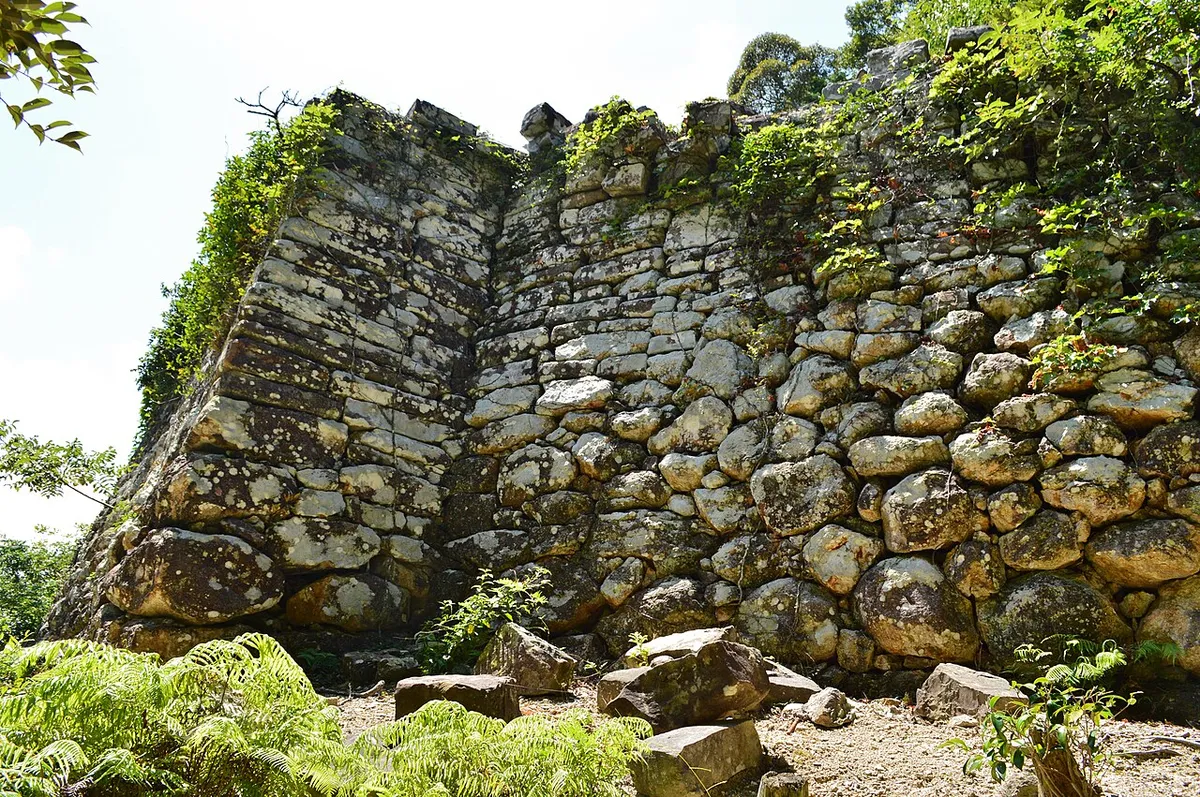
Kaneda Castle

金田城·Kaneda-jo

F Tourism Score 30/100
A Defense Score 82/100

Japan's oldest major fortress — 667 AD stone walls on a remote island in the Korea Strait, built by imperial order after Japan's first recorded naval defeat.

#181 — Continued 100 Castles Ruins
Kaneda Castle (金田城)
Photo:Saigen Jiro/Wikimedia Commons/CC0

Quick Facts

Quick Facts

Admission
Free Free
Hours
00:00 – 23:59
Nearest Station
Izuhara Port or Hitakatsu Port (Tsushima Island, reached by ferry from Hakata/Fukuoka or flight from Fukuoka/Osaka)
Walk from Station
60 min walk
Time Needed
Half day (including travel across the island and 40–60 minute mountain hike each way); plan Tsushima as an overnight trip

Free admission at all times. The mountain trail to the ruins is accessible year-round but can be steep and muddy. The ferry to Tsushima Island adds significant travel cost — plan the island as a dedicated trip.

Defense Overview

Defense Overview

Why Kaneda Castle was hard to attack

This castle is hard to attack because it uses high ground and difficult natural access to deny attackers an easy approach.

An attacker would first have to fight the site itself before reaching the main defenses. They would have to cross water barriers or moat lines and push through successive outer areas before the core.

Overall score

82/100

Estimated range

76–88

Confidence

B

Usable estimate with some inference

This is a site-original comparison score for learning and comparison, not a reconstruction of one historical battle.

Radar view

Terrain 19/20 Entrance 17/20 Internal 16/20 Siege 14/20 Oversight 16/20
How this estimate was built+

This estimate combines broad terrain, approach, layout, and route-control signals. It is meant to explain the castle's defensive logic in plain English, not reconstruct a single historical attack.

Terrain Advantage

How much the terrain itself seems to help: height, slope, ridges, cliffs, water edges, and limited approach directions.

19/20

Entrance Defense

How awkward and dangerous the first entry looks: gates, bridge or moat crossings, chokepoints, and forced turns.

17/20

Internal Complexity

How hard it seems to keep pushing after entry: layered baileys, depth, compartmentalization, and repeated defensive lines.

16/20

Siege Endurance

A rough sense of long-hold potential: moats, water access, space, storage plausibility, and defensive staying power.

14/20

Strategic Oversight

How much the castle appears to command nearby roads, plains, rivers, basins, harbors, or town approaches.

16/20

Why Visit

Kaneda Castle is for dedicated history enthusiasts willing to make the substantial journey to Tsushima Island. The reward is contact with the oldest stone fortification in Japan — walls built in 667 AD by refugees from a destroyed Korean kingdom, on an island that has been Japan's maritime frontier with the continent for all of recorded history. The historical weight is extraordinary for those who engage with it. The Ghost of Tsushima tourism boom has improved island infrastructure for visitors.

Highlights

1

Japan's Oldest Major Fortification — Built Against China and Korea

Kaneda Castle (667 AD) is one of the oldest surviving fortifications in Japan — built over 900 years before the great Sengoku-era castles at Himeji and Osaka. It was constructed in emergency following Japan's catastrophic defeat at the Battle of Baekgang (663 AD), where a Japanese fleet was destroyed by the combined forces of Tang China and Silla Korea. The court feared invasion and ordered a network of mountain fortresses built across western Japan. Kaneda was the first line of defense on Tsushima Island.
2

Stone Walls Built 900 Years Before Himeji

Kaneda Castle's stone walls — built in 667 AD using Korean construction techniques brought by craftsmen from Baekje (an allied Korean kingdom that had just been conquered) — predate the famous ishigaki walls of Himeji Castle by over 900 years. The construction style is called 'Korean style' (choganjitsu) and differs from later Japanese stone wall techniques. These are among the oldest surviving stone walls in Japan.

3

The Island That Guards the Korea Strait

Tsushima Island sits directly in the Korea Strait between the Korean Peninsula and Kyushu — on a clear day you can see Korea from the northern hills. The island has been Japan's maritime frontier with the Asian continent for all of recorded history, serving as a waystation for cultural exchange, a base for pirates, and a frontline defense point in every period of crisis between Japan and the continent. Kaneda Castle encapsulates that entire fraught history in its 667 AD stone walls.

Structure Details

Visitor tip

Getting to Kaneda Castle requires real commitment — a ferry to Tsushima Island (2.5 hours from Hakata/Fukuoka, or high-speed ferry in 1 hour 10 minutes), then car or taxi across the island, then a 40–60 minute mountain hike on rough terrain. The ruins themselves are atmospheric ancient stone walls in a wild mountain setting — not a conventional castle visit but an extraordinary historical experience for those who make the journey. Bring water and good footwear.

Castle type

Mountain castle

Mountain castle — built on a steep mountain on southern Tsushima Island, commanding Mikata Bay and the Korea Strait approach to the island

Layout type

Linked compound layout

Compound style — multiple compounds on different mountain levels, following the Korean-influenced choganjitsu construction style of the 7th century

Main tower

Ancient ruins — stone wall sections and earthworks dating to 667 AD survive; no superstructure of any kind remains; the oldest surviving fortification remains in Japan

Stone walls

Ryukyuan stonework

Kaneda Castle's stone walls, built in 667 AD, represent the oldest large-scale stone fortification construction in Japan. The choanjitsu technique — using carefully fitted stones in a method influenced by Korean and Chinese fortification practice — differs distinctly from the nozurazumi natural stone stacking used in Sengoku-era castles. Substantial wall sections survive on the mountain, providing tangible physical evidence of Japan's 7th-century defensive response to the threat from Tang China.

Key defensive features

Tsushima Island — Natural Maritime Fortress

The island itself is the first line of defense — any attack from the continent must first cross the Korea Strait, visible from the castle heights. The island's mountainous terrain makes landing and advancing from coastal positions to the castle summit extremely difficult.

Mountain Position Commanding Mikata Bay

The castle mountain overlooks Mikata Bay on the southern approach to the island, providing visibility over any fleet approaching from Korea or southern Kyushu. The commanding height gives defenders hours of warning before any landing force could arrive.

7th-Century Choanjitsu Stone Walls

The ancient stone walls, built using Korean construction techniques, encircle the mountain at multiple levels. Though ancient, substantial sections survive and were clearly substantial enough to present a serious obstacle to assault in the pre-gunpowder era.

Korea Strait Visibility

On clear days, the Korean Peninsula is visible from Tsushima's northern hills — approximately 50 km away. Kaneda Castle's position gives visibility over the strait approaches that was the entire strategic point of the fortress: to see the enemy fleet before it arrived.

The Story of Kaneda Castle

Originally built 667 / Imperial Court of Emperor Tenji
Current form 667 / Imperial Court (with Baekje craftsmen)
    663

    The Battle of Baekgang — Japan sends a large fleet to support the Kingdom of Baekje against the allied forces of Tang China and Silla Korea. The Japanese fleet is comprehensively defeated. Japan's allied kingdom of Baekje is destroyed. The imperial court fears a Tang/Silla invasion of the Japanese home islands.

    667

    Emperor Tenji orders the construction of a network of mountain fortresses across western Japan — including Kaneda Castle on Tsushima Island — as emergency defense against the expected Tang/Silla invasion. Craftsmen from the destroyed Kingdom of Baekje, who have fled to Japan as refugees, bring Korean fortification techniques and help construct the stone walls. The invasion never comes.

    701

    The Taiho Code reorganizes the Japanese state administration. Tsushima and its fortress are formally incorporated into the imperial provincial system. The expected Tang invasion having not materialized, Kaneda Castle gradually loses its emergency military character but retains its administrative significance.

    1274

    The First Mongol Invasion — Kublai Khan sends a force that lands on Tsushima Island, attacking and devastating the island's defenders before proceeding toward Kyushu. Kaneda Castle, by this time centuries old, is not recorded as playing a significant role in the defense against the Mongols.

    1419

    The Oei Invasion — Korean forces attack Tsushima to suppress the wokou pirates (Japanese raiders who used the island as a base for attacking Korea). The island is temporarily occupied. Kaneda Castle, by this time essentially an ancient ruin, is not a factor in the military events.

    1905

    The Battle of Tsushima — Japan's navy under Admiral Togo destroys the Russian Baltic Fleet in the straits near Tsushima Island, one of the most decisive naval battles in modern history. Kaneda Castle's ancient stones overlook the same waters where the 20th century's most dramatic naval engagement is fought.

In Pop Culture

game

Ghost of Tsushima (video game, 2020)

The PlayStation game 'Ghost of Tsushima,' set during the 1274 Mongol Invasion of the island, massively increased international awareness of Tsushima's history. While Kaneda Castle is not explicitly featured, the game drove a tourism surge to Tsushima Island including visitors seeking the historical castle ruins.

other

7th-century Japanese historical chronicles

Kaneda Castle's construction in 667 AD is documented in the Nihon Shoki (Chronicle of Japan, 720 AD) — one of Japan's two oldest national chronicles — making it one of the few castle sites with primary historical documentation from the period of its construction.

Did You Know?

  • The Battle of Baekgang (663 AD) that prompted Kaneda Castle's construction is the oldest recorded naval battle involving Japan. The Japanese fleet — reportedly 400–1,000 vessels — was defeated by a much smaller but better-coordinated Tang Chinese force. The defeat had profound consequences: Japan adopted Tang culture, law, and governance systems at an accelerated pace, partly to modernize and partly because the Tang empire was now the dominant power in East Asia and had to be emulated rather than opposed.
  • The Baekje craftsmen who helped build Kaneda Castle were refugees from a destroyed kingdom — their homeland had just been conquered by Tang China and Silla Korea, the same powers that Japan feared would invade. Japan accepted large numbers of Baekje refugees following the kingdom's fall, and these refugees brought Korean craft traditions, Buddhism, and technical knowledge that significantly influenced Japanese culture.
  • On a clear day from Tsushima Island's northern hills, you can see the Korean Peninsula approximately 50 km away — closer than the island is to Kyushu (approximately 132 km). Tsushima has always been culturally and commercially closer to Korea than to mainland Japan, a liminal identity that gives the island a unique historical character.

Score Breakdown

Tourism Score

F 30/100
  • Accessibility 2 /20
  • Foreign-Friendly 3 /20
  • Historical Value 15 /20
  • Visual Impact 7 /20
  • Facilities 3 /20

Defense Score

A 82/100
  • Terrain Advantage 19 /20
  • Entrance Defense 17 /20
  • Internal Complexity 16 /20
  • Siege Endurance 14 /20
  • Strategic Oversight 16 /20

Planning Your Visit

Best Time to Visit

May to October for comfortable hiking conditions. Spring and autumn are ideal. The mountain trail can be slippery and cold in winter.

Time Needed

Half day (including travel across the island and 40–60 minute mountain hike each way); plan Tsushima as an overnight trip

Insider Tip

Tsushima deserves at least two days — combine Kaneda Castle with the island's other historical sites (Tsushima Yamaneko Wildlife Center for the endemic wildcat, the Watatsumi Shrine, the Battle of Tsushima memorial sites) and the spectacular coastal scenery. Rental car is essential for covering the island efficiently. Korean-language tourism has dominated Tsushima in recent years — Korean visitors find it a nostalgic experience to visit the island visible from their own coastline.

Map

Getting There

Nearest station: Izuhara Port or Hitakatsu Port (Tsushima Island, reached by ferry from Hakata/Fukuoka or flight from Fukuoka/Osaka)
Walk from station: 60 min walk
Parking: Small free parking area at the trailhead near Mikata Bay. Limited spaces — arrive early.

Admission

Free

Free admission at all times. The mountain trail to the ruins is accessible year-round but can be steep and muddy. The ferry to Tsushima Island adds significant travel cost — plan the island as a dedicated trip.

Opening Hours

Open00:00 – 23:59

Open at all times as a free outdoor historical site. The trail may be slippery in rain. Best visited in dry weather.

Facilities

  • – English guides
  • – Audio guide
  • – Wheelchair access
  • – Restrooms
  • – Gift shop
  • – Food nearby

Nearby Castles

Featured in collections

FAQ

Frequently Asked Questions

How do I get to Kaneda Castle?

The nearest station is Izuhara Port or Hitakatsu Port (Tsushima Island, reached by ferry from Hakata/Fukuoka or flight from Fukuoka/Osaka). From there it is about 60 minutes on foot.

How much does Kaneda Castle cost to enter?

Kaneda Castle is free to enter.

Is Kaneda Castle worth visiting?

Kaneda Castle is for dedicated history enthusiasts willing to make the substantial journey to Tsushima Island. The reward is contact with the oldest stone fortification in Japan — walls built in 667 AD by refugees from a destroyed Korean kingdom, on an island that has been Japan's maritime frontier with the continent for all of recorded history. The historical weight is extraordinary for those who engage with it. The Ghost of Tsushima tourism boom has improved island infrastructure for visitors.

What are the opening hours of Kaneda Castle?

00:00 to 23:59.

How long should I spend at Kaneda Castle?

Plan for about Half day (including travel across the island and 40–60 minute mountain hike each way); plan Tsushima as an overnight trip, depending on how closely you want to explore the grounds.