Matsumoto Castle

松本城·Matsumoto-jo

A Tourism Score 85/100
C Defense Score 66/100

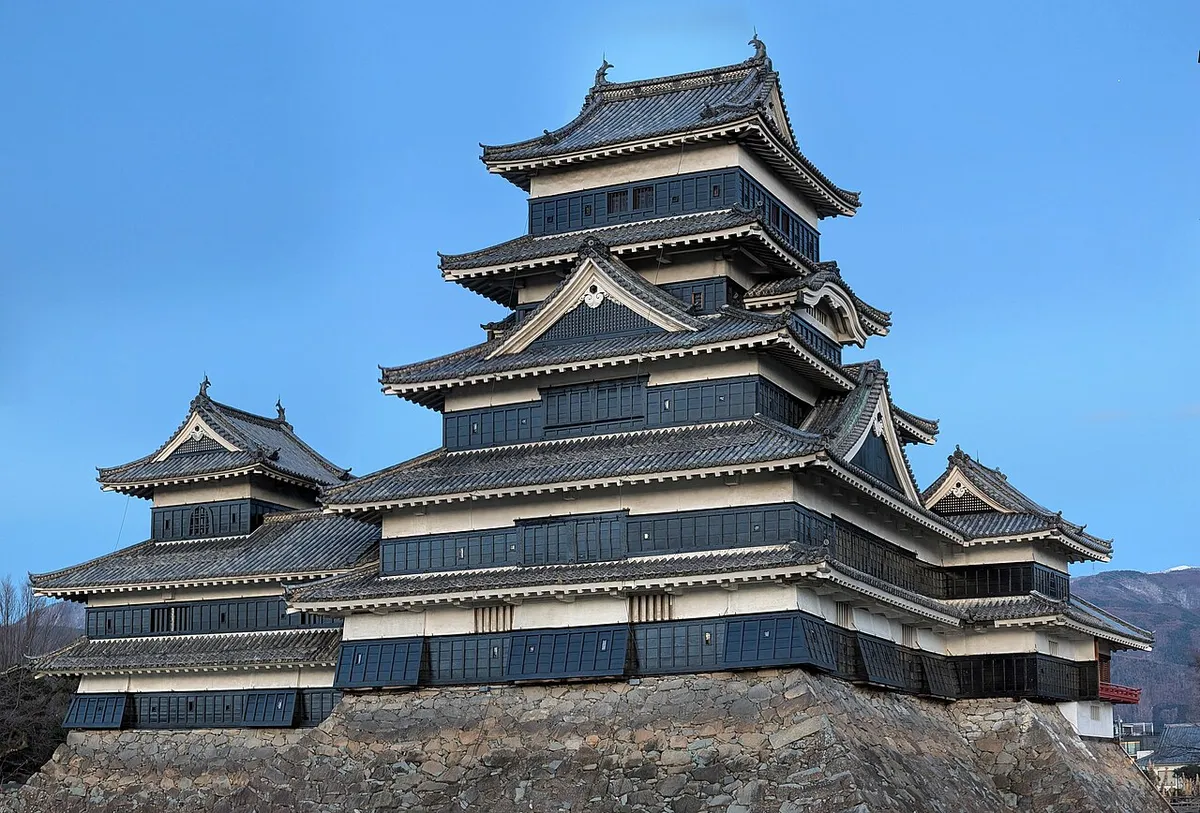
Japan's most dramatically photogenic original castle — a jet-black tower reflected in its moat, framed by the Japanese Alps.

#29 — 100 Famous Castles Surviving
Matsumoto Castle (松本城)
Photo:Syced/Wikimedia Commons/CC0

Quick Facts

Quick Facts

Admission
¥1,200

¥400

Hours
08:30 – 17:00

Last entry 16:30

Nearest Station
Matsumoto Station (JR Chuo Line / Shinonoi Line)
Walk from Station
20 min walk

Bus also available

Time Needed
2-3 hours

Admission increased from April 2025. Digital tickets ¥1,200, physical tickets ¥1,300. Children (elementary) ¥400. Designated date/time slots required for digital tickets.

Defense Overview

Defense Overview

Why Matsumoto Castle was hard to attack

This castle is hard to attack because it combines managed outer defenses on relatively level ground with enough defensive depth to slow attackers before the center.

An attacker would not simply arrive at the center on open flat ground. They would have to cross water barriers or moat lines and push through successive outer areas before the core.

Overall score

66/100

Estimated range

60–72

Confidence

A

Strong multi-source support

This is a site-original comparison score for learning and comparison, not a reconstruction of one historical battle.

Radar view

Terrain 10/20 Entrance 11/20 Internal 16/20 Siege 16/20 Oversight 13/20
How this estimate was built+

This estimate combines broad terrain, approach, layout, and route-control signals. It is meant to explain the castle's defensive logic in plain English, not reconstruct a single historical attack.

Terrain Advantage

How much the terrain itself seems to help: height, slope, ridges, cliffs, water edges, and limited approach directions.

10/20

Entrance Defense

How awkward and dangerous the first entry looks: gates, bridge or moat crossings, chokepoints, and forced turns.

11/20

Internal Complexity

How hard it seems to keep pushing after entry: layered baileys, depth, compartmentalization, and repeated defensive lines.

16/20

Siege Endurance

A rough sense of long-hold potential: moats, water access, space, storage plausibility, and defensive staying power.

16/20

Strategic Oversight

How much the castle appears to command nearby roads, plains, rivers, basins, harbors, or town approaches.

13/20

Why Visit

Matsumoto offers something rare: an original 16th-century castle tower that you can actually climb inside, with every ancient beam and steep staircase intact. The setting — a black castle reflected in a wide moat, mountains visible in every direction — is simply one of Japan's most beautiful scenes. The city itself is charming and underrated, worth a night or two.

Highlights

1

The Crow Castle — Japan's Darkest Beauty

While Himeji is dazzling white, Matsumoto is jet black — its walls are covered in dark plaster and black-lacquered wooden boards, earning it the nickname 'Karasu-jo' (Crow Castle). The contrast between the black tower and the surrounding moat, with the Japanese Alps rising behind it, creates one of the most photographed scenes in all of Japan.
2

Perfectly Original for 430 Years

Matsumoto's main tower complex has stood since the 1590s, making it one of Japan's oldest surviving castle towers. Every timber, every beam, every steep staircase is the real thing — you're walking through a 430-year-old wooden structure that has never burned and never been rebuilt.

3

Built for Guns, Not Just Swords

Matsumoto was constructed during Japan's 'Warring States' period, when firearms had already transformed warfare. The castle features specialized moon-viewing turrets and numerous gun ports at floor level — designed so musketeers could fire at approaching enemies from a prone position. It's a fascinating snapshot of a Japan transitioning between bow-and-sword warfare and firearms.

Structure Details

Visitor tip

The staircases inside are steep and narrow — genuinely steep, like a ladder in some places. Wear comfortable shoes and go slowly. The fifth floor is intentionally dark and has no windows; this was a secret floor hidden from the outside, where defenders could rest without being seen by enemies. The sixth floor offers views of the Japanese Alps on clear days.

Castle type

Flatland castle

Flatland castle — built on flat terrain in a basin surrounded by mountains, relying on water defenses

Layout type

Linked compound layout

Compound style — multiple towers connected by covered corridors forming a unified complex

Main tower

Original wooden tenshu (main keep) — one of only 12 surviving in Japan, designated a National Treasure

29.4m6 floors, 1 below

Stone walls

Natural stone stacking

The stone walls are relatively low compared to Himeji or Osaka, reflecting Matsumoto's reliance on its wide moats for defense. The walls have a characteristic rounded base profile.

Moats

A wide inner moat completely surrounds the main tower complex. The reflection of the black tower in the calm moat water is one of Japan's iconic images, especially during cherry blossom season.

Key defensive features

Tsukimi Yagura (Moon-Viewing Turret)

Unusually, the castle features a turret designed for peaceful moon-viewing — added in the 17th century when the era of castle warfare was over. It connects to the main tower complex and projects over the moat. A reminder that castles served social and cultural functions too.

Floor-Level Gun Ports

Low openings in the walls at floor level allowed musketeers to fire from a prone position — harder to hit and more stable for accurate shooting. This forward-thinking defensive design was state-of-the-art for the late 16th century.

Wide Encircling Moat

The broad inner moat compensated for the flat terrain by creating a significant water barrier. Unlike a mountain castle, there was no high ground here — the moat was the main line of defense before the walls.

The Story of Matsumoto Castle

Originally built 1504 / Shimadachi Sadanaga (for the Ogasawara clan)
Current form 1597 / Ishikawa Kazumasa / Ishikawa Yasunaga
National Treasure
    1504

    A small fort called Fukashi Castle is built on the flat land of the Matsumoto Basin by the Ogasawara clan's retainer Shimadachi Sadanaga. It controls the road through the mountains.

    1550

    The Takeda clan — the fearsome cavalry force of warlord Takeda Shingen — seizes the castle as part of their expansion into Shinano Province (modern Nagano).

    1582

    Takeda Shingen's son is defeated by Oda Nobunaga, and the castle changes hands multiple times during the chaotic period of unification.

    1593

    Ishikawa Kazumasa, a senior retainer sent by Toyotomi Hideyoshi, begins the construction of the current main tower complex, incorporating the latest firearms-era defensive features.

    1615

    The Tokugawa shogunate takes control and appoints a series of lords to govern Matsumoto. The castle serves as an administrative center for the region for the next 250 years.

    1872

    In the early Meiji period, the castle nearly falls apart from neglect and is slated for demolition. Local citizens organize a campaign and purchase the castle to save it, funding basic repairs.

    1952

    The Japanese government designates Matsumoto Castle a National Treasure, recognizing it as an irreplaceable example of original Sengoku-era military architecture.

In Pop Culture

TV

Various NHK Taiga Dramas

Matsumoto Castle's distinctive black silhouette appears in numerous historical dramas set in the Sengoku period.

Did You Know?

  • The castle nearly collapsed in the 1900s — one corner had sunk so badly that the tower was leaning. A major engineering effort between 1903 and 1913 straightened the building by carefully underpinning the foundations while the tower still stood.
  • The hidden fifth floor has no windows and was deliberately not visible from the outside — the exterior of the castle appears to have five floors, concealing the existence of the sixth. This was a standard defensive deception to confuse attackers about the castle's true layout.
  • On the wooden pillars inside the top floor, you can still see faint traces of the names carved by soldiers garrisoned here during the Meiji period — an unexpected piece of graffiti history in a National Treasure.
  • The Matsumoto basin sits at about 600 meters above sea level, and the surrounding Japanese Alps are visible from the castle's upper floors. On a clear winter day, the view of snow-capped peaks behind the black tower is extraordinary.

Score Breakdown

Tourism Score

A 85/100
  • Accessibility 15 /20
  • Foreign-Friendly 17 /20
  • Historical Value 19 /20
  • Visual Impact 20 /20
  • Facilities 14 /20

Defense Score

C 66/100
  • Terrain Advantage 10 /20
  • Entrance Defense 11 /20
  • Internal Complexity 16 /20
  • Siege Endurance 16 /20
  • Strategic Oversight 13 /20

Planning Your Visit

Best Time to Visit

Cherry blossom season (late April in Matsumoto, which is slightly later than lowland areas due to elevation) for the iconic blossom-and-castle reflections. Winter is spectacular if you can handle the cold — snow-dusted mountains behind the black castle are breathtaking.

Time Needed

2-3 hours

Insider Tip

Visit just after opening at 8:30am to beat the tour groups inside the tower — the steep stairs create a bottleneck and lines can form mid-morning. The Ninomaru area just outside the main moat has excellent views of the tower that most visitors rush past.

Map

Getting There

Nearest station: Matsumoto Station (JR Chuo Line / Shinonoi Line)
Walk from station: 20 min walk
Bus: Town Sneaker bus loop (North Course) stops at the castle. ¥200 per ride.
Parking: Limited parking around the castle. Municipal parking available nearby.
Accessible with a JR Pass

Admission

Adult¥1,200
Child¥400

Admission increased from April 2025. Digital tickets ¥1,200, physical tickets ¥1,300. Children (elementary) ¥400. Designated date/time slots required for digital tickets.

Opening Hours

Open08:30 – 17:00
Last entry16:30

Extended to 18:00 during summer (July–August) and special events. Closed December 29–31.

Facilities

  • ✓ English guides
  • ✓ Audio guide
  • – Wheelchair access
  • ✓ Restrooms
  • ✓ Gift shop
  • ✓ Food nearby

Audio guide languages: English, Japanese, Chinese, Korean

Nearby Castles

Featured in collections

FAQ

Frequently Asked Questions

How do I get to Matsumoto Castle?

The nearest station is Matsumoto Station (JR Chuo Line / Shinonoi Line). From there it is about 20 minutes on foot. Town Sneaker bus loop (North Course) stops at the castle. ¥200 per ride.

How much does Matsumoto Castle cost to enter?

Adult admission is ¥1,200 and child admission is ¥400.

Is Matsumoto Castle worth visiting?

Matsumoto offers something rare: an original 16th-century castle tower that you can actually climb inside, with every ancient beam and steep staircase intact. The setting — a black castle reflected in a wide moat, mountains visible in every direction — is simply one of Japan's most beautiful scenes. The city itself is charming and underrated, worth a night or two.

What are the opening hours of Matsumoto Castle?

08:30 to 17:00, last entry 16:30.

How long should I spend at Matsumoto Castle?

Plan for about 2-3 hours, depending on how closely you want to explore the grounds.