Takamatsu Castle

高松城·Takamatsu-jo

D Tourism Score 58/100
B Defense Score 79/100

Japan's castle that floated on the sea — three original turrets, seawater moats, and a missing main tower that may yet return.

#77 — 100 Famous Castles Ruins
Takamatsu Castle (高松城)
Photo:Unknown/Wikimedia Commons/Public domain

Quick Facts

Quick Facts

Admission
¥300

¥0

Hours
09:00 – 17:00

Last entry 16:30

Nearest Station
Takamatsu Station (JR Yosan Line / JR Kotoku Line / Kotoden Kotohira Line)
Walk from Station
5 min walk
Time Needed
1-1.5 hours

Admission increased to ¥300 from April 2026. Visitors under 18 free.

Defense Overview

Defense Overview

Why Takamatsu Castle was hard to attack

This castle is hard to attack because water barriers shape the entire approach and keep attackers from pressing straight into the defended center.

An attacker would have to deal with water-shaped access before pressing into the defended core. They would have to cross water barriers or moat lines, pass tighter turns and chokepoints, and face more defensive depth after the first line.

Overall score

79/100

Estimated range

73–85

Confidence

B

Usable estimate with some inference

This is a site-original comparison score for learning and comparison, not a reconstruction of one historical battle.

Radar view

Terrain 15/20 Entrance 16/20 Internal 16/20 Siege 15/20 Oversight 17/20
How this estimate was built+

This estimate combines broad terrain, approach, layout, and route-control signals. It is meant to explain the castle's defensive logic in plain English, not reconstruct a single historical attack.

Terrain Advantage

How much the terrain itself seems to help: height, slope, ridges, cliffs, water edges, and limited approach directions.

15/20

Entrance Defense

How awkward and dangerous the first entry looks: gates, bridge or moat crossings, chokepoints, and forced turns.

16/20

Internal Complexity

How hard it seems to keep pushing after entry: layered baileys, depth, compartmentalization, and repeated defensive lines.

16/20

Siege Endurance

A rough sense of long-hold potential: moats, water access, space, storage plausibility, and defensive staying power.

15/20

Strategic Oversight

How much the castle appears to command nearby roads, plains, rivers, basins, harbors, or town approaches.

17/20

Why Visit

Takamatsu Castle is an important and genuinely unusual site — one of Japan's three great water castles, with seawater moats that connected directly to the Seto Inland Sea and three surviving original turrets that are architecturally exceptional. The missing main tower is the obvious absence, but the park itself is pleasant, the turrets are worth examining closely, and the historical concept of a sea castle with tidal moats is worth understanding. The extraordinary accessibility (five minutes from Takamatsu Station) makes this an easy visit to combine with the city's main attraction, Ritsurin Garden.

Highlights

1

One of Japan's Three Great Water Castles — with Real Seawater

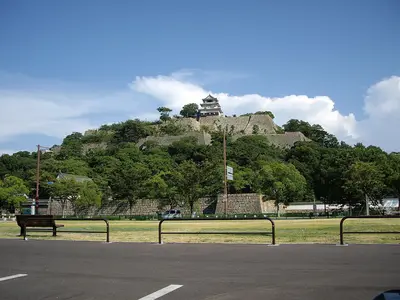
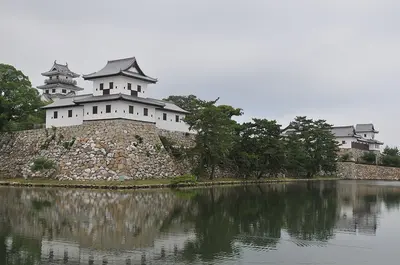
Takamatsu Castle (also known as Tamamo Castle) is recognized as one of Japan's three great water castles (sanmei mizujiro), alongside Imabari in Ehime and Nakatsu in Oita. What makes Takamatsu uniquely extraordinary is that its moats are — or were — filled with actual seawater directly from the Seto Inland Sea. The castle was built on a promontory extending into the sea itself, with moats fed by tidal channels, making it one of the very few castles in the world where the water defense was literally the ocean.
2

Three Surviving Turrets

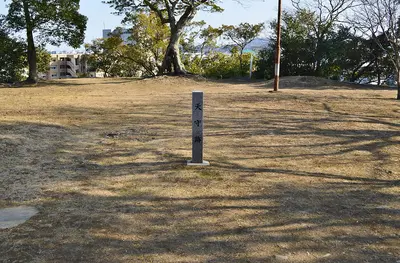
Although the main tower was demolished in 1884, Takamatsu Castle retains three original turrets — the Tsukimi-yagura (Moon-viewing Turret), the Suimon-yagura (Water Gate Turret), and the Higashi-no-maru Minami-yagura (East Compound South Turret). These three surviving structures are all designated Important Cultural Properties and give a concrete sense of the castle's original scale and quality of construction. The Tsukimi-yagura in particular is considered one of the finest surviving castle turrets in Japan.

3

Main Tower Reconstruction Project

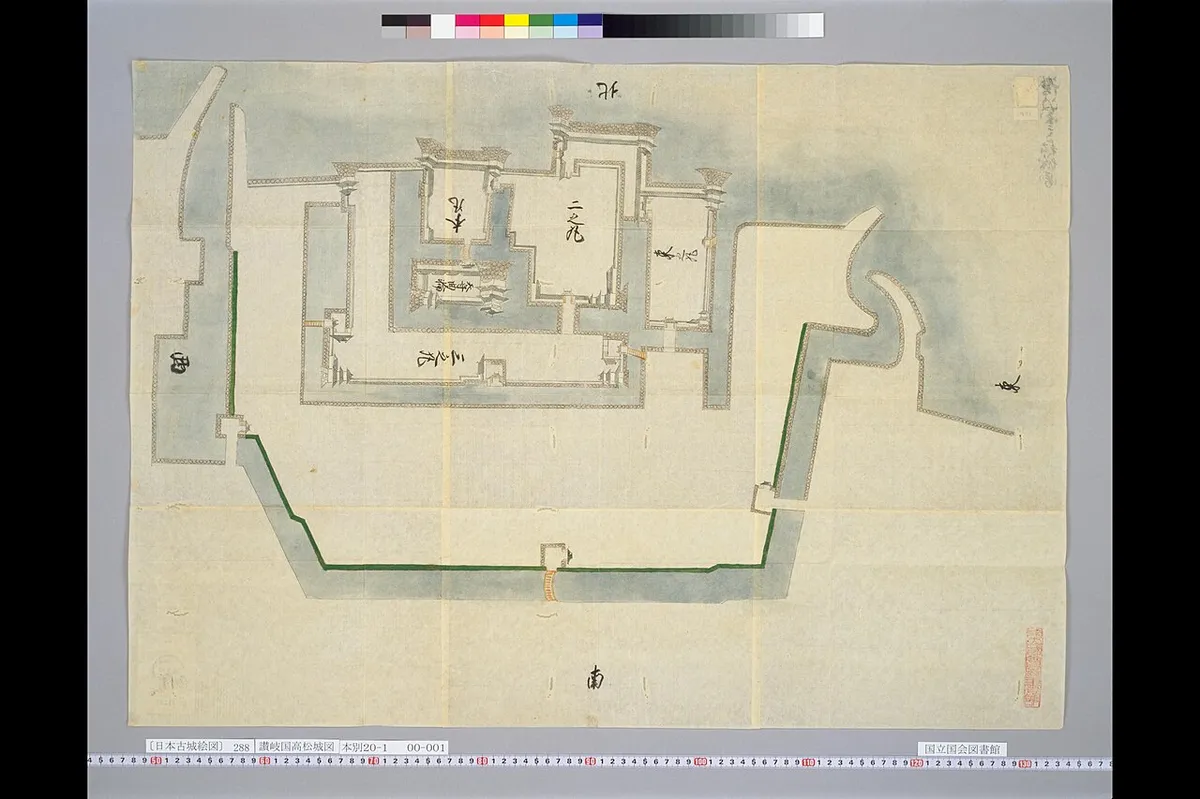
Takamatsu Castle is actively planning to reconstruct its main tower — one of Japan's most ambitious ongoing castle reconstruction discussions. Original architectural blueprints (genban) discovered in 1980 have provided accurate data for a potential reconstruction. The project has been debated for decades and represents a question of national significance: whether and how to rebuild a significant historical structure with high-quality historical documentation.

Structure Details

Visitor tip

The main tower is gone, but Takamatsu Castle's park is one of the more pleasant castle grounds in Shikoku — walk the inner moat circuit, look at the three surviving turrets, and appreciate the seawater moat concept. The Tsukimi-yagura (Moon-viewing Turret) is particularly elegant and worth a close look. The ¥200 admission is very reasonable for what is a historically significant site with genuine surviving structures.

Castle type

Water castle

Water castle — built on a promontory on the Seto Inland Sea coast, with moats originally fed by tidal seawater directly from the sea. One of Japan's three great water castles.

Layout type

Concentric layout

Enclosure style — concentric compounds surrounded by seawater moats, with the innermost compound built partially over the sea

Main tower

Stone ruins with original turrets — the main tower (original, three stories) was demolished in 1884. Three original turrets (Important Cultural Properties) survive. Original architectural drawings (genban) exist, supporting an ongoing reconstruction discussion.

Stone walls

Natural stone stacking

The stone walls at Takamatsu are built to stand in contact with seawater — a demanding engineering challenge that required durable stone selection and careful construction. The walls rise directly from the water's edge in several sections, with the tidal variation in the moat historically visible in the weathering pattern on the lower courses. The walls enclose three compounds of successively smaller size toward the inner compound.

Moats

The moats were originally filled with seawater directly from the Seto Inland Sea via tidal channels — a feature unique in Japanese castle design. Three moats (inner, middle, outer) concentric around the main compound, all originally connected to the sea. Modern land reclamation has reduced the seawater connection, but the moats retain water and maintain their essential visual form.

Key defensive features

Seawater Moats

The castle's moats were fed by tidal channels from the Seto Inland Sea — meaning the water was saltwater, subject to tidal variation, and connected to the open sea. This created a moat system that was genuinely dynamic and difficult to drain or bypass. Swimming across in armor was effectively impossible, and any boat crossing would have been exposed to fire from multiple angles.

Sea-Gate Approach

The original main approach to the castle was by boat from the sea — a controlled water entry point that gave defenders complete visibility and fire control over all approaching vessels. The Suimon-yagura (Water Gate Turret) overlooked this maritime entry, combining a defensive post with the aesthetic pleasure of viewing the sea.

Tidal Variation Barrier

The connection to the tidal sea meant that water levels in the moats varied with the tide — creating an unpredictable defensive feature that would complicate any coordinated assault timing. Attackers would need to account for tidal schedules, giving defenders a natural early warning system.

The Story of Takamatsu Castle

Originally built 1588 / Ikoma Chikamasa
Current form 1640 / Matsudaira Yorishige (Takamatsu Matsudaira, significant expansion)
    1588

    Ikoma Chikamasa, given Sanuki Province (Kagawa) by Toyotomi Hideyoshi after the Shikoku campaign, builds Takamatsu Castle on the Seto Inland Sea coast. The decision to use seawater moats was both a practical defense and a statement about maritime power over the Inland Sea.

    1615

    The Ikoma clan runs into political difficulties with the Tokugawa shogunate and is eventually transferred out of Sanuki in 1640. The Matsudaira Yorishige (a Tokugawa branch lord) takes over Takamatsu domain.

    1640

    Matsudaira Yorishige undertakes major expansion of the castle, adding the eastern compound and multiple turrets including the surviving Moon-viewing Turret and Water Gate Turret. The castle takes on the form it would maintain for the rest of the Edo period.

    1884

    The Meiji government orders demolition of the main tower — one of Japan's great castle towers, three stories and imposing in scale. The three surviving turrets are spared, though most other buildings are demolished. The decision to demolish rather than preserve was later widely regretted.

    1980

    Original architectural blueprints (genban) for Takamatsu Castle's main tower are discovered, providing detailed historical documentation for a potential reconstruction. The discovery triggers ongoing debate about rebuilding, which continues to the present day.

Did You Know?

  • Takamatsu Castle is one of only a handful of castles in the world where the defensive moat was filled with actual seawater from the adjacent sea. The tidal variation in the moat was historically noted in castle administrative documents — certain maintenance tasks had to be timed around the tides.
  • The Tsukimi-yagura (Moon-viewing Turret) at Takamatsu is considered one of the finest surviving castle turrets in Japan and is rated higher by some architectural historians than several more famous castle towers. Its proportions, roof curve, and the quality of its timber joinery are exceptional.
  • Original architectural blueprints for Takamatsu's demolished main tower were discovered in 1980 — making it one of the best-documented demolished castle towers in Japan. The blueprints have been cited as the primary evidence supporting the reconstruction debate, though the project has never progressed to an official approval stage.
  • The nickname 'Tamamo Castle' (Tamamo-jo) comes from a poem in the Man'yoshu (Japan's oldest poetry anthology) referring to 'tamamo' (beautiful seaweed) on the Sanuki coast. The poetic castle name has medieval roots independent of any military association.

Score Breakdown

Tourism Score

D 58/100
  • Accessibility 16 /20
  • Foreign-Friendly 12 /20
  • Historical Value 14 /20
  • Visual Impact 11 /20
  • Facilities 5 /20

Defense Score

B 79/100
  • Terrain Advantage 15 /20
  • Entrance Defense 16 /20
  • Internal Complexity 16 /20
  • Siege Endurance 15 /20
  • Strategic Oversight 17 /20

Planning Your Visit

Best Time to Visit

Early morning (before 09:30, walk along the outer moat for free before paying admission) for the most atmospheric visit — mist over the seawater moat and the turrets catching the morning light. Cherry blossom season (late March to early April) fills the park beautifully. The castle is pleasant year-round.

Time Needed

1-1.5 hours

Insider Tip

After the castle, walk the five minutes to the port area and look back at the castle grounds from across the water — this gives the best sense of the original maritime setting. The Seto Inland Sea ferry terminal is adjacent to the castle; if you are heading to Naoshima or other Inland Sea islands, the castle makes a perfect pre-departure visit. Ritsurin Garden (one of Japan's finest stroll gardens) is 3km south of the castle and should be paired in the same day.

Map

Getting There

Nearest station: Takamatsu Station (JR Yosan Line / JR Kotoku Line / Kotoden Kotohira Line)
Walk from station: 5 min walk
Parking: Limited parking within the park. The central station location makes train access far preferable.
Accessible with a JR Pass

Admission

Adult¥300
ChildFree

Admission increased to ¥300 from April 2026. Visitors under 18 free.

Opening Hours

Open09:00 – 17:00
Last entry16:30

Hours vary by season and gate. East gate: opens 7:00–8:30 depending on month, closes 17:00–18:00. West gate: 7:00–17:00 year-round.

Facilities

  • – English guides
  • – Audio guide
  • ✓ Wheelchair access
  • ✓ Restrooms
  • – Gift shop
  • ✓ Food nearby

Nearby Castles

Featured in collections

FAQ

Frequently Asked Questions

How do I get to Takamatsu Castle?

The nearest station is Takamatsu Station (JR Yosan Line / JR Kotoku Line / Kotoden Kotohira Line). From there it is about 5 minutes on foot.

How much does Takamatsu Castle cost to enter?

Adult admission is ¥300 and child admission is ¥0.

Is Takamatsu Castle worth visiting?

Takamatsu Castle is an important and genuinely unusual site — one of Japan's three great water castles, with seawater moats that connected directly to the Seto Inland Sea and three surviving original turrets that are architecturally exceptional. The missing main tower is the obvious absence, but the park itself is pleasant, the turrets are worth examining closely, and the historical concept of a sea castle with tidal moats is worth understanding. The extraordinary accessibility (five minutes from Takamatsu Station) makes this an easy visit to combine with the city's main attraction, Ritsurin Garden.

What are the opening hours of Takamatsu Castle?

09:00 to 17:00, last entry 16:30.

How long should I spend at Takamatsu Castle?

Plan for about 1-1.5 hours, depending on how closely you want to explore the grounds.