Takiyama Castle

滝山城·Takiyama-jo

F Tourism Score 35/100
A Defense Score 85/100

Tokyo's forgotten mountain fortress — the Hojo clan's earthwork masterpiece held off Takeda Shingen, and its ridge-cut moats remain dramatic 450 years after abandonment.

#20 — 100 Famous Castles Ruins
Takiyama Castle (滝山城)
Photo:TT mk2/Wikimedia Commons/CC BY-SA 4.0

Quick Facts

Quick Facts

Admission
Free Free
Hours
00:00 – 23:59
Nearest Station
Akikawa Station (JR Itsukaichi Line), then 25-minute walk; or Hachioji Station (JR Chuo Line / Yokohama Line), then bus
Walk from Station
25 min walk

Bus also available

Time Needed
2–3 hours including travel from Hachioji Station and full ruins trail

Castle ruins are a designated national historic site within Takiyama Park. Completely free to enter. No facilities at the ruins themselves — bring water.

Defense Overview

Defense Overview

Why Takiyama Castle was hard to attack

This castle is hard to attack because it combines high ground and difficult natural access with a controlled route inward.

An attacker would first have to fight the site itself before reaching the main defenses. They would have to cross water barriers or moat lines and face more defensive depth after the first line.

Overall score

85/100

Estimated range

79–91

Confidence

B

Usable estimate with some inference

This is a site-original comparison score for learning and comparison, not a reconstruction of one historical battle.

Radar view

Terrain 19/20 Entrance 17/20 Internal 14/20 Siege 16/20 Oversight 19/20
How this estimate was built+

This estimate combines broad terrain, approach, layout, and route-control signals. It is meant to explain the castle's defensive logic in plain English, not reconstruct a single historical attack.

Terrain Advantage

How much the terrain itself seems to help: height, slope, ridges, cliffs, water edges, and limited approach directions.

19/20

Entrance Defense

How awkward and dangerous the first entry looks: gates, bridge or moat crossings, chokepoints, and forced turns.

17/20

Internal Complexity

How hard it seems to keep pushing after entry: layered baileys, depth, compartmentalization, and repeated defensive lines.

14/20

Siege Endurance

A rough sense of long-hold potential: moats, water access, space, storage plausibility, and defensive staying power.

16/20

Strategic Oversight

How much the castle appears to command nearby roads, plains, rivers, basins, harbors, or town approaches.

19/20

Why Visit

Takiyama Castle is for visitors who want the authentic Japanese mountain castle experience within an hour of central Tokyo — forest trails, ancient earthworks, moat cuts that are still meters deep, and the specific atmospheric quality of a site that has been abandoned for 430 years. Unlike reconstructed concrete castles, Takiyama is entirely original: the same earthwork ridges and moat cuts that stopped Takeda Shingen in 1569. The forest setting and river valley views are genuinely beautiful. This is not a tourist site with facilities — it is a historical site that rewards visitors who show up prepared and know what they're looking at.

Highlights

1

The Hojo Clan's Kanto Masterwork

Takiyama Castle was the primary stronghold of the Later Hojo clan (Go-Hojo) in the central Kanto region — built on a 160-meter hill above the confluence of the Tama River and Akigawa River, exploiting complex natural terrain to create one of the most sophisticated mountain castle layouts in eastern Japan. Before Hachioji Castle was built further west, Takiyama was the Hojo clan's key fortification controlling the approaches to their headquarters at Odawara.
2

Earthwork Engineering at Its Finest

Takiyama Castle is celebrated among Japanese castle scholars for the sophistication of its earthwork engineering — cut moats (horikiri), raised earthwork walls (dobei), secondary defensive ridges, and multiple island-like compound platforms created by cutting away the hillsides. The layout makes maximum use of the natural ridge and river-cliff terrain, creating a castle whose complexity in earthworks rivals the stone-walled sophistication of Sengoku giants like Osaka or Himeji.

3

Tokyo's Best Mountain Castle Ruins

Within reach of central Tokyo, Takiyama Castle offers one of the Kanto region's most rewarding castle ruin walks — through mature forest on clearly preserved earthwork remains, with views over the Tama River valley and (on clear days) Mt. Fuji to the southwest. The trail through the ruins takes about an hour, passing successive defensive tiers and the characteristic 'nagare-horikiri' (continuous moats flowing down the ridge) that are Hojo clan engineering signatures.

Structure Details

Visitor tip

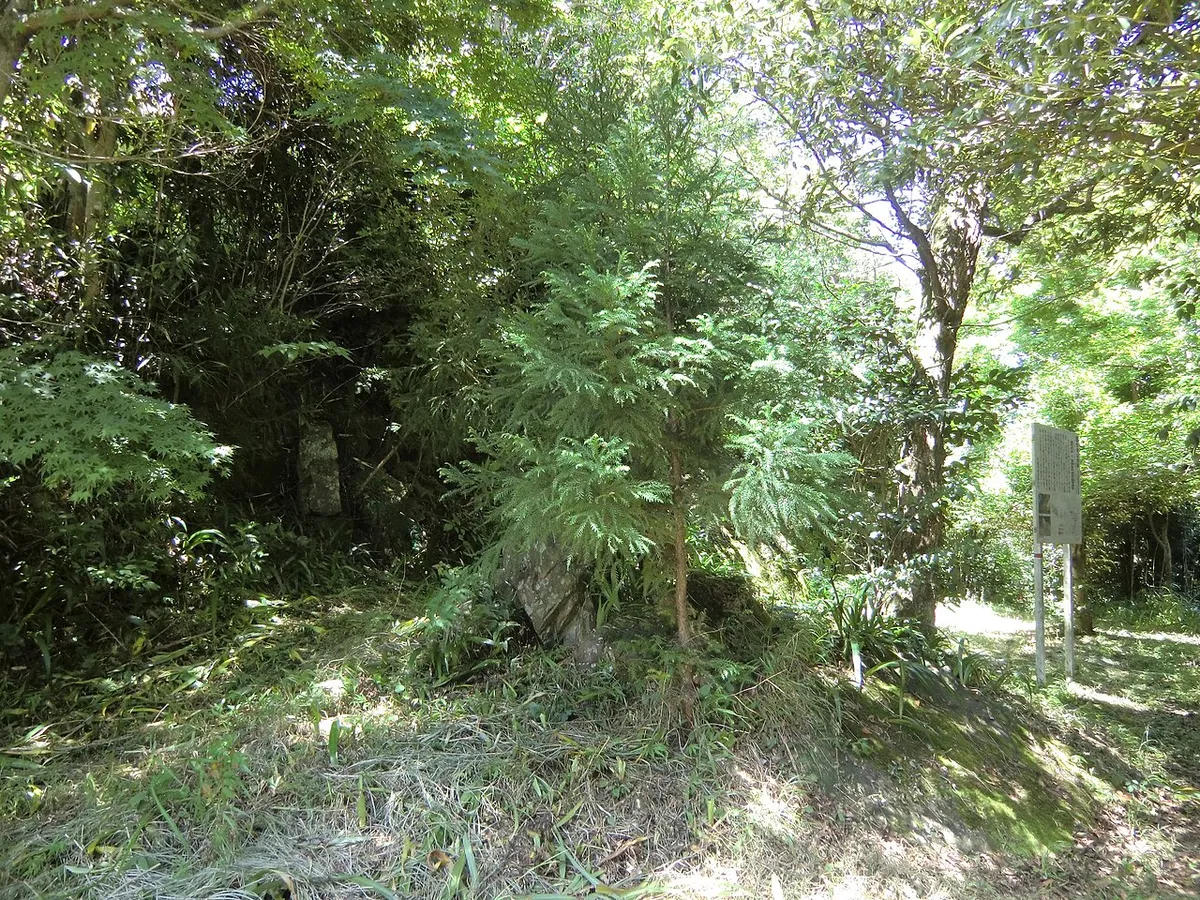
Takiyama Castle is earthworks only — no walls, no towers, no buildings. What you see is shaped terrain: raised earth walls, cut moats, leveled platforms. The trail through the ruins is well-maintained and clearly marked, taking about 45–60 minutes to complete. The earthworks are actually impressive in physical scale once you're walking among them — the moat cuts in particular are deeper and more dramatic than photographs suggest. Wear walking shoes.

Castle type

Mountain castle

Mountain castle — built on a complex hill system at the confluence of the Tama and Akigawa Rivers, 160 meters above the surrounding valley floor

Layout type

Ladder layout

Tier-style — successive defensive platforms and moat-cut ridges following the natural hilltop terrain, each tier reinforced by earthwork walls and cut moats (horikiri)

Main tower

No main tower — Takiyama Castle had no tenshu (main keep). Its defense relied on earthwork engineering and natural terrain rather than a central tower structure. The ruins consist entirely of earthworks, moat cuts, and natural terrain features.

Stone walls

Earthen walls

Takiyama Castle's earthwork engineering is its defining feature. The Hojo clan were masters of earthwork castle construction — their castles used cut-moat techniques (horikiri) to sever ridges connecting the castle to surrounding terrain, creating island-like defensive platforms. At Takiyama, this engineering reaches exceptional sophistication, with multiple moat cuts, raised earth walls, and carefully shaped terrain designed to control attacker movement.

Moats

Multiple horikiri (cut moats across ridges) and natural river-cliff moats define Takiyama's defensive system. The Tama River cliffs on the south side and Akigawa River cliffs on the north side served as natural moats supplemented by cut earthwork moats across the ridgelines connecting the hill to the surrounding terrain.

Key defensive features

River Confluence Cliff Position

The castle sits on a hill at the confluence of two rivers — the Tama River and Akigawa River — whose eroded valley cliffs provide near-vertical natural moats on the south and north sides. Attackers could approach only from the east along a connecting ridge, where the Hojo clan concentrated their earthwork defenses.

Horikiri (Ridge-Cut Moats)

The Hojo clan's signature defensive technique: cutting deep trenches across ridges to sever natural approach paths and create isolated defensive platforms. At Takiyama, multiple horikiri cross the eastern approach ridge, each one requiring attackers to descend and re-ascend under fire. The cuts are still deep and clear after 450 years.

Nagare-horikiri (Continuous Flowing Moats)

A refinement of the basic horikiri: instead of isolated moat cuts, a continuous moat system flows down the hillside, cutting off lateral movement between the ridge and the slope below. Any attacker trying to bypass a horikiri by descending the slope finds themselves in a channel that directs them into the next defensive position.

Multiple Compound System

Takiyama Castle's complex natural terrain allowed for multiple independent defensive compounds — west compound, east compound, main compound, outer compounds — that could operate semi-independently. An attacker who broke through one compound still faced intact defenses ahead, and the compound's garrison could fall back to the next position without exposing themselves to fire on open ground.

The Story of Takiyama Castle

Originally built 1521 / Oi Dokan (later expanded by Hojo clan)
    1521

    The initial fortification at Takiyama is established by the Oi clan. The river-confluence hill position is already recognized as strategically significant for controlling the central Kanto plain.

    1558

    The Later Hojo clan (Go-Hojo), expanding their control over the Kanto region from their Odawara headquarters, take control of Takiyama and massively expand and develop the castle using their signature earthwork engineering techniques. Hojo Ujiyori governs the castle as the clan's central Kanto stronghold.

    1569

    Takeda Shingen launches a major invasion of the Kanto region, advancing to within sight of Takiyama Castle. The castle holds — the Hojo earthwork defenses prove too formidable for Takeda's forces to assault directly. Shingen withdraws without taking the castle, demonstrating the effectiveness of the Hojo engineering investment.

    1587

    Hojo Ujiteru, Hachioji Castle's commander, gradually shifts the strategic center westward to the newly expanded Hachioji Castle. Takiyama is maintained but plays a reduced role as Hachioji becomes the Hojo's primary western Kanto fortress.

    1590

    Toyotomi Hideyoshi's subjugation of the Hojo clan results in the clan's defeat and the abandonment of all Hojo castles including Takiyama. The castle is not reoccupied under Tokugawa rule — it becomes ruins within a generation.

Did You Know?

  • Takeda Shingen's 1569 Kanto invasion, during which he advanced to the walls of Takiyama Castle and withdrew without taking it, is cited in Japanese military history as evidence of the Hojo clan's earthwork engineering excellence — Shingen was one of the greatest generals of the Sengoku period, and his inability to crack Takiyama through direct assault is the highest endorsement the castle's design received.
  • Takiyama Castle is within the modern boundaries of Hachioji City — a city in Tokyo Prefecture with a notable castle of its own (Hachioji Castle, destroyed in 1590). Tokyo therefore has two 100 Famous Castle designations: the better-known Edo Castle (now Imperial Palace) and Takiyama, plus the nearby ruins of Hachioji Castle.
  • The Hojo clan's earthwork castle engineering approach — eschewing stone walls in favor of sophisticated earthwork and moat engineering — was a deliberate strategic choice reflecting the geology and timber resources of the Kanto region, where good castle-building stone was scarce but skilled earthwork labor was abundant. The Hojo built their Kanto empire on earth, not stone.
  • Takiyama Park, which encompasses the castle ruins, is maintained by Hachioji City as both a historical site and a nature park. The forest that covers the castle earthworks is mature secondary woodland — oak, cedar, and bamboo — that has grown back since the castle was abandoned in 1590. Walking through it, the earthworks emerge from the undergrowth with the quality of archaeological discovery.

Score Breakdown

Tourism Score

F 35/100
  • Accessibility 7 /20
  • Foreign-Friendly 4 /20
  • Historical Value 13 /20
  • Visual Impact 6 /20
  • Facilities 5 /20

Defense Score

A 85/100
  • Terrain Advantage 19 /20
  • Entrance Defense 17 /20
  • Internal Complexity 14 /20
  • Siege Endurance 16 /20
  • Strategic Oversight 19 /20

Planning Your Visit

Best Time to Visit

Spring (cherry blossoms late March to early April) and autumn foliage (mid-November) are most scenic. Summer can be humid in the forest — wear light clothing and bring water. Clear winter days offer the best Fuji views.

Time Needed

2–3 hours including travel from Hachioji Station and full ruins trail

Insider Tip

Download a ruins map before visiting — the trail through the castle earthworks is well-marked but the numbered waypoints correspond to specific defensive features (horikiri moat cuts, compound platforms, etc.) that are easy to miss without a map. The Hachioji City website has a PDF ruins map in Japanese with feature numbers; even without Japanese reading ability, the numbered markers match the map layout. The deepest horikiri moat cut is at marker #7 — pause here to appreciate the scale of earthwork engineering that stopped a medieval army.

Map

Getting There

Nearest station: Akikawa Station (JR Itsukaichi Line), then 25-minute walk; or Hachioji Station (JR Chuo Line / Yokohama Line), then bus
Walk from station: 25 min walk
Bus: Bus from Hachioji Station to Takiyama-jo Iriguchi stop. Alternatively, direct walk from Akikawa Station through residential streets to the park entrance.
Parking: Free parking available at the base of Takiyama (Takiyama Park entrance). Easy day trip from central Tokyo — approximately 1 hour from Shinjuku.
Accessible with a JR Pass

Admission

Free

Castle ruins are a designated national historic site within Takiyama Park. Completely free to enter. No facilities at the ruins themselves — bring water.

Opening Hours

Open00:00 – 23:59

Open year-round. The trail through the ruins takes 45–60 minutes to walk fully. Early morning visits offer the quietest experience.

Facilities

  • – English guides
  • – Audio guide
  • – Wheelchair access
  • ✓ Restrooms
  • – Gift shop
  • – Food nearby

Nearby Castles

Featured in collections

FAQ

Frequently Asked Questions

How do I get to Takiyama Castle?

The nearest station is Akikawa Station (JR Itsukaichi Line), then 25-minute walk; or Hachioji Station (JR Chuo Line / Yokohama Line), then bus. From there it is about 25 minutes on foot. Bus from Hachioji Station to Takiyama-jo Iriguchi stop. Alternatively, direct walk from Akikawa Station through residential streets to the park entrance.

How much does Takiyama Castle cost to enter?

Takiyama Castle is free to enter.

Is Takiyama Castle worth visiting?

Takiyama Castle is for visitors who want the authentic Japanese mountain castle experience within an hour of central Tokyo — forest trails, ancient earthworks, moat cuts that are still meters deep, and the specific atmospheric quality of a site that has been abandoned for 430 years. Unlike reconstructed concrete castles, Takiyama is entirely original: the same earthwork ridges and moat cuts that stopped Takeda Shingen in 1569. The forest setting and river valley views are genuinely beautiful. This is not a tourist site with facilities — it is a historical site that rewards visitors who show up prepared and know what they're looking at.

What are the opening hours of Takiyama Castle?

00:00 to 23:59.

How long should I spend at Takiyama Castle?

Plan for about 2–3 hours including travel from Hachioji Station and full ruins trail, depending on how closely you want to explore the grounds.