Uto Castle

宇土城·Uto-jo

F Tourism Score 35/100
B Defense Score 75/100

Konishi Yukinaga's coastal stronghold — whose stone was stolen for Kumamoto Castle and whose Christian lord chose execution over apostasy.

#186 — Continued 100 Castles Ruins
Uto Castle (宇土城)
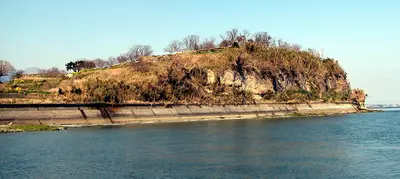
Photo:Saigen Jiro/Wikimedia Commons/CC0

Quick Facts

Quick Facts

Admission
Free Free
Hours
00:00 – 23:59
Nearest Station
Uto Station (JR Misumi Line)
Walk from Station
20 min walk
Time Needed
30 to 45 minutes

Entirely free. The ruins are on a public park hill. No facilities charge for entry.

Defense Overview

Defense Overview

Why Uto Castle was hard to attack

This castle is hard to attack because it combines a raised core with defended outer space with enough defensive depth to slow attackers before the center.

An attacker would not get a simple direct approach to the center. They would have to cross water barriers or moat lines and push through successive outer areas before the core.

Overall score

75/100

Estimated range

69–81

Confidence

B

Usable estimate with some inference

This is a site-original comparison score for learning and comparison, not a reconstruction of one historical battle.

Radar view

Terrain 15/20 Entrance 14/20 Internal 16/20 Siege 15/20 Oversight 15/20
How this estimate was built+

This estimate combines broad terrain, approach, layout, and route-control signals. It is meant to explain the castle's defensive logic in plain English, not reconstruct a single historical attack.

Terrain Advantage

How much the terrain itself seems to help: height, slope, ridges, cliffs, water edges, and limited approach directions.

15/20

Entrance Defense

How awkward and dangerous the first entry looks: gates, bridge or moat crossings, chokepoints, and forced turns.

14/20

Internal Complexity

How hard it seems to keep pushing after entry: layered baileys, depth, compartmentalization, and repeated defensive lines.

16/20

Siege Endurance

A rough sense of long-hold potential: moats, water access, space, storage plausibility, and defensive staying power.

15/20

Strategic Oversight

How much the castle appears to command nearby roads, plains, rivers, basins, harbors, or town approaches.

15/20

Why Visit

Uto Castle is most powerful as a biographical site — the place to contemplate Konishi Yukinaga's extraordinary life before visiting the Uto Tower at Kumamoto Castle that physically preserved something of his work. The ruins themselves are modest, but the Konishi story (merchant family, Christian general, Korean campaign vanguard, principled death at Sekigahara) is one of the most compelling individual biographies of the Sengoku period. Best visited as part of a Kumamoto area castle day combining Uto, Yatsushiro, and Kumamoto Castle.

Highlights

1

Konishi Yukinaga — The Christian Daimyo of Kyushu

Uto Castle was the seat of Konishi Yukinaga, one of the most remarkable figures of the late Sengoku period. Born into a merchant family, Konishi rose to become one of Hideyoshi's most trusted generals — a Christian daimyo who commanded the vanguard of the Korean invasion in 1592, established diplomatic contact with the Philippines and other Asian powers, and ultimately chose death over apostasy after his defeat at Sekigahara. His castle at Uto was the administrative center of a domain that represented Japan's most open engagement with the outside world.
2

The Mysterious 'Fifth Tower' at Kumamoto Castle

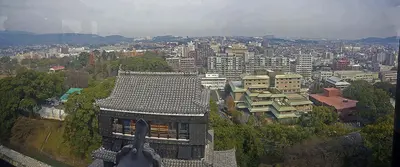
When Konishi Yukinaga was executed after Sekigahara and his domains were redistributed, Kato Kiyomasa — who became lord of Kumamoto — dismantled Uto Castle and used its materials in the construction of the new Kumamoto Castle. Castle historians believe the distinctive 'Uto Tower' (Uto Yagura) at Kumamoto Castle preserves construction elements or techniques from the demolished Uto Castle, making it effectively a piece of Uto physically embedded in Kumamoto's structure. The Uto Tower is the only original surviving tower at Kumamoto Castle.

3

Earthworks and Moats of the Western Kyushu Coast

Uto Castle's hilltop position commands the Ariake Sea coast and the Yatsushiro Sea approaches — the western maritime routes of Kyushu. Konishi Yukinaga's maritime background (merchant family turned naval commander) made coastal control a priority, and Uto Castle's position reflects this orientation toward the sea and toward the international trade routes that made his domain distinctive.

Structure Details

Visitor tip

Uto Castle ruins are a modest but historically interesting site best appreciated for the Konishi Yukinaga connection and the 'Uto Tower at Kumamoto Castle' story. The hilltop gives views of the Ariake Sea coast. Combine with a visit to Kumamoto Castle (35 minutes by car) where the surviving Uto Tower preserves an architectural memory of this site.

Castle type

Hill castle

Flatland hill castle — built on a low hill rising from the coastal plain of western Kumamoto, with views of the Ariake Sea

Layout type

Linked compound layout

Compound style — terraced compounds on the low hill, with earthwork and moat defenses compensating for the modest elevation

Main tower

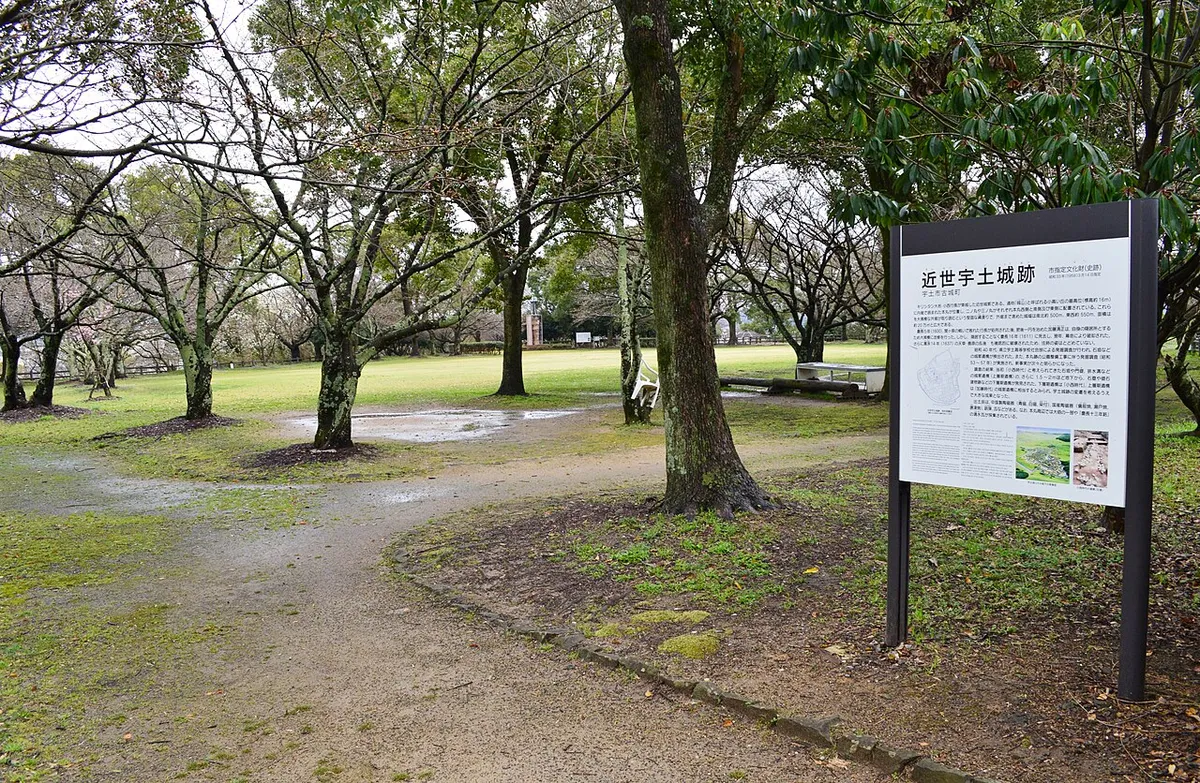
Ruins — no keep survives. Earthwork platforms, moat traces, and stone wall remnants remain on the hill. Most of the stone was removed by Kato Kiyomasa for use in Kumamoto Castle construction.

Stone walls

Natural stone stacking

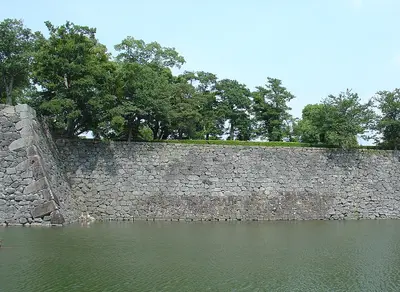
Surviving stone wall sections are fragmentary — much of Uto Castle's stone material was removed by Kato Kiyomasa for the construction of Kumamoto Castle after Konishi's fall in 1600. Earthwork platforms and moat traces give the clearest sense of the original layout.

Moats

Moat traces survive around the castle hill, though no longer water-filled. The moat system combined with the hill elevation to create a multi-layer defense appropriate for the coastal plain setting.

Key defensive features

Coastal Plain Hill Position

The castle's elevated position on a hill above the Kumamoto coastal plain provided visibility over the Ariake Sea approaches and the road network of western Kyushu. The flat surroundings meant any approaching force was visible at considerable distance.

Moat and Earthwork System

The combination of water moats and earthwork ramparts on the flat approaches compensated for the modest height of the castle hill, creating a multi-layer barrier system appropriate for a domain lord's administrative castle.

The Story of Uto Castle

Originally built 1588 / Konishi Yukinaga
Current form 1590 / Konishi Yukinaga (expansion and completion)
    1588

    Konishi Yukinaga, granted Uto domain by Toyotomi Hideyoshi, begins construction of Uto Castle as the administrative center of his coastal domain. His merchant family background gives him an instinct for accessible coastal positioning.

    1592

    Konishi leads the vanguard of the first Korean invasion (Bunroku no eki), commanding the troops that advance fastest into Korea and capture Seoul. His military success and his Christian faith (he is one of Hideyoshi's most prominent Christian generals) make him one of the most remarkable figures of the campaign.

    1600

    Konishi sides with the Western forces at Sekigahara. After the Western army's defeat, Konishi is captured. As a Christian who believed in the prohibition against suicide, he refuses to commit seppuku and instead accepts execution. His refusal to apostatize and his choice of Christian death over samurai death is one of the defining moments of Japanese Christian history.

    1601

    Kato Kiyomasa is awarded Konishi's former domains. He begins dismantling Uto Castle and using its materials — stones, timber, and skilled workers — in the construction of his new Kumamoto Castle, the most sophisticated castle of its era in Kyushu.

In Pop Culture

TV

Various Sengoku dramas featuring Konishi Yukinaga

Konishi Yukinaga appears in NHK dramas about Toyotomi Hideyoshi, the Korean campaigns, and Sekigahara. His distinctive status as a Christian general gives him a visual and narrative uniqueness in historical drama — cross-wearing samurai are a cinematically compelling paradox.

Did You Know?

  • The Uto Tower (Uto Yagura) at Kumamoto Castle is the only original surviving tower from the original 1607 construction — all other original Kumamoto towers were destroyed in the Seinan War (1877) or subsequent damage. The tower's alternate name directly acknowledges that it may incorporate elements or expertise from the demolished Uto Castle, creating a physical connection between the two sites.
  • Konishi Yukinaga's refusal to commit seppuku after Sekigahara caused controversy among his contemporaries — suicide was the expected response for a defeated samurai commander of his rank. His Christian conscience made seppuku impossible, and he accepted public execution instead. The incident is cited in Japanese Christian history as one of the clearest demonstrations of the conflict between samurai code and Christian ethics in the late Sengoku period.
  • The Ariake Sea, visible from Uto Castle's hilltop, is famous as one of the most productive fishing grounds in Japan, particularly for nori (seaweed) cultivation. The sea's extreme tidal range — up to 6 metres — creates the mudflat conditions that support this cultivation. Konishi Yukinaga's merchant family background likely made him attentive to the maritime trade potential of his coastal domain.

Score Breakdown

Tourism Score

F 35/100
  • Accessibility 7 /20
  • Foreign-Friendly 5 /20
  • Historical Value 12 /20
  • Visual Impact 7 /20
  • Facilities 4 /20

Defense Score

B 75/100
  • Terrain Advantage 15 /20
  • Entrance Defense 14 /20
  • Internal Complexity 16 /20
  • Siege Endurance 15 /20
  • Strategic Oversight 15 /20

Planning Your Visit

Best Time to Visit

Late March to early April for cherry blossoms around the moat area. Any season for the historical interest.

Time Needed

30 to 45 minutes

Insider Tip

After visiting Uto Castle, specifically seek out the Uto Tower at Kumamoto Castle and consider that you are looking at possible physical traces of what stood here — one castle quite literally incorporated into another. The Kumamoto Castle museum has good displays on the Konishi-to-Kato transition that explains the relationship between the two sites.

Map

Getting There

Nearest station: Uto Station (JR Misumi Line)
Walk from station: 20 min walk
Parking: Free parking at the castle park. Easy access by car from Route 57.
Accessible with a JR Pass

Admission

Free

Entirely free. The ruins are on a public park hill. No facilities charge for entry.

Opening Hours

Open00:00 – 23:59

Open at all times. The site is a public park. Cherry blossoms in late March to early April make the moat area particularly attractive.

Facilities

  • – English guides
  • – Audio guide
  • – Wheelchair access
  • ✓ Restrooms
  • – Gift shop
  • – Food nearby

Nearby Castles

Featured in collections

FAQ

Frequently Asked Questions

How do I get to Uto Castle?

The nearest station is Uto Station (JR Misumi Line). From there it is about 20 minutes on foot.

How much does Uto Castle cost to enter?

Uto Castle is free to enter.

Is Uto Castle worth visiting?

Uto Castle is most powerful as a biographical site — the place to contemplate Konishi Yukinaga's extraordinary life before visiting the Uto Tower at Kumamoto Castle that physically preserved something of his work. The ruins themselves are modest, but the Konishi story (merchant family, Christian general, Korean campaign vanguard, principled death at Sekigahara) is one of the most compelling individual biographies of the Sengoku period. Best visited as part of a Kumamoto area castle day combining Uto, Yatsushiro, and Kumamoto Castle.

What are the opening hours of Uto Castle?

00:00 to 23:59.

How long should I spend at Uto Castle?

Plan for about 30 to 45 minutes, depending on how closely you want to explore the grounds.