Fukui Castle

福井城·Fukui-jo

D Tourism Score 40/100
C Defense Score 66/100

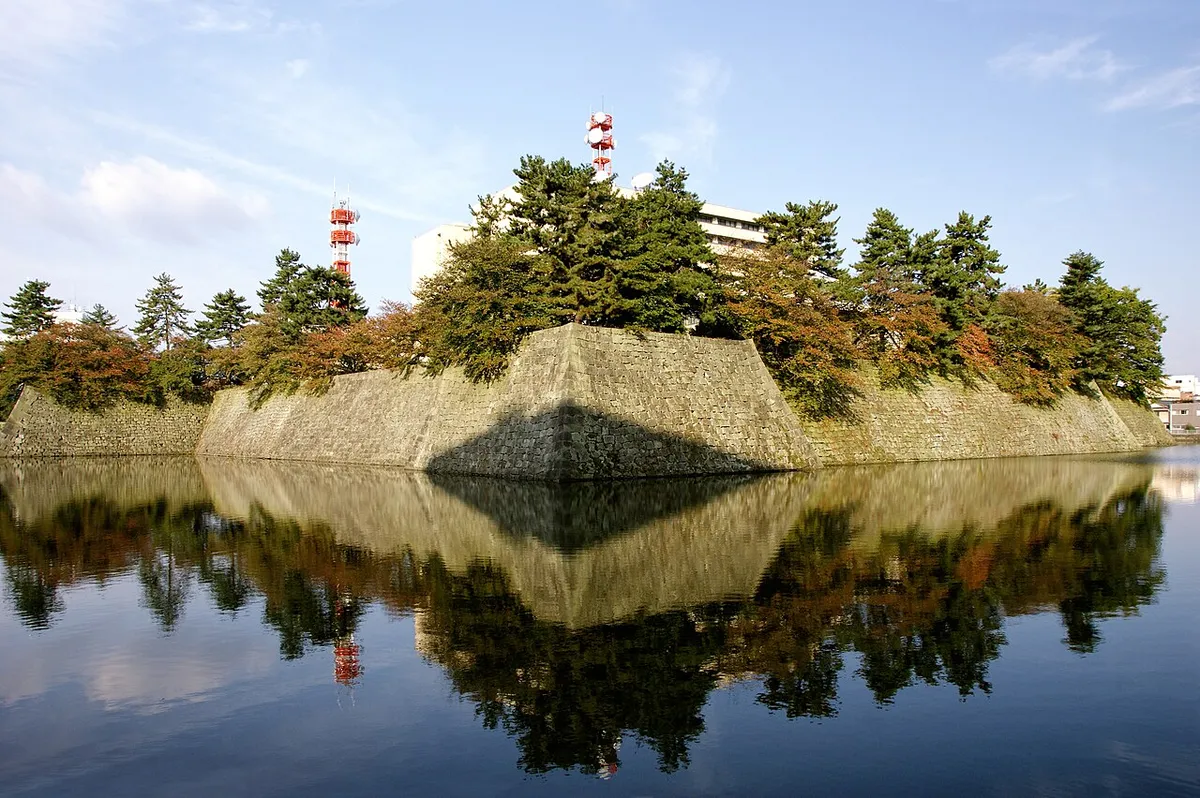
A government inside a castle — the original Edo-period moats and stone walls of Fukui domain's capital, now surrounding a modern prefectural government office.

#137 — Continued 100 Castles Ruins
Fukui Castle (福井城)
Photo:663highland/Wikimedia Commons/CC BY 2.5

Quick Facts

Quick Facts

Admission
Free Free
Hours
00:00 – 23:59
Nearest Station
Fukui Station (JR Hokuriku Main Line / Hokuriku Shinkansen)
Walk from Station
10 min walk
Time Needed
30–45 minutes for a thorough moat circuit

The castle grounds and moats are fully free to visit at all times — they form the open grounds of Fukui Prefectural Government. No admission charged anywhere on site.

Defense Overview

Defense Overview

Why Fukui Castle was hard to attack

This castle is hard to attack because attackers have to work across water barriers before pressing inward instead of getting a direct run at the core.

An attacker would not simply arrive at the center on open flat ground. They would have to cross water barriers or moat lines, approach through at least some constrained entry space, and push through successive outer areas before the core.

Overall score

66/100

Estimated range

60–72

Confidence

B

Usable estimate with some inference

This is a site-original comparison score for learning and comparison, not a reconstruction of one historical battle.

Radar view

Terrain 11/20 Entrance 13/20 Internal 15/20 Siege 15/20 Oversight 12/20
How this estimate was built+

This estimate combines broad terrain, approach, layout, and route-control signals. It is meant to explain the castle's defensive logic in plain English, not reconstruct a single historical attack.

Terrain Advantage

How much the terrain itself seems to help: height, slope, ridges, cliffs, water edges, and limited approach directions.

11/20

Entrance Defense

How awkward and dangerous the first entry looks: gates, bridge or moat crossings, chokepoints, and forced turns.

13/20

Internal Complexity

How hard it seems to keep pushing after entry: layered baileys, depth, compartmentalization, and repeated defensive lines.

15/20

Siege Endurance

A rough sense of long-hold potential: moats, water access, space, storage plausibility, and defensive staying power.

15/20

Strategic Oversight

How much the castle appears to command nearby roads, plains, rivers, basins, harbors, or town approaches.

12/20

Why Visit

Fukui Castle is primarily interesting for its extraordinary contextual situation — a functioning democratic government operating from inside feudal-era water moats — and for the quality of the surviving stone walls on the western face. It's a quick visit from Fukui Station (now on the Hokuriku Shinkansen) and pairs excellently with the Ichijodani Asakura clan ruins a short distance away, which offers the more dramatic ruin experience.

Highlights

1

A Government Inside a Castle

Fukui Castle's most remarkable aspect is what stands inside its original moats today: the entire Fukui Prefectural Government complex — office buildings, assembly hall, and parking lots — occupying the castle's Honmaru and inner compound areas. The original stone walls and water moats that once protected the Fukui domain's lord now protect a democratically elected regional government. The juxtaposition is distinctly Japanese in its pragmatic relationship with historical space.
2

Intact Original Moats

While most of the castle's structures are gone, the original water moats (wide, still water-filled) and substantial ishigaki stone walls are largely intact and create a genuinely impressive castle atmosphere — particularly the view from the west side where a long stone wall and moat still look very much as they did in the Edo period.

3

The Tokugawa Branch Domain

Fukui Castle was the seat of the Fukui (Echizen Matsudaira) domain — one of the most important Tokugawa branch families (gosanke-adjacent). The Fukui domain lords were trusted relatives of the Tokugawa shogunate, and the castle's status reflected this political importance even as its physical form remained more modest than shogunal castles.

Structure Details

Visitor tip

Fukui Castle is best approached as a walk around the moats rather than a visit to interior structures. The best viewing points are from the western moat side, where the stone walls and water moat present a coherent castle picture. Then cross into the compound area (freely accessible as government grounds) to see the main stone wall faces from inside. The Yamazato-guchi gate area is the most photogenic surviving architectural element.

Castle type

Flatland castle

Flatland castle — built on level ground in the Echizen plain, relying entirely on water moats for defense

Layout type

Concentric layout

Ring-style — concentric moat and wall system around a central Honmaru compound

Main tower

Ruins — stone walls and moats survive; the tenshu was destroyed in the 1669 earthquake and never rebuilt. The Prefectural Government occupies the former main compound.

Stone walls

Natural stone stacking

The ishigaki stone walls of Fukui Castle are original Edo-period construction — tall, well-preserved sections face the moat on the western and southern sides. These walls are among the most impressive surviving elements, giving a clear picture of the castle's original fortified character despite the modern buildings within.

Moats

Original water moats survive largely intact, filling the original castle defensive channels. The moat system is visible and water-filled, particularly on the west and north sides — wide, still-water moats backed by tall stone walls create the clearest surviving impression of the castle's original defensive appearance.

Key defensive features

Water Moat System (Surviving)

The original water moats provide the primary surviving defensive element — still filled, wide, and backed by stone walls on multiple sides. The moat system would have made approaches to the castle walls extremely difficult without bridging equipment.

Tall Ishigaki Stone Walls

The surviving stone walls on the western and southern faces are among the best-preserved aspects of the castle — tall, clean-faced stone walls rising directly from the moat water edge, presenting an imposing barrier to any theoretical attacker.

Yamazato-guchi Gate Remains

The Yamazato-guchi gate foundation and surrounding stone wall section is the best-preserved gateway area of the castle, giving a clear picture of the castle's entrance architecture at a key approach point.

The Story of Fukui Castle

Originally built 1601 / Yuki Hideyasu (Tokugawa Ieyasu's second son)
Current form 1624 / Matsudaira Mitsunaga (expanded)
    1601

    Yuki Hideyasu, the second son of Tokugawa Ieyasu, begins construction of Fukui Castle in Echizen Province following the Tokugawa victory at Sekigahara. Hideyasu is one of the most powerful Tokugawa relatives, and the Echizen domain becomes one of the largest outside the direct Tokugawa holdings.

    1624

    Matsudaira Mitsunaga completes a major expansion of the castle complex, establishing the full moat and compound system that survives (partially) today. The Fukui Matsudaira domain settles into its Edo-period role as a major Tokugawa-aligned branch domain.

    1669

    A major earthquake destroys the castle's tenshu (main tower). The Tokugawa shogunate has, by this period, prohibited reconstruction of castle towers without specific permission — a policy designed to prevent any domain from rebuilding military capability. The Fukui tenshu is never rebuilt, and the castle's tower-less appearance from this point becomes permanent.

    1871

    The Meiji government abolishes the domain system (haihan chiken). The Fukui domain is replaced by Fukui Prefecture, and the castle immediately becomes the seat of the prefectural government — a function it has served continuously ever since.

    1948

    The Fukui earthquake (magnitude 7.1) causes catastrophic damage to the city, killing over 3,700 people and destroying most of central Fukui. The castle's stone walls and moats survive but various remaining historical structures are damaged. Post-war reconstruction builds the current prefectural government complex within the original castle moats.

In Pop Culture

other

Matsudaira Shungaku historical accounts

Matsudaira Yoshinaga (Shungaku), the 16th lord of Fukui domain who lived in Fukui Castle during the turbulent Bakumatsu period (1850s–1860s), was one of the most influential political figures of the late Edo period. His role in the debates that led to the Meiji Restoration is documented in numerous historical studies.

Did You Know?

  • Fukui Castle is one of the very few castle sites in Japan where the original main compound (Honmaru) is still in continuous official governmental use — the Fukui Prefectural Government has operated from inside the castle's original moats without interruption since 1871. This makes the transition from feudal domain capital to democratic prefectural government remarkably direct.
  • The Fukui domain's most famous lord, Matsudaira Shungaku (Yoshinaga), was so politically significant during the Bakumatsu period that he was made head of the national government's political council (Seiji Sosai) in 1862 — effectively the most powerful official in Japan for a brief period. He lived in Fukui Castle.
  • Fukui Prefecture is home to over 90% of Japan's eyeglass frame production — the Sabae area of Fukui produces frames that supply opticians worldwide. The city of Fukui, protected in the Edo period by the castle's moats, now exports an unglamorous but globally significant industrial product.

Score Breakdown

Tourism Score

D 40/100
  • Accessibility 13 /20
  • Foreign-Friendly 7 /20
  • Historical Value 10 /20
  • Visual Impact 6 /20
  • Facilities 4 /20

Defense Score

C 66/100
  • Terrain Advantage 11 /20
  • Entrance Defense 13 /20
  • Internal Complexity 15 /20
  • Siege Endurance 15 /20
  • Strategic Oversight 12 /20

Planning Your Visit

Best Time to Visit

Year-round accessible — the moat walk is pleasant in all seasons. Cherry blossom season (late March to early April) adds atmosphere to the moat surroundings.

Time Needed

30–45 minutes for a thorough moat circuit

Insider Tip

Walk the full perimeter of the inner moat rather than just viewing the main gate — the western face, where the tallest stone walls rise directly from the moat water, is the most impressive section and is often bypassed by visitors who come only for the government building entrance. The contrast between the Edo-period stone walls and the 1950s government buildings within is most stark from this angle.

Map

Getting There

Nearest station: Fukui Station (JR Hokuriku Main Line / Hokuriku Shinkansen)
Walk from station: 10 min walk
Parking: Government parking lots available on weekdays for official business; public parking nearby. Walking from the station is strongly recommended.
Accessible with a JR Pass

Admission

Free

The castle grounds and moats are fully free to visit at all times — they form the open grounds of Fukui Prefectural Government. No admission charged anywhere on site.

Opening Hours

Open00:00 – 23:59

The grounds are publicly accessible at all times, though the government buildings obviously operate on standard business hours. The moats, stone walls, and Yamazato-guchi gate can be viewed 24 hours.

Facilities

  • – English guides
  • – Audio guide
  • ✓ Wheelchair access
  • ✓ Restrooms
  • – Gift shop
  • ✓ Food nearby

Nearby Castles

Featured in collections

FAQ

Frequently Asked Questions

How do I get to Fukui Castle?

The nearest station is Fukui Station (JR Hokuriku Main Line / Hokuriku Shinkansen). From there it is about 10 minutes on foot.

How much does Fukui Castle cost to enter?

Fukui Castle is free to enter.

Is Fukui Castle worth visiting?

Fukui Castle is primarily interesting for its extraordinary contextual situation — a functioning democratic government operating from inside feudal-era water moats — and for the quality of the surviving stone walls on the western face. It's a quick visit from Fukui Station (now on the Hokuriku Shinkansen) and pairs excellently with the Ichijodani Asakura clan ruins a short distance away, which offers the more dramatic ruin experience.

What are the opening hours of Fukui Castle?

00:00 to 23:59.

How long should I spend at Fukui Castle?

Plan for about 30–45 minutes for a thorough moat circuit, depending on how closely you want to explore the grounds.