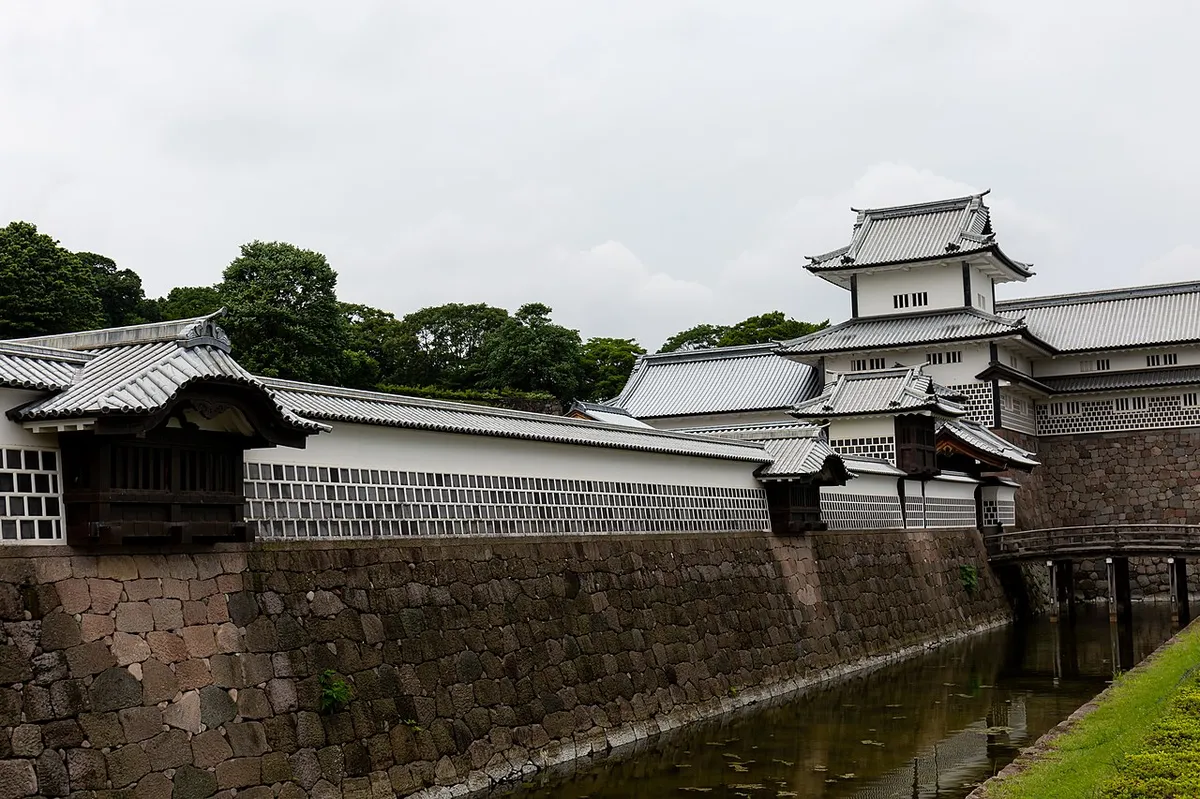
Kanazawa Castle

金沢城·Kanazawa-jo

B Tourism Score 78/100
D Defense Score 59/100

The silver-roofed castle of Japan's wealthiest samurai clan — best experienced alongside Kenrokuen, the garden that its lords spent 300 years perfecting next door.

#35 — 100 Famous Castles Reconstructed
Kanazawa Castle (金沢城)
Photo:Balon Greyjoy/Wikimedia Commons/CC0

Quick Facts

Quick Facts

Admission
Free Free
Hours
07:00 – 18:00

Last entry 17:30

Nearest Station
Kanazawa Station (JR Hokuriku Shinkansen / Hokuriku Main Line)
Walk from Station
25 min walk

Bus also available

Time Needed
1-1.5 hours castle, 1.5-2 hours Kenrokuen Garden; plan a half-day for both

Castle grounds (Kanazawa Castle Park) are free to enter. Admission of ¥320 is charged for specific reconstructed buildings: the Hishi Yagura turret, the Gojikken Nagaya storehouse, and the Hashizume-mon Tsuzuki Yagura. Combined ticket with Kenrokuen Garden available.

Defense Overview

Defense Overview

Why Kanazawa Castle was hard to attack

This castle is hard to attack because attackers have to work through successive outer spaces before the core instead of getting a direct run at the core.

An attacker would not simply arrive at the center on open flat ground. They would have to cross water barriers or moat lines and face more defensive depth after the first line.

Overall score

59/100

Estimated range

53–65

Confidence

B

Usable estimate with some inference

This is a site-original comparison score for learning and comparison, not a reconstruction of one historical battle.

Radar view

Terrain 10/20 Entrance 10/20 Internal 16/20 Siege 13/20 Oversight 10/20
How this estimate was built+

This estimate combines broad terrain, approach, layout, and route-control signals. It is meant to explain the castle's defensive logic in plain English, not reconstruct a single historical attack.

Terrain Advantage

How much the terrain itself seems to help: height, slope, ridges, cliffs, water edges, and limited approach directions.

10/20

Entrance Defense

How awkward and dangerous the first entry looks: gates, bridge or moat crossings, chokepoints, and forced turns.

10/20

Internal Complexity

How hard it seems to keep pushing after entry: layered baileys, depth, compartmentalization, and repeated defensive lines.

16/20

Siege Endurance

A rough sense of long-hold potential: moats, water access, space, storage plausibility, and defensive staying power.

13/20

Strategic Oversight

How much the castle appears to command nearby roads, plains, rivers, basins, harbors, or town approaches.

10/20

Why Visit

Kanazawa is Japan's most underrated major cultural city, and the castle-garden combination here is exceptional. The free castle grounds reward extended exploration — the reconstructed wooden buildings are among the finest examples of traditional castle architecture built in modern times. Paired with Kenrokuen immediately next door, this is a half-day of some of Japan's best historical and garden scenery. The city itself — with intact geisha districts, samurai residential areas, and exceptional local food — deserves at least two days.

Highlights

1

White Lead Tiles: Unique in Japan

Kanazawa Castle is instantly recognizable for its roofs — covered not in ceramic tiles or wood shingles but in lead-coated tiles ('namari-gawara'), giving the castle a distinctive silver-white appearance. Lead was chosen for its durability in Kanazawa's heavy snowfall, and it creates an appearance unlike any other castle in Japan.
2

Next Door to Kenrokuen: Japan's Most Beautiful Garden

Kanazawa Castle sits immediately adjacent to Kenrokuen, consistently ranked among Japan's top three traditional gardens. The two sites share a border — you can walk directly from the castle compound into the garden. Together they form the finest castle-garden complex in Japan outside of Kyoto.

3

Modern Wood Reconstruction Done Right

The Hishi Yagura turret, Gojikken Nagaya storehouse, and Hashizume-mon Tsuzuki Yagura were reconstructed in 2001 using traditional wooden construction methods — carpenters used hand tools and traditional joinery techniques to create buildings that match original historical records precisely. The result is arguably the finest example of authentically-built castle reconstruction in modern Japan.

4

Maeda Clan: Japan's Wealthiest Domain

The Maeda clan of Kaga domain ruled from Kanazawa Castle and controlled a rice production of one million koku — the largest domain outside the Tokugawa family itself. This extraordinary wealth made Kanazawa one of Japan's great cultural cities, supporting traditional crafts (gold leaf, Kenzan pottery, Kutani ware, Noh theater) that survive vibrantly today.

Structure Details

Visitor tip

Enter through Kahoku-mon Gate from the Kenrokuen side — the gate complex gives a good introduction to the castle's defensive layers before entering the open park interior. The Hishi Yagura compound has a small admission fee but is worth it for the authentic wooden interior. Plan to visit both the castle and Kenrokuen Garden in the same trip — they're immediately adjacent.

Castle type

Flatland castle

Flatland castle — built on a low bluff between the Asano and Sai rivers, with the rivers providing natural flanking defense

Layout type

Linked compound layout

Compound style — main compound connected to subsidiary compounds via gates and covered corridors

Main tower

Partial wooden reconstruction (2001–2020) — several major structures reconstructed in traditional wood using period-accurate techniques: Hishi Yagura (1999), Gojikken Nagaya (2001), Hashizume-mon Tsuzuki Yagura (2020). The main tower (tenshu) has not yet been reconstructed.

Stone walls

Natural stone stacking

Kanazawa Castle's stone walls feature a distinctive combination of nozurazumi (natural stone) and kirikomi-hagi (cut stone) techniques used in different sections, visible in the surviving original walls throughout the compound. The walls are well-preserved and form one of the castle's strongest visual features.

Moats

The castle's inner moat (Otehori) partially survives on the east side, now a stone-walled channel. The Asano and Sai rivers flanking the castle site served as natural outer defenses.

Key defensive features

River Flank Defense

The castle sits on a bluff between two rivers — the Asano River to the north and the Sai River to the south — providing natural moats on the flanking sides. The castle had to be approached primarily from the east or west, limiting attack vectors.

Lead-Tile Roofs (Functional Design)

Beyond their aesthetic uniqueness, the lead tiles provided practical benefits: lead is highly fire-resistant, addressing the constant threat of castle fires that destroyed many other castles. The choice reflects Kaga domain's wealth (lead was expensive) and pragmatic engineering.

Gojikken Nagaya (50-Bay Storehouse)

The long storehouse along the inner compound wall was not just storage — its design allows defenders to fire from loopholes along its entire length, creating a defensive wall with built-in garrison capability. The reconstructed building preserves these original loophole designs.

The Story of Kanazawa Castle

Originally built 1583 / Maeda Toshiie
Current form 2001 / Ishikawa Prefecture
    1583

    Maeda Toshiie, one of Toyotomi Hideyoshi's most trusted generals, enters Kanazawa and begins construction of a proper castle befitting his status as lord of the wealthiest domain outside the Tokugawa family.

    1602

    A massive fire destroys the main tower (tenshu). The Maeda clan rebuilds much of the castle but the main tower is not reconstructed — a decision that left Kanazawa without a tenshu for over 400 years.

    1759

    Another devastating fire destroys most of the castle's buildings, leaving primarily the Ishikawa-mon Gate and stone walls intact. The gate (built 1788) is now the most famous surviving original structure.

    1871

    The Meiji government takes control of the castle and converts it to military use as a Japanese Army barracks — a fate that paradoxically preserved the stone walls while precluding civilian restoration.

    1997

    Kanazawa University (which had occupied the site after the military) relocates, freeing the castle grounds for restoration. Ishikawa Prefecture begins a long-term program to reconstruct the castle's historical structures.

    2001

    The Gojikken Nagaya storehouse and Hishi Yagura turret open after meticulous wooden reconstruction using traditional techniques — widely praised as a model for authentic castle restoration in Japan.

    2020

    The Hashizume-mon Tsuzuki Yagura is completed, continuing the restoration program. Plans for eventual tenshu reconstruction remain under discussion.

In Pop Culture

TV

Various travel and cultural programs

Kanazawa and its castle regularly appear in Japanese travel television as the centerpiece of Hokuriku culture, often paired with coverage of Kenrokuen Garden and Kanazawa's traditional crafts.

Did You Know?

  • The lead tiles on Kanazawa Castle's roofs require periodic maintenance — the Ishikawa Prefecture employs specialized craftsmen trained in traditional lead roofing techniques, a dying skill kept alive specifically for this castle.
  • Kanazawa was one of very few major Japanese cities not heavily bombed during WWII, leaving its traditional townscape — including geisha districts, samurai residences, and temple areas — remarkably intact alongside the castle.
  • The Maeda clan's one-million-koku rice production figure made Kaga domain the third most powerful entity in Japan after the Tokugawa shogunate and the Imperial Court — yet they maintained this position for 265 years entirely through political calculation rather than military challenge.
  • Kenrokuen Garden, directly adjacent to the castle, contains a stone lantern (Kotoji-toro) that is arguably the most photographed object in Kanazawa — its two-legged design is unique and has become the symbol of the city.

Score Breakdown

Tourism Score

B 78/100
  • Accessibility 14 /20
  • Foreign-Friendly 15 /20
  • Historical Value 16 /20
  • Visual Impact 17 /20
  • Facilities 16 /20

Defense Score

D 59/100
  • Terrain Advantage 10 /20
  • Entrance Defense 10 /20
  • Internal Complexity 16 /20
  • Siege Endurance 13 /20
  • Strategic Oversight 10 /20

Planning Your Visit

Best Time to Visit

All seasons offer distinct appeal: cherry blossoms in April, lush green in summer, spectacular foliage in November, and snow-covered castle and garden in winter (January–February) create the iconic silver-and-white scene. Kanazawa receives heavy snow — a benefit for aesthetics, less so for comfort.

Time Needed

1-1.5 hours castle, 1.5-2 hours Kenrokuen Garden; plan a half-day for both

Insider Tip

The walk between the castle's Ishikawa-mon Gate and Kenrokuen's main entrance is less than 100 meters — go back and forth freely. For the castle interior buildings, visit the Hishi Yagura early (opens 9:00) before crowds arrive. The Seisonkaku Villa adjacent to Kenrokuen is often skipped but is a superb example of Edo-period aristocratic architecture worth the additional entry fee.

Map

Getting There

Nearest station: Kanazawa Station (JR Hokuriku Shinkansen / Hokuriku Main Line)
Walk from station: 25 min walk
Bus: Kanazawa Loop Bus 'Kenroku' stops at Kenrokuen-shita (adjacent to castle). ¥200 per ride. Recommended over walking from the station.
Parking: Paid parking available near Kenrokuen Garden entrance. Busiest on weekends; arrive early.
Accessible with a JR Pass

Admission

Free

Castle grounds (Kanazawa Castle Park) are free to enter. Admission of ¥320 is charged for specific reconstructed buildings: the Hishi Yagura turret, the Gojikken Nagaya storehouse, and the Hashizume-mon Tsuzuki Yagura. Combined ticket with Kenrokuen Garden available.

Opening Hours

Open07:00 – 18:00
Last entry17:30

Park open year-round 7:00–18:00 (October–February: closes at 17:00). Reconstructed buildings open 09:00. Closed December 29–31.

Facilities

  • – English guides
  • – Audio guide
  • ✓ Wheelchair access
  • ✓ Restrooms
  • ✓ Gift shop
  • ✓ Food nearby

Nearby Castles

Featured in collections

FAQ

Frequently Asked Questions

How do I get to Kanazawa Castle?

The nearest station is Kanazawa Station (JR Hokuriku Shinkansen / Hokuriku Main Line). From there it is about 25 minutes on foot. Kanazawa Loop Bus 'Kenroku' stops at Kenrokuen-shita (adjacent to castle). ¥200 per ride. Recommended over walking from the station.

How much does Kanazawa Castle cost to enter?

Kanazawa Castle is free to enter.

Is Kanazawa Castle worth visiting?

Kanazawa is Japan's most underrated major cultural city, and the castle-garden combination here is exceptional. The free castle grounds reward extended exploration — the reconstructed wooden buildings are among the finest examples of traditional castle architecture built in modern times. Paired with Kenrokuen immediately next door, this is a half-day of some of Japan's best historical and garden scenery. The city itself — with intact geisha districts, samurai residential areas, and exceptional local food — deserves at least two days.

What are the opening hours of Kanazawa Castle?

07:00 to 18:00, last entry 17:30.

How long should I spend at Kanazawa Castle?

Plan for about 1-1.5 hours castle, 1.5-2 hours Kenrokuen Garden; plan a half-day for both, depending on how closely you want to explore the grounds.