Maruoka Castle

丸岡城·Maruoka-jo

D Tourism Score 55/100
B Defense Score 72/100

Possibly Japan's oldest castle tower — small, dark, and steep-staircased, Maruoka's ancient authenticity makes it a pilgrimage for serious castle enthusiasts.

#36 — 100 Famous Castles Surviving
Maruoka Castle (丸岡城)
Photo:Supermidget/Wikimedia Commons/Public domain

Quick Facts

Quick Facts

Admission
¥450

¥150

Hours
08:30 – 17:00

Last entry 16:30

Nearest Station
Maruoka Station (Echizen Railway Mikuni-Awara Line)
Walk from Station
25 min walk

Bus also available

Time Needed
1-2 hours

Combined ticket with Ichijo-dani Asakura Clan Ruins available. Children (elementary school age and under) free.

Defense Overview

Defense Overview

Why Maruoka Castle was hard to attack

This castle is hard to attack because it combines a raised core with defended outer space with enough defensive depth to slow attackers before the center.

An attacker would not get a simple direct approach to the center. They would have to cross water barriers or moat lines.

Overall score

72/100

Estimated range

66–78

Confidence

A

Strong multi-source support

This is a site-original comparison score for learning and comparison, not a reconstruction of one historical battle.

Radar view

Terrain 15/20 Entrance 14/20 Internal 16/20 Siege 14/20 Oversight 13/20
How this estimate was built+

This estimate combines broad terrain, approach, layout, and route-control signals. It is meant to explain the castle's defensive logic in plain English, not reconstruct a single historical attack.

Terrain Advantage

How much the terrain itself seems to help: height, slope, ridges, cliffs, water edges, and limited approach directions.

15/20

Entrance Defense

How awkward and dangerous the first entry looks: gates, bridge or moat crossings, chokepoints, and forced turns.

14/20

Internal Complexity

How hard it seems to keep pushing after entry: layered baileys, depth, compartmentalization, and repeated defensive lines.

16/20

Siege Endurance

A rough sense of long-hold potential: moats, water access, space, storage plausibility, and defensive staying power.

14/20

Strategic Oversight

How much the castle appears to command nearby roads, plains, rivers, basins, harbors, or town approaches.

13/20

Why Visit

Maruoka is for visitors who care about authentic age over impressive scale. If the traditional 1576 date is correct, you are standing in what may be the oldest surviving castle tower in Japan — a remarkable thing to contemplate. Even if the date is debated, the castle's primitive stonework, stone roof tiles, and extraordinarily steep interior stairs communicate genuine antiquity. Cherry blossom season is beautiful.

Highlights

1

Possibly the Oldest Surviving Castle Tower in Japan

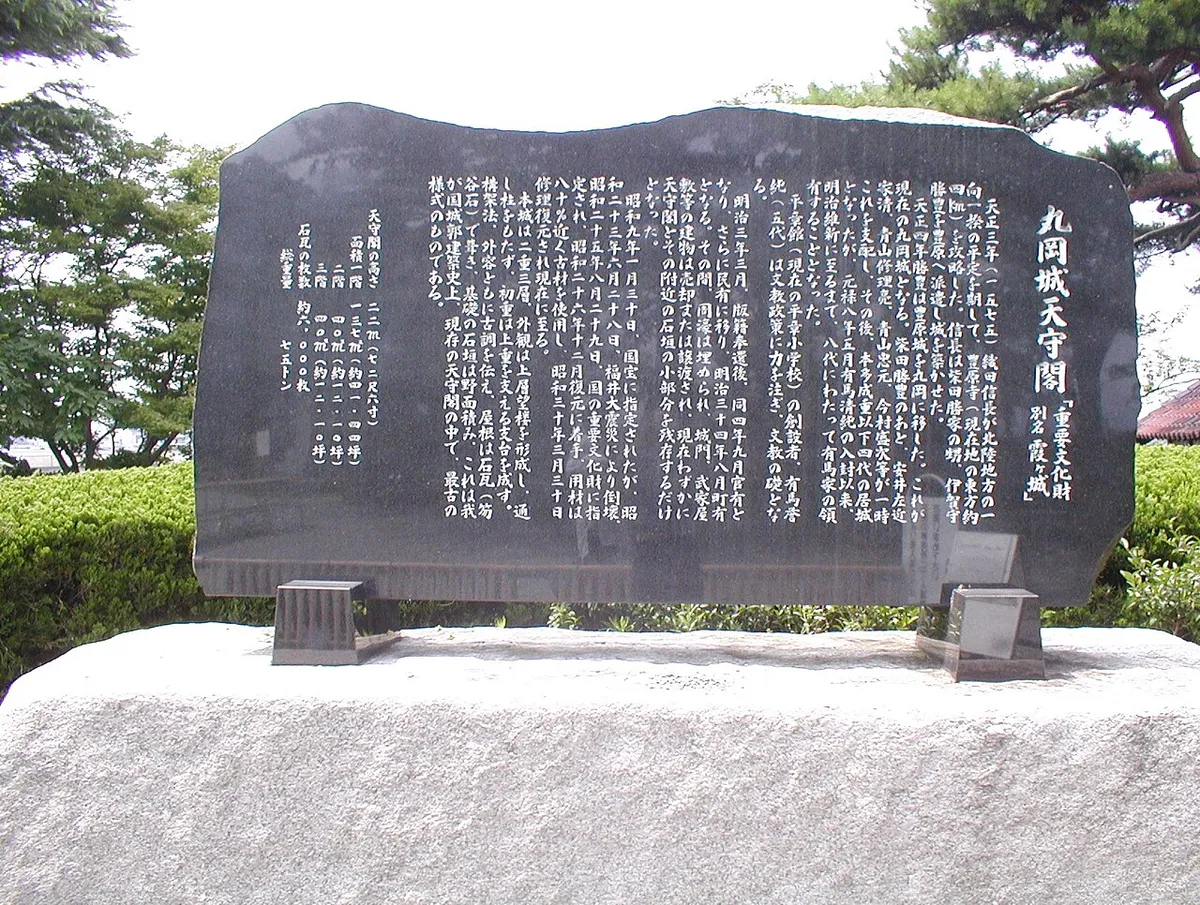
Maruoka Castle's two-story tower is often cited as the oldest surviving tenshu in Japan, traditionally dated to 1576 — which would make it older than Himeji, Matsumoto, and all others. This claim is debated by historians, but whether or not it wins the age contest, it is certainly one of the most ancient and authentic castle structures in the country.
2

Kasumi-ga-jo: The Mist Castle

Maruoka Castle's poetic nickname is 'Kasumi-ga-jō' — the Mist Castle. On spring mornings and autumn evenings, mist rises from the surrounding fields and town to partially obscure the small dark tower, creating an atmospheric scene that inspired the name and still rewards patient photographers.

3

Steep Stairs, Slippery History

The interior ladder-like staircases are among the steepest in any Japanese castle tower — a rope handrail is provided for climbing. These precipitous stairs are original and have remained unchanged for centuries, giving visitors a visceral sense of what it was like to move through a medieval Japanese castle under urgency.

Structure Details

Visitor tip

The tower interior is very small with extremely steep stairs — a rope handrail is provided. Visitors with mobility concerns or fear of heights may find the interior challenging. The grounds are pleasant and the cherry blossom season is excellent. The tower takes about 20 minutes to explore.

Castle type

Hill castle

Flatland hill castle — a small, low hill rising from the surrounding plains of Echizen

Layout type

Linked compound layout

Compound style — main tower connected to surrounding walls and secondary structures

Main tower

Original wooden tenshu (main keep) — possibly the oldest surviving castle tower in Japan, traditionally dated to 1576 (date debated by historians)

17m2 floors, 1 below

Stone walls

Natural stone stacking

The stone walls of Maruoka are characteristic of early Japanese castle construction — rough, uncut stones piled naturally, quite different from the precisely fitted walls of later castles. The primitive style reinforces the sense that this is one of Japan's oldest surviving castle complexes.

Moats

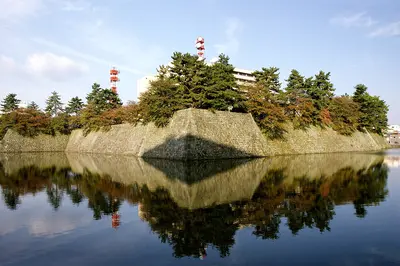
A water-filled moat surrounds the main castle area, now a pleasant feature for cherry blossom viewing rather than a military defense.

Key defensive features

Early Stone Wall Technique

The rough nozurazumi stonework represents some of the earliest Japanese castle wall construction, predating the sophisticated fitted-stone techniques of later eras. Though less refined, the thick walls were durable.

Moat

A surrounding moat provided the primary water defense, compensating for the modest elevation of the hill site.

The Story of Maruoka Castle

Originally built 1576 / Shibata Katsutoyo
Current form 1576 / Shibata Katsutoyo
    1576

    Shibata Katsutoyo, nephew of the powerful general Shibata Katsuie, builds Maruoka Castle as a base for controlling Echizen Province. The tower traditionally dated to this year is the subject of ongoing historical debate.

    1631

    The Honda clan takes control of Maruoka domain and carries out renovations to the castle. Some historians argue the current tower dates to this period rather than 1576.

    1948

    A major earthquake severely damages the main tower, causing it to collapse. The fallen structure is carefully reassembled using the original timbers and stones between 1955 and 1957 — earning it the designation of 'restored' by some, though the materials are largely original.

    1955

    Full-scale restoration of the collapsed tower begins, meticulously reconstructing it from the original fallen timbers. The restored tower is designated an Important Cultural Property.

Did You Know?

  • The age debate around Maruoka Castle centers on whether the current tower dates to 1576 (Shibata Katsutoyo's construction) or 1631 (Honda clan renovations). Dendrochronological studies have produced inconclusive results, and the debate continues among castle historians.
  • The 1948 Fukui earthquake was one of Japan's most destructive post-war natural disasters. That the original timbers of the fallen tower were carefully preserved and used in reconstruction reflects the deep local attachment to the castle.
  • The castle's stone roof tiles (ishigawara) are a rare surviving example — most castles used fired ceramic tiles, but Maruoka's stone tiles were practical in the heavy snow climate of Fukui.
  • A local legend says the castle is haunted by the ghost of Oshizu, a woman who agreed to be buried alive in the walls as a 'pillar sacrifice' (hitobashira) in exchange for her son receiving a samurai position. The castle's spring moat flooding is attributed to her tears.

Score Breakdown

Tourism Score

D 55/100
  • Accessibility 10 /20
  • Foreign-Friendly 9 /20
  • Historical Value 17 /20
  • Visual Impact 12 /20
  • Facilities 7 /20

Defense Score

B 72/100
  • Terrain Advantage 15 /20
  • Entrance Defense 14 /20
  • Internal Complexity 16 /20
  • Siege Endurance 14 /20
  • Strategic Oversight 13 /20

Planning Your Visit

Best Time to Visit

Late March to mid-April for cherry blossoms. Autumn is pleasant. The castle is open year-round but winter in Fukui can be snowy — which actually suits the atmospheric 'Mist Castle' nickname well.

Time Needed

1-2 hours

Insider Tip

The stone roof tiles (ishigawara) are genuinely unusual and worth looking for — most Japanese castle towers use ceramic tiles, but Maruoka's stone tiles reflect the heavy-snow climate of Fukui and are one of the features that support arguments for its great age. Also look for the rough, uncut nozurazumi stonework in the walls — it has a primitive quality very different from the later, more sophisticated castle-building styles.

Map

Getting There

Nearest station: Maruoka Station (Echizen Railway Mikuni-Awara Line)
Walk from station: 25 min walk
Bus: Bus from Fukui Station to Maruoka area. Taxi recommended for final approach.
Parking: Free parking available near the castle. Easy car access from Fukui City (about 20 minutes by car).

Admission

Adult¥450
Child¥150

Combined ticket with Ichijo-dani Asakura Clan Ruins available. Children (elementary school age and under) free.

Opening Hours

Open08:30 – 17:00
Last entry16:30

Open year-round. Spring cherry blossom events extend hours. NOTICE: Major seismic renovation planned Dec 2025 – Nov 2027; check official site for closures.

Facilities

  • – English guides
  • – Audio guide
  • – Wheelchair access
  • ✓ Restrooms
  • ✓ Gift shop
  • ✓ Food nearby

Nearby Castles

Featured in collections

FAQ

Frequently Asked Questions

How do I get to Maruoka Castle?

The nearest station is Maruoka Station (Echizen Railway Mikuni-Awara Line). From there it is about 25 minutes on foot. Bus from Fukui Station to Maruoka area. Taxi recommended for final approach.

How much does Maruoka Castle cost to enter?

Adult admission is ¥450 and child admission is ¥150.

Is Maruoka Castle worth visiting?

Maruoka is for visitors who care about authentic age over impressive scale. If the traditional 1576 date is correct, you are standing in what may be the oldest surviving castle tower in Japan — a remarkable thing to contemplate. Even if the date is debated, the castle's primitive stonework, stone roof tiles, and extraordinarily steep interior stairs communicate genuine antiquity. Cherry blossom season is beautiful.

What are the opening hours of Maruoka Castle?

08:30 to 17:00, last entry 16:30.

How long should I spend at Maruoka Castle?

Plan for about 1-2 hours, depending on how closely you want to explore the grounds.