Iwakuni Castle

岩国城·Iwakuni-jo

B Tourism Score 70/100
A Defense Score 88/100

Kintai Bridge is the star, but the mountain castle above completes one of western Japan's best half-day heritage circuits.

#74 — 100 Famous Castles Reconstructed
Iwakuni Castle (岩国城)
Photo:z tanuki/Wikimedia Commons/CC BY 3.0

Quick Facts

Quick Facts

Admission
¥270

¥120

Hours
09:00 – 16:45

Last entry 16:30

Nearest Station
Iwakuni Station (JR San'yo Main Line) or Shin-Iwakuni Station (JR Sanyo Shinkansen)
Walk from Station
30 min walk

Bus also available

Time Needed
2.5-3 hours for the complete circuit (bridge + town + ropeway + castle)

Elementary school children ¥120.

Defense Overview

Defense Overview

Why Iwakuni Castle was hard to attack

This castle is hard to attack because it holds stronger ground above the surrounding approaches instead of letting attackers close on the core from easy footing.

An attacker would first have to fight the site itself before reaching the main defenses. They would have to cross water barriers or moat lines, pass tighter turns and chokepoints, and push through successive outer areas before the core.

Overall score

88/100

Estimated range

82–94

Confidence

A

Strong multi-source support

This is a site-original comparison score for learning and comparison, not a reconstruction of one historical battle.

Radar view

Terrain 20/20 Entrance 20/20 Internal 16/20 Siege 15/20 Oversight 17/20
How this estimate was built+

This estimate combines broad terrain, approach, layout, and route-control signals. It is meant to explain the castle's defensive logic in plain English, not reconstruct a single historical attack.

Terrain Advantage

How much the terrain itself seems to help: height, slope, ridges, cliffs, water edges, and limited approach directions.

20/20

Entrance Defense

How awkward and dangerous the first entry looks: gates, bridge or moat crossings, chokepoints, and forced turns.

20/20

Internal Complexity

How hard it seems to keep pushing after entry: layered baileys, depth, compartmentalization, and repeated defensive lines.

16/20

Siege Endurance

A rough sense of long-hold potential: moats, water access, space, storage plausibility, and defensive staying power.

15/20

Strategic Oversight

How much the castle appears to command nearby roads, plains, rivers, basins, harbors, or town approaches.

17/20

Why Visit

Iwakuni Castle is best understood as the anchor of a wider heritage experience rather than a destination in itself. The Kintai Bridge is genuinely one of Japan's great architectural achievements — a five-arch wooden masterpiece that must be crossed in person to understand. The castle tower above provides a satisfying destination and panoramic views. The samurai district between bridge and ropeway adds historical texture. Together, the circuit is one of the most enjoyable half-day heritage visits in the Chugoku region, and the train access from Hiroshima makes it a natural day-trip companion.

Highlights

1

Kintai Bridge: Japan's Most Beautiful Wooden Bridge

The route to Iwakuni Castle passes over the Kintai Bridge (Kintaikyo) — a stunning five-arch wooden bridge over the Nishiki River, first built in 1673 and repeatedly reconstructed using traditional techniques. The bridge's graceful repeated arches are considered one of Japan's finest examples of traditional wooden engineering, and the combination of the bridge in the foreground with the castle tower visible on the mountain behind it is one of the most photographed landscapes in western Japan. Coming here and not crossing the bridge would be like visiting Miyajima and not seeing the torii.
2

Mountain Castle, City View

From the reconstructed main tower at 200 meters elevation, the view encompasses the Nishiki River delta, the elegant arches of the Kintai Bridge far below, the US Iwakuni Marine Corps Air Station across the river, and on clear days the islands of the Seto Inland Sea. The juxtaposition of feudal Japan's most elegant wooden bridge and a modern American military base visible from a 17th-century castle tower is one of Japan's more historically layered panoramas.

3

The Tower That Stood for Just Nine Years

The original Iwakuni Castle was completed in 1608 — and demolished in 1615, just seven years later, by order of the Tokugawa shogunate under its 'one castle per domain' rule. The reconstruction you see today (1962) is built slightly off from the original site, which was discovered by archaeological investigation. The tower existed so briefly that it was almost more a statement of intent than a functioning fortress.

Structure Details

Visitor tip

The visit is structured as a journey: bus to the river, cross the Kintai Bridge on foot (must be experienced — do not skip), walk through the pleasant Kikkawa samurai district, take the ropeway to the castle summit. The ropeway ride is short but gives excellent views. The tower interior is a small museum. Budget a full half-day for the complete experience including the bridge and the town.

Castle type

Mountain castle

Mountain castle — built on Shiroyama (200 meters), rising directly above the Nishiki River delta and the famous Kintai Bridge

Layout type

Linked compound layout

Compound style — main compound with subsidiary enclosures on the mountain summit, with a lower town compound connected by the bridge-and-ropeway approach

Main tower

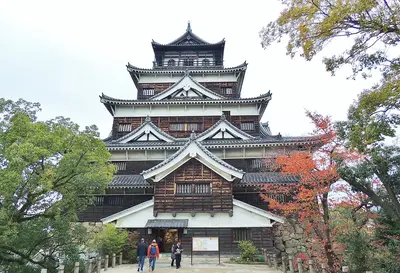
Concrete reconstruction (1962) — the original main tower existed for only nine years (1608–1615) before being demolished under the Tokugawa shogunate's one-castle-per-domain order. The 1962 reconstruction is sited slightly differently from the original tower location, which was confirmed by later archaeological excavation.

13m4 floors, 1 below

Stone walls

Natural stone stacking

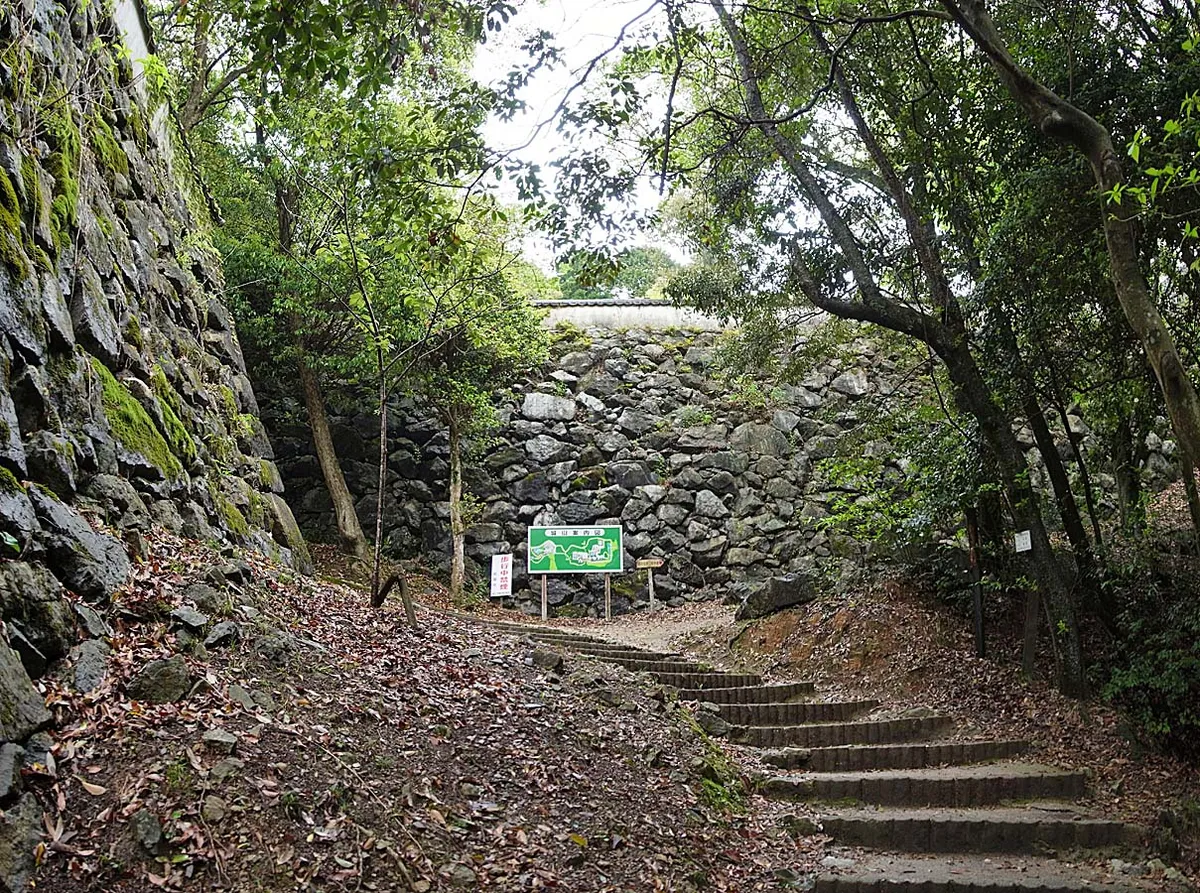
The stone walls at Iwakuni are relatively modest compared to great plains castles — the mountain position provided the primary defense, and the walls served more as compound definition and fall-prevention than as primary defensive barriers. Surviving wall sections are visible around the summit compound.

Key defensive features

Mountain Summit Elevation (200m)

The castle's 200-meter summit position on Shiroyama provides commanding views over the Nishiki River delta and all approaches. Any attacking force had to ascend the mountain under observation and fire — the ropeway that tourists take today follows roughly the same route any attacker would have been forced to use.

Nishiki River Crossing Requirement

The Nishiki River at the mountain's base created a mandatory crossing point for any attacking force approaching from the east — the most likely direction. Controlling the river crossing (where the Kintai Bridge now stands) meant controlling access to the castle approach.

The Story of Iwakuni Castle

Originally built 1608 / Kikkawa Hiroie
Current form 1962 / Iwakuni city (concrete reconstruction based on historical records)
    1608

    Kikkawa Hiroie completes Iwakuni Castle on Shiroyama, creating a mountain stronghold above the Nishiki River delta. The castle is part of a comprehensive domain development plan that also includes the construction of the Kintai Bridge to control the river crossing.

    1615

    The Tokugawa shogunate issues the 'one castle per domain' order (Ikkoku Ichijo Rei). Iwakuni Castle is ordered demolished because the Kikkawa domain already has a primary castle elsewhere. The tower is torn down just seven years after completion — one of the shortest-lived main towers in Japanese castle history.

    1673

    The first Kintai Bridge is built across the Nishiki River by Kikkawa Hiroyoshi. The bridge becomes far more famous and beloved than the demolished castle it was originally built to serve.

    1950

    The Kintai Bridge, damaged by a typhoon in 1950, is reconstructed using traditional wooden techniques, reviving the 300-year-old bridge-building tradition. The reconstruction project generates renewed interest in the castle site.

    1962

    A concrete reconstruction of the main tower is built on Shiroyama — positioned slightly differently from the original location. Archaeological investigations subsequently confirm the original tower footprint was approximately 35 meters from the reconstruction site.

In Pop Culture

documentary

Various Kintai Bridge features

The Kintai Bridge has been featured in numerous Japanese and international travel documentaries, typically framing it as a gateway to Iwakuni Castle. The bridge consistently ranks among Japan's most photographed traditional structures.

Did You Know?

  • The original Iwakuni Castle tower stood for just seven years (1608–1615) — built during the last gasp of unrestricted castle construction before the Tokugawa shogunate began regulating fortifications. The 1962 concrete reconstruction has already outlasted the original by many decades.
  • The Kintai Bridge has been rebuilt multiple times since 1673 — typhoons and floods periodically damaged or destroyed the wooden structure. The current bridge was rebuilt in 1953 using traditional techniques without nails, relying entirely on interlocking wooden joints.
  • White snakes (albino Japanese rat snakes) are considered a local symbol of good luck in Iwakuni and are kept in a special shrine in the castle town. White snake-themed souvenirs, snacks, and decorations are everywhere in the tourist shops.
  • Iwakuni is home to a large US Marine Corps Air Station visible from the castle tower — an unexpected juxtaposition that has coexisted with the historical castle town for decades. The air station's land was originally reclaimed from the Nishiki River delta.

Score Breakdown

Tourism Score

B 70/100
  • Accessibility 12 /20
  • Foreign-Friendly 13 /20
  • Historical Value 15 /20
  • Visual Impact 18 /20
  • Facilities 12 /20

Defense Score

A 88/100
  • Terrain Advantage 20 /20
  • Entrance Defense 20 /20
  • Internal Complexity 16 /20
  • Siege Endurance 15 /20
  • Strategic Oversight 17 /20

Planning Your Visit

Best Time to Visit

Cherry blossom season (late March to early April) is spectacular — cherry trees line the Kintai Bridge approach and the castle hill, and this is one of the most celebrated blossom sites in western Japan. Autumn (October–November) for quieter visits with good light. Summer is manageable but can be hot on the mountain.

Time Needed

2.5-3 hours for the complete circuit (bridge + town + ropeway + castle)

Insider Tip

Cross the Kintai Bridge twice — once going to the castle (morning light on the bridge) and once returning (look back at the castle on the mountain reflected in the river). The bridge crossing is a physical pleasure — the wooden planks flex slightly underfoot, and the elegant curves of each arch frame the view ahead. Do not shortcut by skipping the bridge for the ropeway.

Map

Getting There

Nearest station: Iwakuni Station (JR San'yo Main Line) or Shin-Iwakuni Station (JR Sanyo Shinkansen)
Walk from station: 30 min walk
Bus: Bus from Iwakuni Station to 'Kintaikyo' bus stop (approximately 20 minutes). From there, cross the Kintai Bridge on foot (¥310) and take the ropeway to the castle summit. The ropeway runs every few minutes.
Parking: Large free parking area on the east bank of the Nishiki River, near the Kintai Bridge approach. Fills up during cherry blossom season and public holidays.
Accessible with a JR Pass

Admission

Adult¥270
Child¥120

Elementary school children ¥120.

Opening Hours

Open09:00 – 16:45
Last entry16:30

Closed December 15–31. The Kintai Bridge and ropeway operate on slightly different schedules. In cherry blossom season (late March to April), extended evening ropeway hours are sometimes offered.

Facilities

  • – English guides
  • – Audio guide
  • – Wheelchair access
  • ✓ Restrooms
  • ✓ Gift shop
  • ✓ Food nearby

Nearby Castles

Featured in collections

FAQ

Frequently Asked Questions

How do I get to Iwakuni Castle?

The nearest station is Iwakuni Station (JR San'yo Main Line) or Shin-Iwakuni Station (JR Sanyo Shinkansen). From there it is about 30 minutes on foot. Bus from Iwakuni Station to 'Kintaikyo' bus stop (approximately 20 minutes). From there, cross the Kintai Bridge on foot (¥310) and take the ropeway to the castle summit. The ropeway runs every few minutes.

How much does Iwakuni Castle cost to enter?

Adult admission is ¥270 and child admission is ¥120.

Is Iwakuni Castle worth visiting?

Iwakuni Castle is best understood as the anchor of a wider heritage experience rather than a destination in itself. The Kintai Bridge is genuinely one of Japan's great architectural achievements — a five-arch wooden masterpiece that must be crossed in person to understand. The castle tower above provides a satisfying destination and panoramic views. The samurai district between bridge and ropeway adds historical texture. Together, the circuit is one of the most enjoyable half-day heritage visits in the Chugoku region, and the train access from Hiroshima makes it a natural day-trip companion.

What are the opening hours of Iwakuni Castle?

09:00 to 16:45, last entry 16:30.

How long should I spend at Iwakuni Castle?

Plan for about 2.5-3 hours for the complete circuit (bridge + town + ropeway + castle), depending on how closely you want to explore the grounds.