Iwamura Castle

岩村城·Iwamura-jo

D Tourism Score 40/100
A Defense Score 82/100

Japan's highest mountain castle at 717 meters — dramatic stone wall ruins, the story of a remarkable female lord, and one of the finest preserved castle towns in inland Japan.

#38 — 100 Famous Castles Ruins
Iwamura Castle (岩村城)
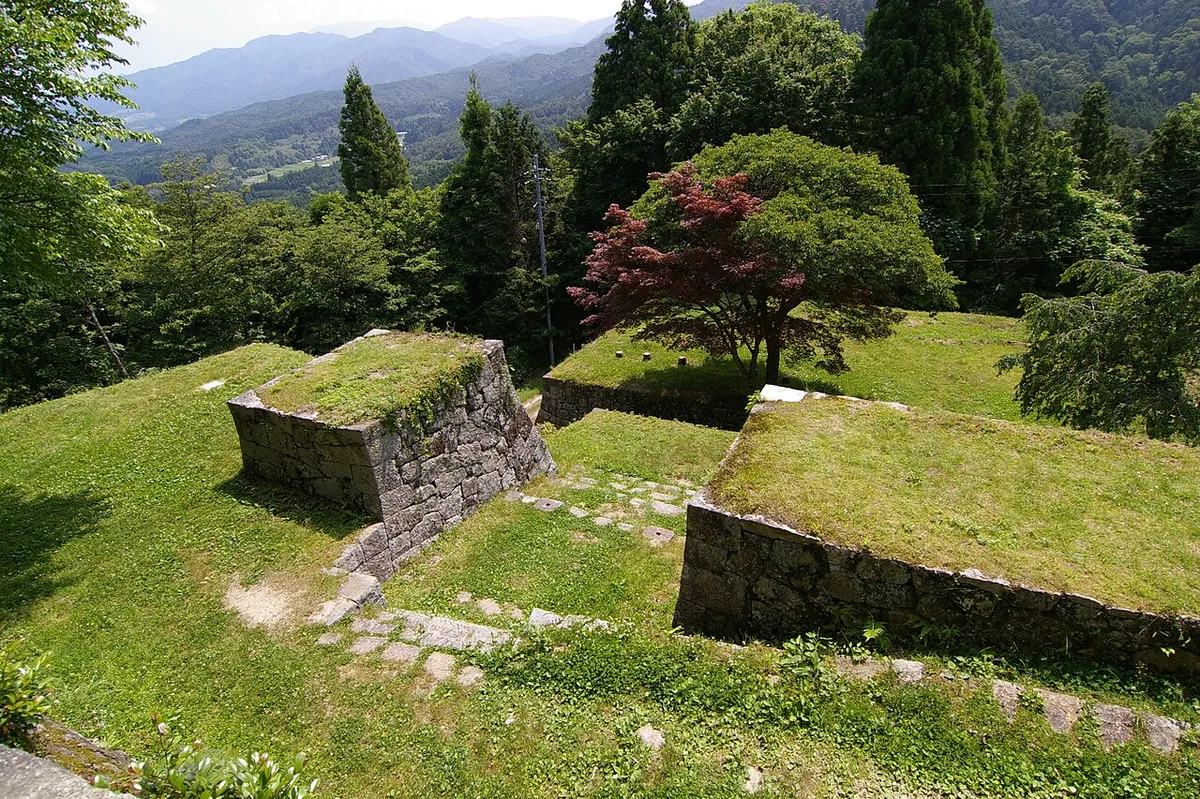
Photo:takami torao (Koiroha (talk) 00:34, 28 June 2009 (UTC))/Wikimedia Commons/Public domain

Quick Facts

Quick Facts

Admission
Free Free
Hours
00:00 – 23:59
Nearest Station
Iwamura Station (Akiha Railway Minami-Aichi Railway Toyosato Line)
Walk from Station
40 min walk
Time Needed
3–4 hours (castle town + hike + summit ruins + History Museum)

The ruins are freely accessible at all times. The Iwamura History Museum at the foot of the mountain charges ¥320 for adults. Castle town walking is completely free.

Defense Overview

Defense Overview

Why Iwamura Castle was hard to attack

This castle is hard to attack because natural ground and added defensive depth work together to make every push inward more difficult.

An attacker would first have to fight the site itself before reaching the main defenses. They would have to cross water barriers or moat lines, approach through at least some constrained entry space, and face more defensive depth after the first line.

Overall score

82/100

Estimated range

76–88

Confidence

B

Usable estimate with some inference

This is a site-original comparison score for learning and comparison, not a reconstruction of one historical battle.

Radar view

Terrain 19/20 Entrance 18/20 Internal 14/20 Siege 14/20 Oversight 17/20
How this estimate was built+

This estimate combines broad terrain, approach, layout, and route-control signals. It is meant to explain the castle's defensive logic in plain English, not reconstruct a single historical attack.

Terrain Advantage

How much the terrain itself seems to help: height, slope, ridges, cliffs, water edges, and limited approach directions.

19/20

Entrance Defense

How awkward and dangerous the first entry looks: gates, bridge or moat crossings, chokepoints, and forced turns.

18/20

Internal Complexity

How hard it seems to keep pushing after entry: layered baileys, depth, compartmentalization, and repeated defensive lines.

14/20

Siege Endurance

A rough sense of long-hold potential: moats, water access, space, storage plausibility, and defensive staying power.

14/20

Strategic Oversight

How much the castle appears to command nearby roads, plains, rivers, basins, harbors, or town approaches.

17/20

Why Visit

Iwamura Castle rewards serious castle enthusiasts with some of the finest mountain castle stonework in Japan, dramatic history involving Oda Nobunaga's own family, and the bonus of one of the best-preserved Edo-period castle towns at the mountain's base. The hike is a genuine commitment — 40+ minutes of mountain walking — but the six terraced stone wall sections at the summit justify the effort. The combination of castle ruins, castle town, and history museum makes this a full half-day experience.

Highlights

1

Japan's Highest Mountain Castle at 717 Meters

Iwamura Castle stands at 717 meters above sea level — making it the highest mountain castle in Japan. Along with Takeda Castle (Hyogo) and Bitchu Matsuyama Castle (Okayama), it is ranked as one of Japan's three great mountain castles. The dramatic stone walls that survive at this elevation, built on sheer rocky outcrops, demonstrate extraordinary engineering by any standard. The views from the summit over the Kiso mountains are breathtaking.
2

Lady Otsuya — Japan's Most Formidable Female Castle Lord

In the 1570s, Iwamura Castle was governed by Otsuya no Kata — Oda Nobunaga's aunt — who became the castle's de facto lord after the death of her husband. In a remarkable episode, she fell in love with and married a visiting general, Akiyama Nobutomo, who served the Takeda clan. This act put her in direct opposition to her nephew Nobunaga. When Nobunaga finally took the castle in 1575, he executed Otsuya and Nobutomo by crucifixion — one of the most dramatic personal betrayals of the Sengoku period.

3

Six Terraced Stone Wall Sections

The summit ruins preserve remarkable stone walls arranged in six terraced levels cascading down the mountain from the highest compound. These walls — built from local stone on sheer mountain terrain at 717 meters elevation — represent some of the most impressive remaining mountain castle stonework in Japan. Walking through the terraced sections gives a powerful sense of the castle's defensive depth and the sheer ambition of its construction.

Structure Details

Visitor tip

Allow 45–60 minutes for the hike from the castle town to the summit ruins. Wear proper footwear — the mountain path can be slippery. The reward is the six terraced stone wall sections near the summit, which are genuinely impressive ruins. The historic castle town (Edo-period merchant street) at the base is a bonus attraction for the approach and return.

Castle type

Mountain castle

Mountain castle — built on a steep mountain summit at 717 meters elevation, Japan's highest mountain castle

Layout type

Ladder layout

Stepped terrace style — multiple compounds arranged on descending terraces down the mountain from the summit compound

Main tower

Stone wall ruins only — the main tower and all wooden structures were demolished in 1873 under the Meiji government's dismantling orders. The six terraced stone wall sections survive in impressive condition, representing some of the finest mountain castle stonework remaining in Japan.

Stone walls

Natural stone stacking

The stone walls at Iwamura are remarkable for their setting — built on rocky mountain outcrops at 717 meters, they cascade in six terraced levels from the summit. The walls use the local rough stone with considerable skill, adapting to the irregular mountain terrain. Sections near the summit show particularly impressive stonework that has survived centuries of mountain weather.

Key defensive features

717-Meter Summit Position

The castle summit stands at 717 meters above sea level — the approach from the castle town below requires a sustained climb of several hundred meters. Any attacking force faced a grueling ascent under observation before reaching the stone walls, arriving exhausted and in small groups through the narrow mountain paths.

Six Terraced Stone Wall Levels

The summit defenses are arranged in six cascading stone-walled terraces, each providing a fallback position and a new defensive line. An attacker who breached one terrace faced another wall above — the depth of defense was extraordinary for a mountain site.

Rocky Outcrops as Natural Bastions

The castle's builders exploited the natural rocky outcrops of the mountain summit, incorporating them directly into the stone wall system. In several places the walls rise directly from bedrock, making undermining impossible and scaling extremely difficult.

Fog Castle Effect

Iwamura is known as 'Kiri-ga-jo' (Fog Castle) because morning mists frequently envelop the summit while the valley below remains clear. Defenders could operate in visibility-obscuring fog while observing approaching enemies below through the gaps — a significant intelligence advantage.

The Story of Iwamura Castle

Originally built 1185 / Kato Kagekado
Current form 1572 / Akiyama Nobutomo / Otsuya no Kata
    1185

    Kato Kagekado, a local warrior, constructs the first fortification on the Iwamura mountain summit — one of the earliest recorded castle foundations in the region.

    1572

    Otsuya no Kata, Oda Nobunaga's aunt and widow of the castle lord, enters a relationship with the Takeda general Akiyama Nobutomo. They marry, and Nobutomo takes over governance of the castle — placing it under Takeda clan control and in direct opposition to Nobunaga.

    1575

    After the decisive Battle of Nagashino destroys the Takeda cavalry, Nobunaga besieges Iwamura Castle. The garrison, cut off from Takeda support, eventually surrenders. Nobunaga executes Otsuya and Akiyama Nobutomo by crucifixion — a personal revenge for the perceived family betrayal.

    1600

    After the Battle of Sekigahara, the Matsudaira clan (a Tokugawa branch) is awarded the Iwamura domain. The castle is maintained but not significantly expanded under Tokugawa peace.

    1873

    The Meiji government orders the castle's demolition. All wooden structures, including the main tower, are removed. The stone walls are left in place and survive to the present as one of Japan's most impressive mountain castle ruins.

In Pop Culture

TV

Onna Joushu Naotora (NHK Taiga Drama, 2017)

The 2017 NHK Taiga Drama featured Otsuya no Kata and the Iwamura Castle episode as a significant storyline, bringing wider national attention to Iwamura's dramatic history.

Did You Know?

  • Iwamura Castle's most famous historical figure, Otsuya no Kata, was Oda Nobunaga's aunt — making her execution one of the most personally bitter acts of Nobunaga's career. The Sengoku period's famous 'rules' about family loyalty made her marriage to a Takeda general a genuine act of defiance that Nobunaga could not overlook.
  • The castle is nicknamed 'Kiri-ga-jo' (Fog Castle) because mountain fog frequently envelops the summit, an atmospheric phenomenon that is best observed in autumn mornings when temperature inversions fill the Kiso valley with mist.
  • The historic castle town (Iwamura jokamachi) below the mountain is one of the best-preserved Edo-period merchant streets in inland Japan — the stone-paved lane lined with merchants' houses has been designated an Important Preservation District for Historic Buildings.
  • At 717 meters, Iwamura Castle stood significantly higher than any other Japanese castle — the next highest, Bitchu Matsuyama, stands at 480 meters. The altitude difference is not academic: it meant substantially colder winters, shorter supply lines, and a more demanding garrison life for the soldiers stationed there.

Score Breakdown

Tourism Score

D 40/100
  • Accessibility 6 /20
  • Foreign-Friendly 5 /20
  • Historical Value 15 /20
  • Visual Impact 10 /20
  • Facilities 4 /20

Defense Score

A 82/100
  • Terrain Advantage 19 /20
  • Entrance Defense 18 /20
  • Internal Complexity 14 /20
  • Siege Endurance 14 /20
  • Strategic Oversight 17 /20

Planning Your Visit

Best Time to Visit

Autumn (October–November) for autumn foliage and morning mist (fog castle effect). Spring cherry blossoms in the castle town are also beautiful. Avoid winter due to snow and icy paths.

Time Needed

3–4 hours (castle town + hike + summit ruins + History Museum)

Insider Tip

Walk the historic castle town street first, before the hike — it sets the historical context and lets you appreciate the full scale of the castle complex from town to summit. On autumn mornings, arrive before 8am and look back from the mountain path at the valley below: if conditions are right, the valley fills with mist while the castle ruins emerge above. The castle town's old sake breweries and merchant houses are also worth extended exploration on the return.

Map

Getting There

Nearest station: Iwamura Station (Akiha Railway Minami-Aichi Railway Toyosato Line)
Walk from station: 40 min walk
Parking: Parking available at the foot of the mountain near the History Museum. No vehicles beyond that point — the ruins require hiking.

Admission

Free

The ruins are freely accessible at all times. The Iwamura History Museum at the foot of the mountain charges ¥320 for adults. Castle town walking is completely free.

Opening Hours

Open00:00 – 23:59

The mountain path to the ruins is open year-round but can be slippery in winter. The History Museum is open 9:00–17:00, closed Tuesdays and December 28–January 4.

Facilities

  • – English guides
  • – Audio guide
  • – Wheelchair access
  • ✓ Restrooms
  • – Gift shop
  • ✓ Food nearby

Nearby Castles

Featured in collections

FAQ

Frequently Asked Questions

How do I get to Iwamura Castle?

The nearest station is Iwamura Station (Akiha Railway Minami-Aichi Railway Toyosato Line). From there it is about 40 minutes on foot.

How much does Iwamura Castle cost to enter?

Iwamura Castle is free to enter.

Is Iwamura Castle worth visiting?

Iwamura Castle rewards serious castle enthusiasts with some of the finest mountain castle stonework in Japan, dramatic history involving Oda Nobunaga's own family, and the bonus of one of the best-preserved Edo-period castle towns at the mountain's base. The hike is a genuine commitment — 40+ minutes of mountain walking — but the six terraced stone wall sections at the summit justify the effort. The combination of castle ruins, castle town, and history museum makes this a full half-day experience.

What are the opening hours of Iwamura Castle?

00:00 to 23:59.

How long should I spend at Iwamura Castle?

Plan for about 3–4 hours (castle town + hike + summit ruins + History Museum), depending on how closely you want to explore the grounds.