Takeda Castle

竹田城·Takeda-jo

C Tourism Score 62/100
A Defense Score 83/100

Stone walls floating above a sea of clouds — Takeda Castle is Japan's most dramatic ruin, where architecture has dissolved to leave only the mountain and the mist.

#56 — 100 Famous Castles Ruins
Takeda Castle (竹田城)
Photo:Brakeet/Wikimedia Commons/CC0

Quick Facts

Quick Facts

Admission
¥500

¥0

Hours
08:00 – 17:00

Last entry 16:30

Nearest Station
Takeda Station (JR Bantan Line)
Walk from Station
40 min walk

Bus also available

Time Needed
3-4 hours total (including approach hike and summit exploration)

Children (junior high and under) free.

Defense Overview

Defense Overview

Why Takeda Castle was hard to attack

This castle is hard to attack because natural ground and added defensive depth work together to make every push inward more difficult.

An attacker would first have to fight the site itself before reaching the main defenses. They would have to cross water barriers or moat lines and face more defensive depth after the first line.

Overall score

83/100

Estimated range

77–89

Confidence

B

Usable estimate with some inference

This is a site-original comparison score for learning and comparison, not a reconstruction of one historical battle.

Radar view

Terrain 19/20 Entrance 17/20 Internal 17/20 Siege 14/20 Oversight 16/20
How this estimate was built+

This estimate combines broad terrain, approach, layout, and route-control signals. It is meant to explain the castle's defensive logic in plain English, not reconstruct a single historical attack.

Terrain Advantage

How much the terrain itself seems to help: height, slope, ridges, cliffs, water edges, and limited approach directions.

19/20

Entrance Defense

How awkward and dangerous the first entry looks: gates, bridge or moat crossings, chokepoints, and forced turns.

17/20

Internal Complexity

How hard it seems to keep pushing after entry: layered baileys, depth, compartmentalization, and repeated defensive lines.

17/20

Siege Endurance

A rough sense of long-hold potential: moats, water access, space, storage plausibility, and defensive staying power.

14/20

Strategic Oversight

How much the castle appears to command nearby roads, plains, rivers, basins, harbors, or town approaches.

16/20

Why Visit

Takeda Castle offers a completely different experience from any other castle in Japan — there is no tower, no museum, no gift shop. What there is: an extraordinary natural landscape, a genuine mountain adventure, and stone ruins that create one of the country's most iconic visual spectacles. The cloud-sea phenomenon in autumn is a genuine once-in-a-lifetime experience if you catch it. Even without the mist, the summit views justify the climb.

Highlights

1

Japan's 'Castle in the Sky'

On autumn and early winter mornings, the Maruyama River valley below fills with dense ground fog, while the 353-meter mountain peak on which Takeda Castle stands emerges above the mist into clear blue sky. The castle's stone walls, rising from the cloud sea as if floating in mid-air, create one of Japan's most photographed and haunting landscapes — earning the castle its permanent nickname 'Machu Picchu of Japan' and 'Castle in the Sky.'
2

Pure Stone: The Ruins as Art

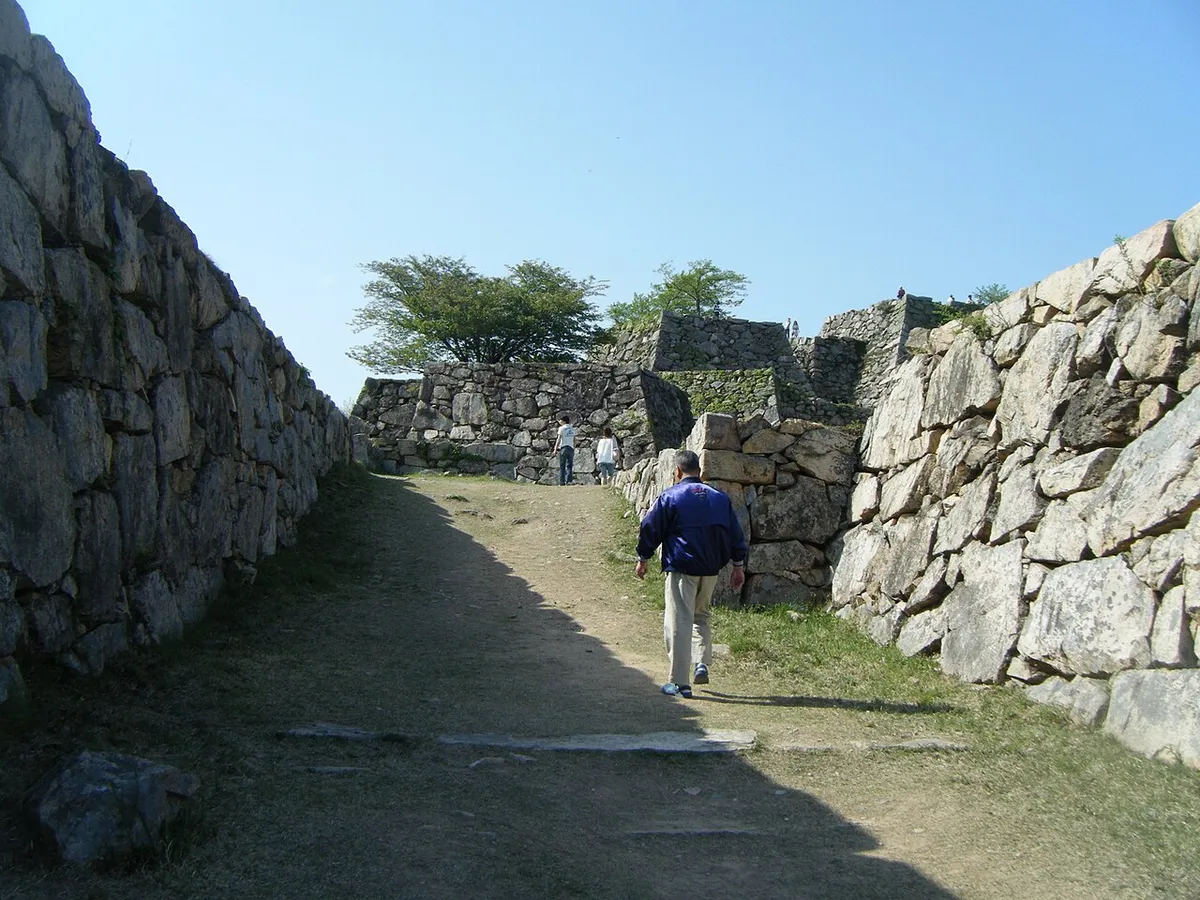
Takeda Castle has no surviving wooden structures — what remains is the stone framework alone: walls, platforms, stone staircases, and the geometric outlines of where buildings once stood. This pure stone skeleton, emerging from mist or silhouetted against autumn sky, has a stark beauty that many visitors find more affecting than any reconstructed castle tower.

3

The Best View in the Country

Even in clear weather, the 360-degree panorama from the summit castle ruins is spectacular — mountain ridges in every direction, the Maruyama River far below, and the town of Asago tiny in the valley. The climb is worthwhile for the view alone. In autumn and winter mornings, the cloud sea transforms it into something otherworldly.

Structure Details

Visitor tip

Wear comfortable walking shoes — the ascent is a real hike. In autumn, arrive before dawn at the Ritsuunkyo viewpoint (across the valley) to witness the cloud sea. For the castle itself, early morning produces the best light and atmosphere. The ruins are surprisingly extensive — budget at least an hour at the top beyond the climb time.

Castle type

Mountain castle

Mountain castle — built on a 353-meter mountain summit, one of Japan's highest castle sites

Layout type

Linked compound layout

Compound style — main compound with north, south, and subsidiary compounds spread across the mountain ridgeline

Main tower

Stone ruins only — all wooden structures (main tower, buildings, gates) have been lost. Only the extensive stone wall foundations remain, preserved in excellent condition.

Stone walls

Natural stone stacking

The stone walls of Takeda Castle are extensive and well-preserved for ruins — long stretches of intact wall reach several meters high, creating impressive geometric platforms across the mountain summit. The scale of the surviving stonework gives a clear sense of how large and well-organized the original castle was.

Key defensive features

353-Meter Summit Position

The castle's elevation is its supreme defensive feature — an attacking force would face a grueling mountain climb before even reaching the first walls. The approach is visible from the summit for a considerable distance, providing ample warning time.

Cliff-Face Walls

The stone walls on the steep mountain faces rise directly from near-vertical cliff edges, making climbing impossible from those directions. Only a few approach routes were viable, all of which could be covered by defenders.

Ridgeline Layout

The castle compounds follow the natural ridgeline of the mountain, with the main compound at the highest point and subsidiary compounds controlling the approaches from different directions. An attacker reaching one compound could still face organized resistance at the next.

The Story of Takeda Castle

Originally built 1443 / Otagaki Mitsukage
Current form 1580 / Toyotomi Hidenaga / Akamatsu Hirohide
    1443

    Otagaki Mitsukage builds a mountain fortification on the summit of Mt. Toraoi as a base for the Yamana clan's control of Tajima Province. The basic mountain fort form begins here.

    1565

    Akamatsu Hirohide is installed as lord of Takeda Castle by Oda Nobunaga's expanding power structure, and carries out major construction work on the stone walls that survive today.

    1580

    Toyotomi Hidenaga (younger brother of Hideyoshi) supervises further development of the castle as part of Oda/Toyotomi campaigns in the region. The castle reaches its greatest extent.

    1600

    After the Battle of Sekigahara, the lord of Takeda Castle supports the losing Western Army. Rather than face Tokugawa retribution, the castle is abandoned. It is never occupied again.

    1600

    With no lord to maintain it, the wooden structures of the castle gradually decay and disappear over the following centuries. The stone foundations remain, preserved by the mountain environment.

    2000

    Increasing interest in castle ruins and spectacular photography of the cloud-sea phenomenon begins drawing visitors. What was an obscure regional site transforms into a nationally recognized destination.

In Pop Culture

social_media

Cloud Sea Photography

Autumn cloud-sea photographs of Takeda Castle spread virally on social media from around 2010, triggering a tourism boom that transformed the previously quiet town of Asago. The images are among the most shared Japanese landscape photographs online.

Did You Know?

  • The cloud-sea (unkai) phenomenon at Takeda Castle is most reliable from late September to mid-November, roughly between 6am and 8am on mornings after cool, clear nights. The Ritsuunkyo viewpoint across the valley is the famous photo spot — not the castle itself.
  • After the Battle of Sekigahara in 1600, Takeda Castle was abandoned and never reoccupied. It became ruins not through war or fire but simply through the passage of time and weather — an unusually peaceful end for a Sengoku fortress.
  • The castle ruins cover an area of approximately 100 by 400 meters — enormous for a mountain summit site. The scale of the surviving stonework suggests a castle capable of housing hundreds of soldiers and considerable supplies.
  • The nickname 'Machu Picchu of Japan' has been used by tourism authorities since around 2012, drawing comparisons to the famous Peruvian mountain ruins. The comparison is mostly atmospheric — both are stone ruins on mountain peaks above cloud level — rather than architectural.

Score Breakdown

Tourism Score

C 62/100
  • Accessibility 8 /20
  • Foreign-Friendly 10 /20
  • Historical Value 13 /20
  • Visual Impact 20 /20
  • Facilities 11 /20

Defense Score

A 83/100
  • Terrain Advantage 19 /20
  • Entrance Defense 17 /20
  • Internal Complexity 17 /20
  • Siege Endurance 14 /20
  • Strategic Oversight 16 /20

Planning Your Visit

Best Time to Visit

Late September to mid-November for cloud-sea views — arrive at the Ritsuunkyo viewpoint before dawn on a clear morning after a cool night. Spring (April to May) for pleasant hiking weather without crowds. Avoid heavy rain and winter snow conditions.

Time Needed

3-4 hours total (including approach hike and summit exploration)

Insider Tip

The famous cloud-sea photograph is taken from the Ritsuunkyo viewpoint on the opposite hillside, not from the castle itself. Check local cloud-sea forecasts the night before and set an early alarm. If you miss the cloud sea, the castle ruins themselves are still impressive — explore all the subsidiary compounds (north and south), which are less visited than the main summit area and provide equally good views.

Map

Getting There

Nearest station: Takeda Station (JR Bantan Line)
Walk from station: 40 min walk
Bus: Shuttle bus from Takeda Station to castle base during peak season (fee applies). Walk from station is 40 minutes uphill — manageable but demanding.
Parking: Parking at base area. No vehicle access to the castle summit itself — walking required from parking.
Accessible with a JR Pass

Admission

Adult¥500
ChildFree

Children (junior high and under) free.

Opening Hours

Open08:00 – 17:00
Last entry16:30

Hours vary significantly by season: Spring (Mar–May) 8:00–17:00; Summer/Autumn (Jun–Nov) 5:00–17:00 (early morning for sea of clouds); Early Winter (Dec 11–Jan 3) 10:00–15:00; Late Winter (Jan 4–Feb) closed.

Facilities

  • – English guides
  • – Audio guide
  • – Wheelchair access
  • ✓ Restrooms
  • – Gift shop
  • – Food nearby

Nearby Castles

Featured in collections

FAQ

Frequently Asked Questions

How do I get to Takeda Castle?

The nearest station is Takeda Station (JR Bantan Line). From there it is about 40 minutes on foot. Shuttle bus from Takeda Station to castle base during peak season (fee applies). Walk from station is 40 minutes uphill — manageable but demanding.

How much does Takeda Castle cost to enter?

Adult admission is ¥500 and child admission is ¥0.

Is Takeda Castle worth visiting?

Takeda Castle offers a completely different experience from any other castle in Japan — there is no tower, no museum, no gift shop. What there is: an extraordinary natural landscape, a genuine mountain adventure, and stone ruins that create one of the country's most iconic visual spectacles. The cloud-sea phenomenon in autumn is a genuine once-in-a-lifetime experience if you catch it. Even without the mist, the summit views justify the climb.

What are the opening hours of Takeda Castle?

08:00 to 17:00, last entry 16:30.

How long should I spend at Takeda Castle?

Plan for about 3-4 hours total (including approach hike and summit exploration), depending on how closely you want to explore the grounds.