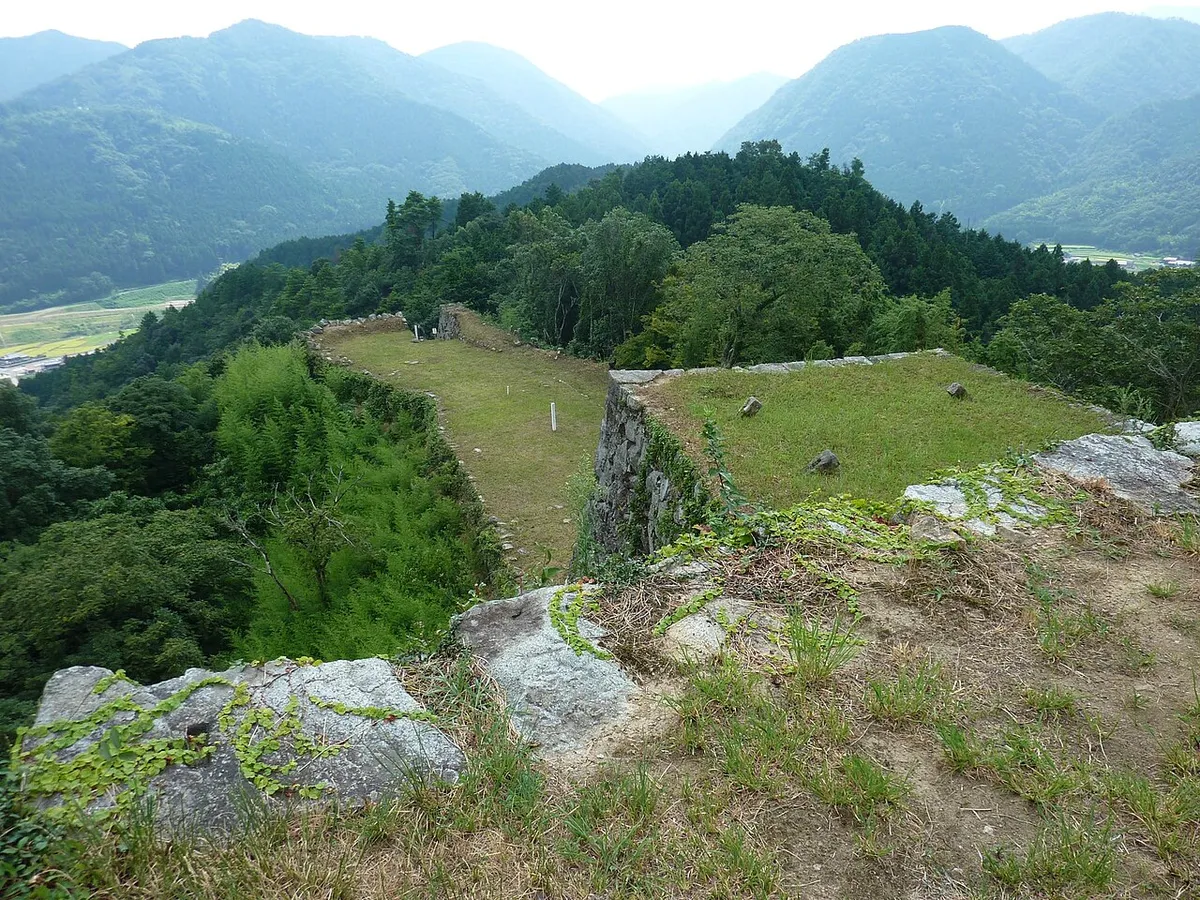
Tsuwano Castle

津和野城·Tsuwano-jo

D Tourism Score 42/100
A Defense Score 84/100

Mountain ruins above one of western Japan's most charming preserved castle towns — the chairlift ride and town stroll are as memorable as the ruins themselves.

#66 — 100 Famous Castles Ruins
Tsuwano Castle (津和野城)
Photo:Mocchy/Wikimedia Commons/Public domain

Quick Facts

Quick Facts

Admission
Free Free
Hours
00:00 – 23:59
Nearest Station
Tsuwano Station (JR Yamaguchi Line)
Walk from Station
25 min walk
Time Needed
Full day (castle town + Inari shrine + castle ruins + mountain views)

The ruins are freely accessible. A chairlift (ropeway) serving the mountain is available for a small fee (approximately ¥500 round trip) — optional, as a walking path also leads to the ruins.

Defense Overview

Defense Overview

Why Tsuwano Castle was hard to attack

This castle is hard to attack because it uses high ground and difficult natural access to deny attackers an easy approach.

An attacker would first have to fight the site itself before reaching the main defenses. They would have to cross water barriers or moat lines, pass tighter turns and chokepoints, and push through successive outer areas before the core.

Overall score

84/100

Estimated range

78–90

Confidence

B

Usable estimate with some inference

This is a site-original comparison score for learning and comparison, not a reconstruction of one historical battle.

Radar view

Terrain 20/20 Entrance 20/20 Internal 13/20 Siege 14/20 Oversight 17/20
How this estimate was built+

This estimate combines broad terrain, approach, layout, and route-control signals. It is meant to explain the castle's defensive logic in plain English, not reconstruct a single historical attack.

Terrain Advantage

How much the terrain itself seems to help: height, slope, ridges, cliffs, water edges, and limited approach directions.

20/20

Entrance Defense

How awkward and dangerous the first entry looks: gates, bridge or moat crossings, chokepoints, and forced turns.

20/20

Internal Complexity

How hard it seems to keep pushing after entry: layered baileys, depth, compartmentalization, and repeated defensive lines.

13/20

Siege Endurance

A rough sense of long-hold potential: moats, water access, space, storage plausibility, and defensive staying power.

14/20

Strategic Oversight

How much the castle appears to command nearby roads, plains, rivers, basins, harbors, or town approaches.

17/20

Why Visit

Tsuwano earns its place on any western Japan itinerary through the combination: a beautiful preserved castle town with carp canals, one of Japan's most visually dramatic shrine approaches (Taikodani Inari's 1,000 torii gates), and mountain castle ruins with excellent views above it all. The ruins themselves are solid rather than spectacular, but the complete Tsuwano experience — town, shrine, and summit — is genuinely excellent. A full day here is well spent.

Highlights

1

Ruins Above One of Japan's Most Beautiful Small Towns

Tsuwano is often called 'the Little Kyoto of San'in' — a remarkably well-preserved castle town of white-walled merchant houses, carp-filled canals, a historic Catholic church, and a grand Shinto shrine, all tucked into a narrow mountain valley. The castle ruins on the ridge above complete the picture: from the summit, the entire town spreads out below in one of the most satisfying small-scale panoramas in western Japan.
2

Stone Walls at 370 Meters

Tsuwano Castle's mountain position at approximately 370 meters above the town provides commanding views and formidable natural defenses. The stone walls that survive on the summit are well-preserved and impressive for a castle that receives relatively few visitors. The combination of the mountain approach (either by chairlift or walking path through cedar forest) and the stone wall ruins at the top makes for a genuinely rewarding castle excursion.

3

Koi Carp in the Castle Town Streets

The drainage channels running alongside the main street of Tsuwano town are filled with enormous, brilliantly colored koi carp — one of the town's most immediately charming features. The carp, originally kept as an emergency food supply during castle sieges, have been maintained for centuries in the town's water channels. Walking from the town up to the castle gives visitors the full Tsuwano experience: elegant old streets, the beautiful Taikodani Inari Shrine with its 1,000 torii gates, and then the mountain ruins above.

Structure Details

Visitor tip

Take the chairlift rather than walking up — the mountain path through cedar forest is atmospheric but the chairlift saves significant energy for exploring the ruins at the top. Explore all the terrace levels, not just the main summit compound. The views of Tsuwano town below from the ruins are excellent. Allow time to visit Taikodani Inari Shrine on the descent — the 1,000 torii gates are one of Japan's most photographed shrine approaches.

Castle type

Mountain castle

Mountain castle — built on a mountain ridge at approximately 370 meters elevation above the Tsuwano valley, with steep mountain slopes providing natural defenses on all sides

Layout type

Ladder layout

Stepped terrace style — compounds arranged on multiple terraced levels following the mountain ridge contour

Main tower

Stone wall ruins only — the main tower and all wooden structures were demolished in 1874 following the Meiji Restoration. Well-preserved stone walls on multiple terrace levels survive at the summit.

Stone walls

Natural stone stacking

The stone walls survive in good condition across several terraced compound levels at the summit. The walls show the characteristic rough stone stacking (nozurazumi) of Sengoku-era mountain construction, adapted to the irregular mountain ridge. Views from within the ruins are spectacular.

Key defensive features

Mountain Ridge Position

The castle's position on a steep mountain ridge made direct assault extremely difficult — attackers would need to climb through dense forest and steep terrain before reaching the stone walls. The ridge's narrowness also limited the frontage available for assault.

Surviving Stone Walls on Multiple Terraces

The castle's multi-terrace design with stone walls at each level meant that even if an attacker breached a lower terrace, they faced another wall above. The depth of defense on the narrow ridge provided genuine tactical resistance.

Panoramic Observation

The castle's elevated position gave defenders comprehensive visibility over the Tsuwano valley and all approaches — no army could enter the valley without being observed from the castle heights.

The Story of Tsuwano Castle

Originally built 1295 / Yoshimi Yoriyuki
Current form 1620 / Sakazaki Naomori (then expanded by Kamei clan)
    1295

    Yoshimi Yoriyuki constructs the first fortification on the Tsuwano mountain ridge, establishing the foundation of what would become Tsuwano Castle.

    1600

    During the Sekigahara campaign, Sakazaki Naomori (a Tokugawa ally) besieges the castle. After a prolonged siege of several months, the castle surrenders. Sakazaki is awarded the domain.

    1620

    Sakazaki Naomori is removed from his domain after a scandalous incident involving the kidnapping of a princess. The Kamei clan takes control and significantly expands the castle, constructing the stone walls that survive today.

    1874

    The Meiji government orders castle demolition. The buildings are removed, leaving only the stone walls — which have survived to the present in good condition.

Did You Know?

  • During the Meiji period, Tsuwano was the site of brutal religious persecution — 153 Urakami Catholics (hidden Christians from Nagasaki) were forcibly relocated to Tsuwano and subjected to years of forced conversion attempts, during which over 30 died. The Maria Cathedral in Tsuwano commemorates this history. The castle town's beautiful exterior conceals this dark episode.
  • The koi carp in Tsuwano's street-side canals are a famous local attraction — the fish have been maintained in the town's water channels for centuries, originally as emergency food provisions for the castle garrison during siege. They are now strictly protected and number in the thousands.
  • Tsuwano is the birthplace of Mori Ogai (1862–1922), one of Japan's most important Meiji-era authors and a key figure in introducing Western literature to Japan. His childhood home is preserved in the castle town.

Score Breakdown

Tourism Score

D 42/100
  • Accessibility 9 /20
  • Foreign-Friendly 7 /20
  • Historical Value 12 /20
  • Visual Impact 10 /20
  • Facilities 4 /20

Defense Score

A 84/100
  • Terrain Advantage 20 /20
  • Entrance Defense 20 /20
  • Internal Complexity 13 /20
  • Siege Endurance 14 /20
  • Strategic Oversight 17 /20

Planning Your Visit

Best Time to Visit

Spring (April–May) for fresh greenery and mild weather. Autumn for foliage on the mountain slopes. The Heron Dance Festival (Sagamai) in late July is a UNESCO-designated intangible cultural heritage performance.

Time Needed

Full day (castle town + Inari shrine + castle ruins + mountain views)

Insider Tip

Do the castle visit before the Inari Shrine, not after — take the chairlift up in the morning when the views are clearest, explore the summit ruins, then descend and walk the 1,000 torii of Taikodani Inari Shrine before exploring the castle town streets. The carp canals are best photographed in morning light. End with lunch at one of the town's traditional restaurants — Tsuwano has a modest but genuine local cuisine tradition.

Map

Getting There

Nearest station: Tsuwano Station (JR Yamaguchi Line)
Walk from station: 25 min walk
Parking: Parking available near the chairlift base station.
Accessible with a JR Pass

Admission

Free

The ruins are freely accessible. A chairlift (ropeway) serving the mountain is available for a small fee (approximately ¥500 round trip) — optional, as a walking path also leads to the ruins.

Opening Hours

Open00:00 – 23:59

The chairlift operates 9:00–17:00 (weather permitting). Walking path accessible at all times. Winter conditions may affect access.

Facilities

  • – English guides
  • – Audio guide
  • – Wheelchair access
  • ✓ Restrooms
  • – Gift shop
  • ✓ Food nearby

Nearby Castles

Featured in collections

FAQ

Frequently Asked Questions

How do I get to Tsuwano Castle?

The nearest station is Tsuwano Station (JR Yamaguchi Line). From there it is about 25 minutes on foot.

How much does Tsuwano Castle cost to enter?

Tsuwano Castle is free to enter.

Is Tsuwano Castle worth visiting?

Tsuwano earns its place on any western Japan itinerary through the combination: a beautiful preserved castle town with carp canals, one of Japan's most visually dramatic shrine approaches (Taikodani Inari's 1,000 torii gates), and mountain castle ruins with excellent views above it all. The ruins themselves are solid rather than spectacular, but the complete Tsuwano experience — town, shrine, and summit — is genuinely excellent. A full day here is well spent.

What are the opening hours of Tsuwano Castle?

00:00 to 23:59.

How long should I spend at Tsuwano Castle?

Plan for about Full day (castle town + Inari shrine + castle ruins + mountain views), depending on how closely you want to explore the grounds.