Hagi Castle

萩城·Hagi-jo

D Tourism Score 48/100
B Defense Score 78/100

The castle where Japan's feudal age ended — from these ruins and the samurai streets around them, the Meiji Restoration was born.

#75 — 100 Famous Castles Ruins
Hagi Castle (萩城)
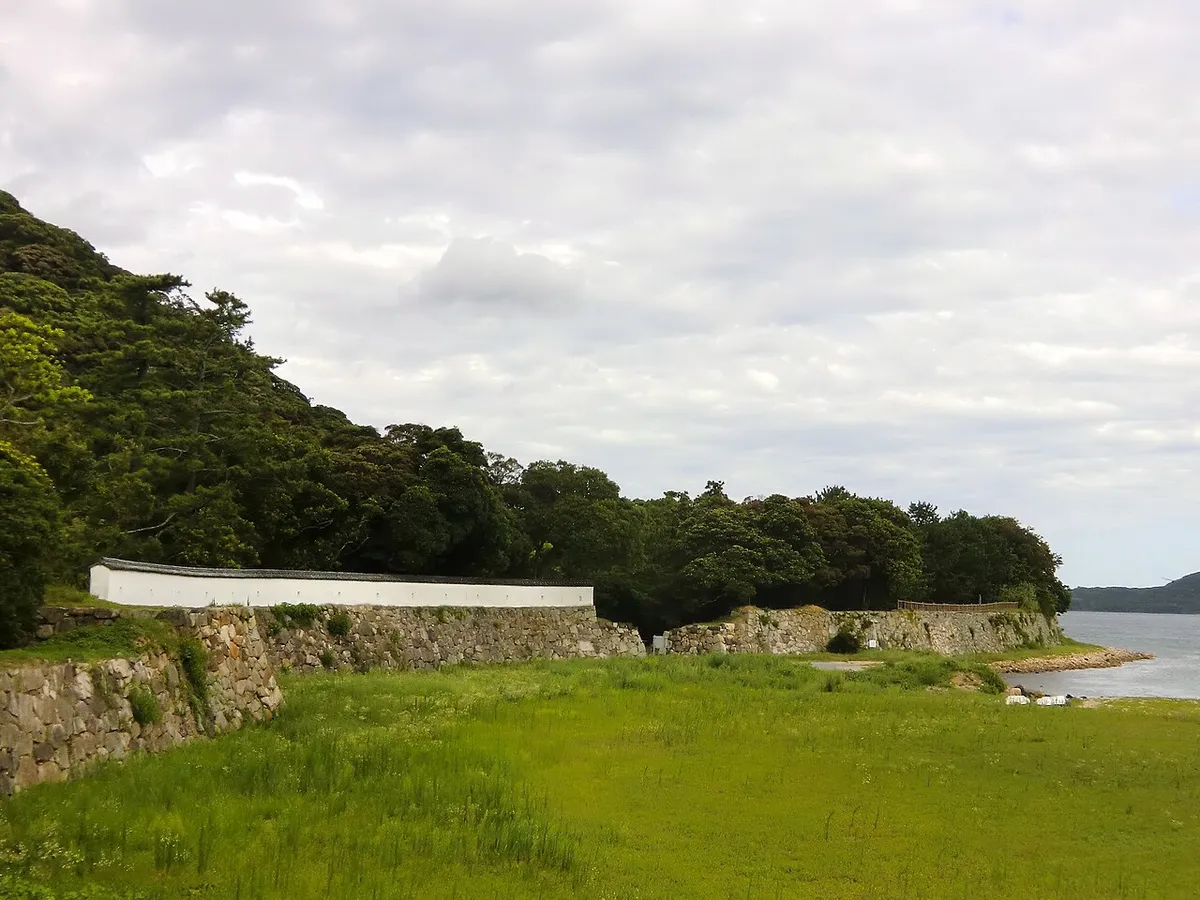
Photo:TT mk2/Wikimedia Commons/CC BY-SA 3.0

Quick Facts

Quick Facts

Admission
¥220

¥100

Hours
08:30 – 18:30

Last entry 18:00

Nearest Station
Higashi-Hagi Station (JR San-in Main Line)
Walk from Station
25 min walk

Bus also available

Time Needed
3–4 hours for castle ruins, Horiuchi district, and Yoshida Shoin shrine; half-day recommended

Elementary/junior high ¥100.

Defense Overview

Defense Overview

Why Hagi Castle was hard to attack

This castle is hard to attack because its strength comes from its command of nearby routes and the surrounding town while still forcing attackers to break through defended space.

An attacker would not get a simple direct approach to the center. They would have to cross water barriers or moat lines, approach through at least some constrained entry space, push through successive outer areas before the core, and do so under a position that also watches the surrounding routes.

Overall score

78/100

Estimated range

72–84

Confidence

B

Usable estimate with some inference

This is a site-original comparison score for learning and comparison, not a reconstruction of one historical battle.

Radar view

Terrain 15/20 Entrance 15/20 Internal 15/20 Siege 16/20 Oversight 17/20
How this estimate was built+

This estimate combines broad terrain, approach, layout, and route-control signals. It is meant to explain the castle's defensive logic in plain English, not reconstruct a single historical attack.

Terrain Advantage

How much the terrain itself seems to help: height, slope, ridges, cliffs, water edges, and limited approach directions.

15/20

Entrance Defense

How awkward and dangerous the first entry looks: gates, bridge or moat crossings, chokepoints, and forced turns.

15/20

Internal Complexity

How hard it seems to keep pushing after entry: layered baileys, depth, compartmentalization, and repeated defensive lines.

15/20

Siege Endurance

A rough sense of long-hold potential: moats, water access, space, storage plausibility, and defensive staying power.

16/20

Strategic Oversight

How much the castle appears to command nearby roads, plains, rivers, basins, harbors, or town approaches.

17/20

Why Visit

Hagi rewards visitors who understand what they're looking at. The castle ruins themselves are beautiful — stone walls facing the sea, pine trees, volcanic peninsula — but the real reason to come is the intact samurai townscape surrounding the ruins, and the extraordinary density of historical significance compressed into this small city. Walking the Horiuchi district, you pass the birthplaces and residences of people who fundamentally transformed Japan. Yoshida Shoin's tiny school, where he taught the revolution to teenage samurai, is preserved behind a modest shrine. The combination of physical beauty and historical weight makes Hagi one of the most genuinely moving castle destinations in Japan.

Highlights

1

Where the Meiji Restoration Was Born

Hagi Castle was the seat of the Choshu domain — the single most important domain in the overthrow of the Tokugawa shogunate. Virtually all the great architects of the Meiji Restoration were born in Hagi or educated here: Yoshida Shoin, Ito Hirobumi (Japan's first Prime Minister), Yamagata Aritomo, Kido Takayoshi. Walking the preserved samurai district surrounding the castle ruins is walking through the neighborhood where modern Japan was born.
2

Castle on a Volcanic Peninsula

Hagi Castle sits at the tip of a small volcanic peninsula (Mt. Shizuki) where the Abu River meets the Sea of Japan. Three sides face water, making it naturally difficult to approach by land. The stone walls that survive are dramatic against the sea backdrop — one of the finest coastal castle ruin settings in western Japan.

3

A Perfectly Preserved Castle Town

The Horiuchi and Jokamachi samurai districts immediately surrounding the castle ruins are extraordinarily well-preserved — white-walled samurai residences, earthen walls, and narrow lanes unchanged since the Edo period. Unlike most Japanese cities where castle towns were swept away by modernization, Hagi's geography and relative isolation preserved its fabric intact. The entire townscape is now a UNESCO World Heritage component.

Structure Details

Visitor tip

The castle itself is a ruin — only stone walls and the main tower foundation platform survive. The real experience is the combination of the ruin setting (sea views, pine trees, dramatic walls) and the surrounding preserved samurai town. Budget time for walking the Horiuchi and Jokamachi districts after the castle — these are among Japan's finest surviving castle-town streetscapes.

Castle type

Hill castle

Hill-top flatland castle — built on a low volcanic hill at the end of a river-delta peninsula, with sea and river providing natural water defenses on multiple sides

Layout type

Concentric layout

Enclosure style — concentric rings of stone walls using the volcanic hill's natural contours

Main tower

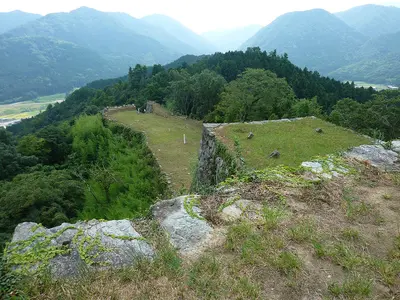
Stone foundations only — the five-story main tower and all wooden structures were demolished by the Mori clan themselves in 1874 under the Meiji government's castle abolition orders. The stone walls and foundations survive in excellent condition.

Stone walls

Natural stone stacking

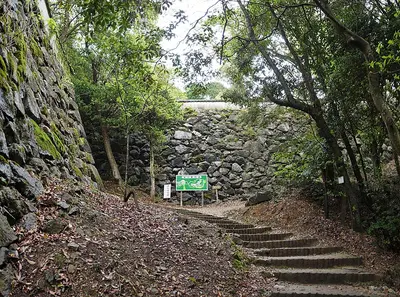
The surviving stone walls are among the most photographically striking castle ruins in western Japan — grey stone against the sea, with pine trees growing from the walls and shoreline rocks visible beyond. The walls using volcanic stone from the peninsula itself give Hagi a distinctive grey-brown coloring unlike the granite walls of many other castles.

Moats

The Sea of Japan and the Abu River form the natural outer moat on three sides. Inner stone-walled moats divided the compound — their outlines are still clearly visible in the ruins.

Key defensive features

Volcanic Peninsula Position

The castle occupies the tip of a small volcanic peninsula projecting into the sea at the mouth of the Abu River. Three sides face open water, leaving only the narrow land connection from the samurai town as the feasible approach route — an attacking army would have to fight through the entire castle town before reaching the walls.

Sea-Facing Stone Walls

The outer walls on the seaward faces rise directly from rocky shoreline, making any sea-borne assault onto the walls essentially impossible for the era's naval capabilities. The combination of natural cliff-edges and stone walls provided passive defense that required minimal garrison to hold.

Mt. Shizuki Rear Elevation

The volcanic hill of Mt. Shizuki rises behind the castle compound, providing elevated observation over the surrounding sea and land approaches. Watchtowers on the hilltop could spot approaching ships or armies hours before they reached the castle.

The Story of Hagi Castle

Originally built 1604 / Mori Terumoto
UNESCO World Heritage 2015
    1600

    After supporting the losing Western Army at Sekigahara, Mori Terumoto is stripped of most of his western Honshu territory by Tokugawa Ieyasu, reduced to the two provinces of Suo and Nagato (modern Yamaguchi Prefecture). He begins planning a new castle at Hagi.

    1604

    Mori Terumoto completes Hagi Castle on the volcanic peninsula. The Mori clan, once masters of western Honshu, settle into Hagi as a significantly reduced domain — but they never forget their losses and never fully reconcile with the Tokugawa order.

    1838

    Yoshida Shoin, the greatest intellectual influence on the Meiji Restoration, is born in Hagi. His Shoka Sonjuku academy, operating from a small building in the samurai town, produces the generation of young men — Ito Hirobumi, Yamagata Aritomo, Kusaka Genzui — who will overthrow the Tokugawa order decades later.

    1863

    The Choshu domain fires on Western ships passing through the Shimonoseki Strait, triggering the Shimonoseki Bombardment of 1864 in which British, French, Dutch, and American fleets destroy Choshu's coastal forts. The humiliation radicalizes Choshu's young samurai and accelerates the anti-Tokugawa movement.

    1874

    Under Meiji government orders to demolish feudal castles, the Mori clan tears down Hagi Castle's tower and wooden structures. The stone walls and ruins are preserved. The act is done with deliberate thoroughness — the Mori had waited 270 years for their revenge on Tokugawa, and now that Tokugawa was gone, they had no need for the castle that symbolized their confinement.

    2015

    'Sites of Japan's Meiji Industrial Revolution,' including Hagi's castle town and related sites, is inscribed as a UNESCO World Heritage Site.

Did You Know?

  • Five of Japan's first eleven Prime Ministers came from the Choshu domain centered on Hagi — a remarkable concentration of political power from a single small city. Ito Hirobumi (Japan's first PM, serving four terms), Yamagata Aritomo (two terms), Katsura Taro (three terms), and others all had roots in the Hagi castle town.
  • The Mori clan who built Hagi Castle had, just four years earlier, been the most powerful lord in western Honshu — controlling 11 provinces after decades of expansion. Their reduction to two provinces after Sekigahara was one of the most dramatic reversals of fortune in Japanese history, and the resentment this caused within Choshu domain is often cited as a root cause of the Meiji Restoration over 250 years later.
  • Yoshida Shoin, born in Hagi in 1830, attempted to sneak aboard one of Commodore Perry's American 'Black Ships' in 1854 to travel abroad and learn Western knowledge — illegal under Tokugawa law. He was caught, imprisoned, then placed under house arrest in Hagi, where he ran his illegal school and radicalized a generation of young samurai before his execution in 1859 at age 29.
  • Hagi's isolation — it sits on the remote Sea of Japan coast, accessible only by winding mountain roads — paradoxically preserved its historical townscape. Cities on major transportation routes were transformed by the railway age; Hagi was bypassed, and its Edo-period fabric survived almost by neglect.

Score Breakdown

Tourism Score

D 48/100
  • Accessibility 8 /20
  • Foreign-Friendly 7 /20
  • Historical Value 16 /20
  • Visual Impact 9 /20
  • Facilities 8 /20

Defense Score

B 78/100
  • Terrain Advantage 15 /20
  • Entrance Defense 15 /20
  • Internal Complexity 15 /20
  • Siege Endurance 16 /20
  • Strategic Oversight 17 /20

Planning Your Visit

Best Time to Visit

Spring (late March to May) and autumn (October–November) offer the best weather and scenery. Summer is hot but the sea breeze at the castle peninsula is pleasant. The town is at its most atmospheric in early morning or evening when day-trippers have left.

Time Needed

3–4 hours for castle ruins, Horiuchi district, and Yoshida Shoin shrine; half-day recommended

Insider Tip

Rent a bicycle from the station — Hagi is perfectly sized for cycling, and the flat roads through the samurai district are far more enjoyable by bike than on foot. Start at the castle, cycle through the Horiuchi samurai streets, stop at Yoshida Shoin's Shoka Sonjuku school, then continue to the Kikuya merchant residence and the Ito Hirobumi birthplace. The combination takes about three hours by bicycle and covers the essential layers of Hagi's extraordinary history.

Map

Getting There

Nearest station: Higashi-Hagi Station (JR San-in Main Line)
Walk from station: 25 min walk
Bus: Hagi Maru Bus (loop bus) serves the castle and samurai district areas. Recommended over walking in summer heat.
Parking: Free parking available near Shizuki Park. Rental bicycles are popular for exploring Hagi — several shops near the station.
Accessible with a JR Pass

Admission

Adult¥220
Child¥100

Elementary/junior high ¥100.

Opening Hours

Open08:30 – 18:30
Last entry18:00

Apr–Oct: 8:30–18:30. Nov–Feb: 8:30–16:30. Mar: 8:30–18:00.

Facilities

  • – English guides
  • – Audio guide
  • – Wheelchair access
  • ✓ Restrooms
  • ✓ Gift shop
  • ✓ Food nearby

Nearby Castles

Featured in collections

FAQ

Frequently Asked Questions

How do I get to Hagi Castle?

The nearest station is Higashi-Hagi Station (JR San-in Main Line). From there it is about 25 minutes on foot. Hagi Maru Bus (loop bus) serves the castle and samurai district areas. Recommended over walking in summer heat.

How much does Hagi Castle cost to enter?

Adult admission is ¥220 and child admission is ¥100.

Is Hagi Castle worth visiting?

Hagi rewards visitors who understand what they're looking at. The castle ruins themselves are beautiful — stone walls facing the sea, pine trees, volcanic peninsula — but the real reason to come is the intact samurai townscape surrounding the ruins, and the extraordinary density of historical significance compressed into this small city. Walking the Horiuchi district, you pass the birthplaces and residences of people who fundamentally transformed Japan. Yoshida Shoin's tiny school, where he taught the revolution to teenage samurai, is preserved behind a modest shrine. The combination of physical beauty and historical weight makes Hagi one of the most genuinely moving castle destinations in Japan.

What are the opening hours of Hagi Castle?

08:30 to 18:30, last entry 18:00.

How long should I spend at Hagi Castle?

Plan for about 3–4 hours for castle ruins, Horiuchi district, and Yoshida Shoin shrine; half-day recommended, depending on how closely you want to explore the grounds.