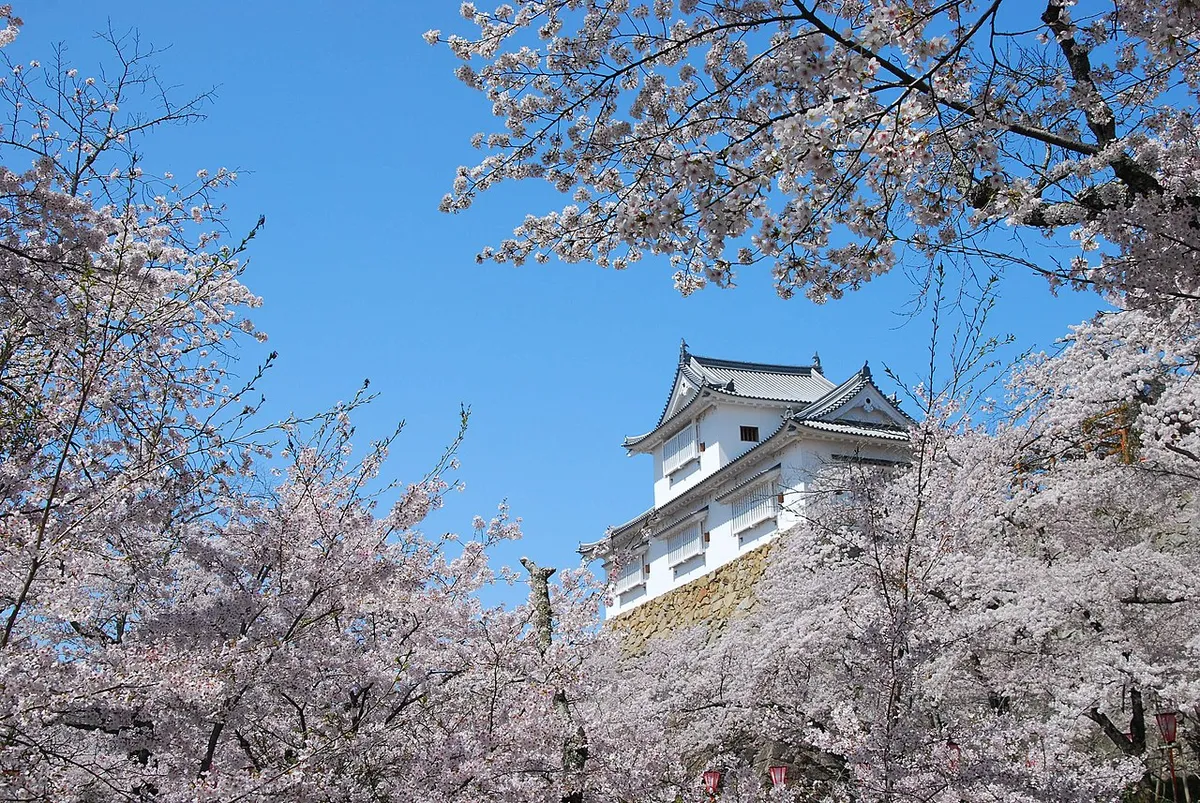
Tsuyama Castle

津山城·Tsuyama-jo

D Tourism Score 52/100
C Defense Score 69/100

Stone walls without a tower — Tsuyama's vast terraced ishigaki are a lesson in how much castle architecture is really about the ground, not the building on top of it.

#67 — 100 Famous Castles Ruins
Tsuyama Castle (津山城)
Photo:denteru/Wikimedia Commons/CC BY 3.0

Quick Facts

Quick Facts

Admission
¥310

¥0

Hours
08:40 – 19:00

Last entry 18:30

Nearest Station
Tsuyama Station (JR Tsuyama Line / JR Kishin Line)
Walk from Station
20 min walk

Bus also available

Time Needed
1-1.5 hours

Children (junior high and under) free. Cherry blossom season may have different pricing.

Defense Overview

Defense Overview

Why Tsuyama Castle was hard to attack

This castle is hard to attack because it combines a raised core with defended outer space with a controlled route inward.

An attacker would not get a simple direct approach to the center. They would have to cross water barriers or moat lines and face more defensive depth after the first line.

Overall score

69/100

Estimated range

63–75

Confidence

B

Usable estimate with some inference

This is a site-original comparison score for learning and comparison, not a reconstruction of one historical battle.

Radar view

Terrain 14/20 Entrance 14/20 Internal 16/20 Siege 13/20 Oversight 12/20
How this estimate was built+

This estimate combines broad terrain, approach, layout, and route-control signals. It is meant to explain the castle's defensive logic in plain English, not reconstruct a single historical attack.

Terrain Advantage

How much the terrain itself seems to help: height, slope, ridges, cliffs, water edges, and limited approach directions.

14/20

Entrance Defense

How awkward and dangerous the first entry looks: gates, bridge or moat crossings, chokepoints, and forced turns.

14/20

Internal Complexity

How hard it seems to keep pushing after entry: layered baileys, depth, compartmentalization, and repeated defensive lines.

16/20

Siege Endurance

A rough sense of long-hold potential: moats, water access, space, storage plausibility, and defensive staying power.

13/20

Strategic Oversight

How much the castle appears to command nearby roads, plains, rivers, basins, harbors, or town approaches.

12/20

Why Visit

Tsuyama Castle is a rewarding visit for anyone who has developed an appreciation for Japanese stone masonry — the walls are extensive, consistent, and remarkably well preserved for a site where every building was demolished 150 years ago. The terraced hillside gives you a physical sense of the castle's defensive logic in a way that reconstructed towers often don't. During cherry blossom season it becomes a spectacular visual experience. As a day trip from Okayama (about 50 minutes by JR), it combines naturally with the well-touristed Okayama Castle and Korakuen Garden.

Highlights

1

Japan's Third-Largest Stone Wall System

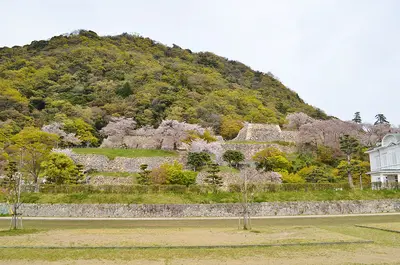
Tsuyama Castle is sometimes called 'the castle of stone walls' because the sheer volume of surviving ishigaki (stone masonry) is extraordinary for a site where every wooden structure is long gone. The walls — built in the nozurazumi (natural stone stacking) style — cover the entire hillside in tier after tier of carefully laid granite, creating an architecture of absence: the stone skeleton of a great castle, stripped of everything but its foundations. The total extent of surviving walls puts Tsuyama among Japan's most impressive stone wall complexes, behind only Osaka and Edo.
2

Cherry Blossom Capital of Northern Okayama

The Kakuzan Park castle ruins host over 1,000 cherry trees, making Tsuyama one of Okayama Prefecture's most celebrated hanami (cherry blossom viewing) destinations. In late March and early April, the stone walls disappear under a canopy of pink blossoms, and the castle's terraced structure — a series of stone platforms stepping up the hillside — creates a layered landscape of blossoms and ancient masonry that draws visitors from across the region.

3

A Sanuki's Ambitious Legacy

Tsuyama Castle was built by Mori Tadauji in 1604–1616 in a single massive construction campaign. The ambition of the project was extraordinary — 77 buildings, a five-story main tower, and some of the most extensive stone walls in western Japan, all constructed within the stable early Tokugawa period when there was no military reason to build so large. It was an expression of clan prestige, and the stone walls — impossible to demolish easily — are what remain of that ambition.

Structure Details

Visitor tip

The admission fee is for the castle park rather than any surviving tower — come for the stone walls, not a building. The walls are best appreciated by walking all the way to the main compound at the summit and looking back down at the terraced layers descending below you. During cherry blossom season, arrive early — the combination of pink blossoms and grey stone walls photographed from the hillside paths can be genuinely spectacular.

Castle type

Hill castle

Hill-top flatland castle — built on Kakuzan (Crane Mountain), a low wooded hill rising from the flat Tsuyama Basin along the Yoshii River

Layout type

Linked compound layout

Compound style — multiple walled terraces ascending the hillside to the main compound at the summit

Main tower

Stone ruins only — the original five-story main tower and all 77 buildings were demolished in 1874 during the Meiji government's castle demolition campaign, one of the most comprehensive clearances of any Japanese castle. Only the extensive stone walls remain.

Stone walls

Natural stone stacking

The stone walls at Tsuyama are the defining experience of the site — extensive, well-preserved, and covering the entire hillside in tier after interlocking tier. The walls were built in a single construction campaign (1604–1616) using uniform techniques, creating an unusual stylistic consistency across the entire complex. Some individual wall sections reach 7–8 meters in height.

Moats

The Yoshii River and an associated moat system encircled the castle base. Partial moat remnants are visible in the lower park area, though much of the outer moat has been absorbed into the modern cityscape.

Key defensive features

Terraced Stone Wall Labyrinth

The hillside is covered in multiple ascending stone terraces, each requiring separate assault before the next could be approached. The layout creates a maze of approaches with stone walls on every side, giving defenders firing positions from multiple elevations simultaneously.

Yoshii River Outer Barrier

The Yoshii River flows along the castle's western and southern perimeter, creating a natural water barrier that complicated any approach with siege equipment. Combined with the moat system on other sides, the castle was ringed by water.

The Story of Tsuyama Castle

Originally built 1604 / Mori Tadauji
Current form 1616 / Mori Tadauji (completion of initial construction campaign)
    1604

    Mori Tadauji, lord of Tsuyama domain, begins a massive construction campaign at Kakuzan Hill. The scale of the project — 77 buildings planned, with some of the most extensive stone walls in western Japan — reflects the ambition and wealth of the early Mori domain.

    1616

    The main construction campaign is complete. Tsuyama Castle now has a five-story main tower, multiple subsidiary towers and turrets, 77 buildings in total, and stone walls covering the entire hillside. It is one of the grandest castle complexes in the Chugoku region.

    1697

    The Mori clan is transferred out of Tsuyama domain due to financial mismanagement. The Matsudaira clan (a Tokugawa branch family) takes over Tsuyama domain, inheriting the castle.

    1874

    The Meiji government's decree requiring demolition of castles not needed for military purposes is applied comprehensively at Tsuyama — all 77 buildings are demolished, leaving only the stone walls. This makes Tsuyama one of the most complete Meiji-era castle demolitions in Japan, which paradoxically preserves its stone walls in pristine condition (nothing was rebuilt on them to disturb their original state).

    1955

    The remaining stone wall complex is designated an Important Cultural Property, beginning formal preservation. Cherry trees are planted in the park, creating the blossom landscape the site is now known for.

Did You Know?

  • The 1874 demolition at Tsuyama was remarkably thorough — all 77 original buildings, including the five-story main tower, were removed without trace. This completeness of demolition, while culturally tragic, inadvertently preserved the stone walls in their original condition, undisturbed by subsequent construction or modification.
  • Tsuyama's stone walls are sometimes cited by masonry experts as the best example of early Edo-period nozurazumi (natural stone stacking) in Japan — the consistent construction period (1604–1616) means the entire wall system reflects a single engineering philosophy, unlike most castles that were modified repeatedly.
  • The city of Tsuyama is known for a local beef dish (Tsuyama beef hot-pot, 'nabe') and for its preserved castle-town street layout — the grid pattern of the original domain town is still visible in the modern city center.
  • Tsuyama domain was frequently cited in Edo-period administrative records as a model of financial mismanagement — the Mori clan's removal in 1697 was triggered by debts that had accumulated over generations, in part because the original castle construction campaign had been ruinously expensive.

Score Breakdown

Tourism Score

D 52/100
  • Accessibility 10 /20
  • Foreign-Friendly 7 /20
  • Historical Value 13 /20
  • Visual Impact 13 /20
  • Facilities 9 /20

Defense Score

C 69/100
  • Terrain Advantage 14 /20
  • Entrance Defense 14 /20
  • Internal Complexity 16 /20
  • Siege Endurance 13 /20
  • Strategic Oversight 12 /20

Planning Your Visit

Best Time to Visit

Late March to early April for cherry blossoms — this is when Tsuyama is at its most beautiful and most visited. Autumn (October–November) for quieter visits with good light for photographing the stone walls. Avoid weekdays in summer when the site is often empty and facilities are minimal.

Time Needed

1-1.5 hours

Insider Tip

The best single viewpoint is from the main compound (Honmaru) looking back down the terraced hillside — you can count tier after tier of stone walls descending below you, all the way to the outer moat. This view makes the castle's scale comprehensible in a way that no map or photograph conveys. The information board at the main compound shows a reconstruction drawing of how the 77 buildings once filled these terraces — compare it with the empty stone reality.

Map

Getting There

Nearest station: Tsuyama Station (JR Tsuyama Line / JR Kishin Line)
Walk from station: 20 min walk
Bus: City loop buses from Tsuyama Station pass the castle park entrance. Bus stop 'Kakuzan-koen-mae.' The walk from the station through the castle town area is pleasant.
Parking: Paid parking at the castle park entrance. Reasonable capacity, rarely full except during cherry blossom peak.
Accessible with a JR Pass

Admission

Adult¥310
ChildFree

Children (junior high and under) free. Cherry blossom season may have different pricing.

Opening Hours

Open08:40 – 19:00
Last entry18:30

Hours vary by season: Apr–Aug 8:40–19:00; Sep 8:40–18:00; Oct–Mar 8:40–17:00. Closed December 29–31.

Facilities

  • – English guides
  • – Audio guide
  • – Wheelchair access
  • ✓ Restrooms
  • ✓ Gift shop
  • ✓ Food nearby

Nearby Castles

Featured in collections

FAQ

Frequently Asked Questions

How do I get to Tsuyama Castle?

The nearest station is Tsuyama Station (JR Tsuyama Line / JR Kishin Line). From there it is about 20 minutes on foot. City loop buses from Tsuyama Station pass the castle park entrance. Bus stop 'Kakuzan-koen-mae.' The walk from the station through the castle town area is pleasant.

How much does Tsuyama Castle cost to enter?

Adult admission is ¥310 and child admission is ¥0.

Is Tsuyama Castle worth visiting?

Tsuyama Castle is a rewarding visit for anyone who has developed an appreciation for Japanese stone masonry — the walls are extensive, consistent, and remarkably well preserved for a site where every building was demolished 150 years ago. The terraced hillside gives you a physical sense of the castle's defensive logic in a way that reconstructed towers often don't. During cherry blossom season it becomes a spectacular visual experience. As a day trip from Okayama (about 50 minutes by JR), it combines naturally with the well-touristed Okayama Castle and Korakuen Garden.

What are the opening hours of Tsuyama Castle?

08:40 to 19:00, last entry 18:30.

How long should I spend at Tsuyama Castle?

Plan for about 1-1.5 hours, depending on how closely you want to explore the grounds.