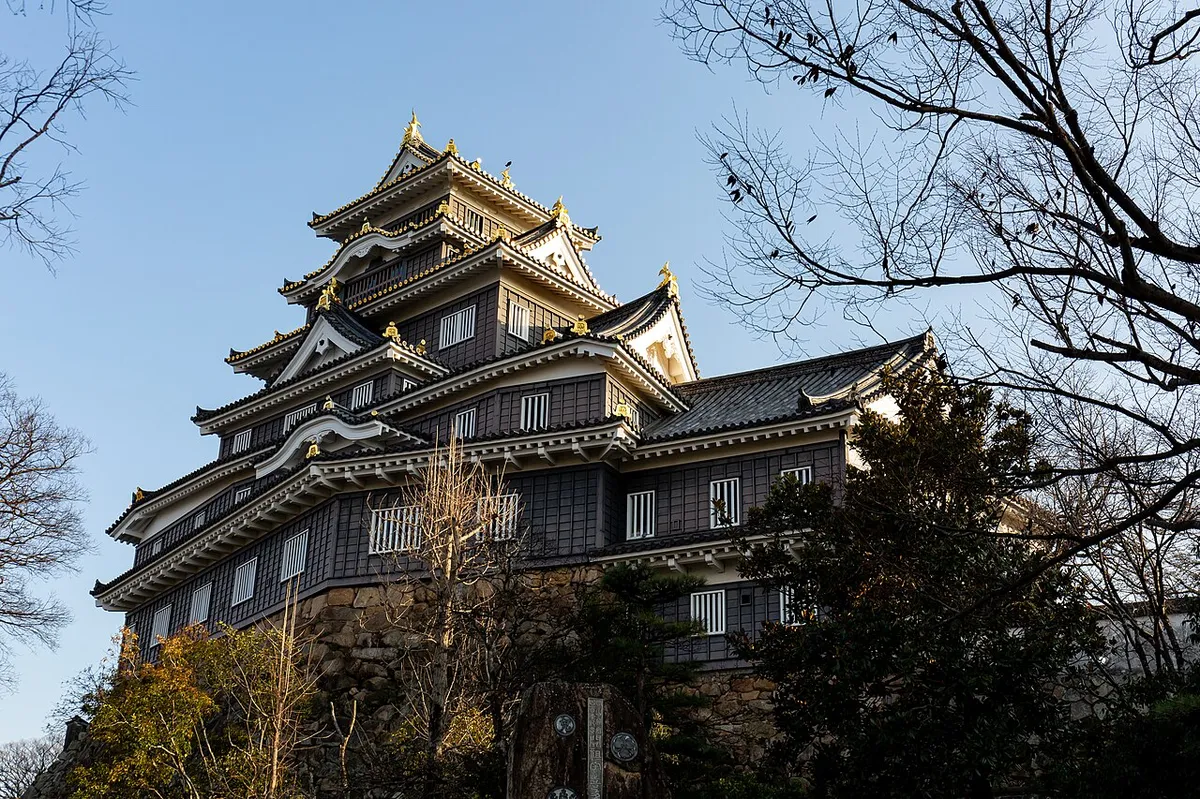
Okayama Castle

岡山城·Okayama-jo

B Tourism Score 73/100
B Defense Score 70/100

Japan's Black Crow Castle — freshly renovated, beautifully reflected in the Asahi River, and paired with one of Japan's finest gardens just across the water.

#70 — 100 Famous Castles Reconstructed
Okayama Castle (岡山城)
Photo:Balon Greyjoy/Wikimedia Commons/CC0

Quick Facts

Quick Facts

Admission
¥500

¥0

Hours
09:00 – 17:30

Last entry 17:00

Nearest Station
Okayama Station (JR Sanyo Shinkansen / JR Sanyo Main Line)
Walk from Station
25 min walk

Bus also available

Time Needed
2 hours for castle; allow 1-2 additional hours for Korakuen Garden

Admission increased to ¥500 from April 2026. Children (high school and under) free. Combined ticket with Korakuen Garden available (highly recommended).

Defense Overview

Defense Overview

Why Okayama Castle was hard to attack

This castle is hard to attack because it combines a raised core with defended outer space with enough defensive depth to slow attackers before the center.

An attacker would not get a simple direct approach to the center. They would have to cross water barriers or moat lines and push through successive outer areas before the core.

Overall score

70/100

Estimated range

64–76

Confidence

A

Strong multi-source support

This is a site-original comparison score for learning and comparison, not a reconstruction of one historical battle.

Radar view

Terrain 15/20 Entrance 14/20 Internal 16/20 Siege 13/20 Oversight 12/20
How this estimate was built+

This estimate combines broad terrain, approach, layout, and route-control signals. It is meant to explain the castle's defensive logic in plain English, not reconstruct a single historical attack.

Terrain Advantage

How much the terrain itself seems to help: height, slope, ridges, cliffs, water edges, and limited approach directions.

15/20

Entrance Defense

How awkward and dangerous the first entry looks: gates, bridge or moat crossings, chokepoints, and forced turns.

14/20

Internal Complexity

How hard it seems to keep pushing after entry: layered baileys, depth, compartmentalization, and repeated defensive lines.

16/20

Siege Endurance

A rough sense of long-hold potential: moats, water access, space, storage plausibility, and defensive staying power.

13/20

Strategic Oversight

How much the castle appears to command nearby roads, plains, rivers, basins, harbors, or town approaches.

12/20

Why Visit

Okayama Castle is excellent value for a concrete reconstruction — the 2022 renovation has made the interior experience genuinely good, and the combination with Korakuen Garden (just across the river, visible from the top floor) creates one of Japan's best single-day heritage experiences. The black tower's visual distinctiveness and the river reflection make it more photogenic than most reconstructed castles.

Highlights

1

The Crow Castle: Japan's Black Beauty

Okayama Castle is one of Japan's rare black castles — nicknamed 'Ujo' (Crow Castle) for its striking black lacquered wooden boards covering the exterior walls. The visual contrast with the more common white-plastered castles is dramatic, and the dark tower reflected in the Asahi River creates one of Japan's most distinctive castle images.
2

Completely Renovated in 2022

Okayama Castle completed a major interior renovation in November 2022, transforming it from a standard castle museum into an interactive, modern heritage experience. The renovation introduced English-language content throughout, hands-on exhibits, and significantly improved facilities — making it one of Japan's most visitor-friendly castle experiences.

3

Korakuen: Japan's Top Garden Next Door

Directly across the Asahi River from the castle sits Korakuen, consistently ranked among Japan's top three traditional gardens. The castle and garden were designed as a complementary pair — from Korakuen, the black tower reflected in the river is the garden's backdrop and focal point. This combination makes Okayama one of Japan's best single-day cultural destinations.

Structure Details

Visitor tip

The 2022 renovation makes the interior experience significantly better than most concrete reconstruction castles. Interactive exhibits on the lower floors cover Okayama's history and the castle's destruction in WWII. The top floor observation deck offers excellent views of Korakuen Garden directly across the river. Purchase the combined ticket for castle and Korakuen.

Castle type

Hill castle

Flatland hill castle — built on a low bluff above the Asahi River in the center of Okayama

Layout type

Linked compound layout

Compound style — main tower with subsidiary structures on the river bluff

Main tower

Concrete reconstruction (1966, renovated 2022) — the original black tower was destroyed in the 1945 bombing of Okayama. The reconstruction faithfully reproduces the original's distinctive black exterior.

22m6 floors, 2 below

Stone walls

Fitted cut-stone masonry

Stone walls rise from the Asahi River bluff, providing the elevated foundation for the black-walled tower. The walls are well-constructed but the site's primary defense was the river rather than elaborate stonework.

Key defensive features

Asahi River Natural Moat

The Asahi River on the eastern side provided a natural water barrier, reducing the perimeter requiring active defense and serving as a reliable moat against direct assault from that direction.

River Bluff Position

The castle's position on a bluff above the river gave it elevation advantage and good visibility over the river crossing points, making surprise approach from the water difficult.

The Story of Okayama Castle

Originally built 1597 / Ukita Hideie
Current form 1966 / Okayama City (reconstruction)
    1597

    Ukita Hideie completes Okayama Castle after years of construction, establishing it as the center of his 570,000-koku domain. The black-walled tower becomes a landmark of the Kibi region.

    1600

    Ukita Hideie supports the Western Army at the Battle of Sekigahara and loses. He is exiled, and Okayama Castle passes to Kobayakawa Hideaki (who betrayed the Western Army), then to the Ikeda clan.

    1654

    Ikeda Mitsumasa begins construction of Korakuen Garden across the Asahi River from the castle, creating the garden-castle landscape combination that defines Okayama to this day.

    1945

    US air raids on June 29 destroy most of Okayama's historic buildings. The main castle tower burns to the ground. The original 'Tsukimi Yagura' (moon-viewing turret) survives as the only original castle structure.

    1966

    Okayama City constructs a concrete reproduction of the original black tower, restoring the castle's distinctive appearance to the Okayama skyline.

    2022

    A major renovation of the tower interior is completed, completely modernizing the visitor experience with interactive exhibits, English content throughout, and improved facilities.

In Pop Culture

folklore

Momotaro Mythology

Okayama is the claimed birthplace of Momotaro (Peach Boy) — Japan's most beloved folk hero. The legend's imagery is everywhere in the city, including at the castle, connecting the historical site to popular cultural mythology.

Did You Know?

  • The black exterior of Okayama Castle was achieved using charcoal-coated wooden shingles (roofing) and black lacquered boards — a deliberate design choice by lord Ukita Hideie to make the tower visually distinctive and imposing.
  • The 'Tsukimi Yagura' (moon-viewing turret) that survived the 1945 bombing is the only original structure remaining from the Sengoku-era castle. It is designated an Important Cultural Property.
  • Korakuen Garden, built as the castle's companion landscape, takes its name from a Chinese poem phrase meaning 'one who delays pleasure until after the hardship of others' — a Confucian ideal of virtuous rulership that Ikeda Mitsumasa wanted to embody.
  • Okayama Prefecture is Japan's largest producer of white peaches and Muscat grapes — luxury fruits associated with the fertile Kibi region that the castle once administered. The famous Okayama Muscat grapes command prices of ¥5,000–20,000 per bunch.

Score Breakdown

Tourism Score

B 73/100
  • Accessibility 15 /20
  • Foreign-Friendly 14 /20
  • Historical Value 14 /20
  • Visual Impact 16 /20
  • Facilities 14 /20

Defense Score

B 70/100
  • Terrain Advantage 15 /20
  • Entrance Defense 14 /20
  • Internal Complexity 16 /20
  • Siege Endurance 13 /20
  • Strategic Oversight 12 /20

Planning Your Visit

Best Time to Visit

Spring cherry blossoms in Korakuen (late March to early April) with the black castle backdrop are spectacular. Autumn foliage in November is equally beautiful. Avoid summer heat; winter is pleasant in Okayama's mild climate.

Time Needed

2 hours for castle; allow 1-2 additional hours for Korakuen Garden

Insider Tip

Always buy the combined ticket for castle and Korakuen Garden — separately they cost more, and the garden is at least as rewarding as the castle. Enter the garden first in the morning when it's quiet, photograph the castle reflection in the garden ponds, then cross to the castle. The Tsukimi Yagura (moon-viewing turret) in the castle compound is the only original surviving structure and often overlooked — it is designated an Important Cultural Property.

Map

Getting There

Nearest station: Okayama Station (JR Sanyo Shinkansen / JR Sanyo Main Line)
Walk from station: 25 min walk
Bus: City tram (streetcar) to Shiroshita stop, then short walk. City loop bus also available.
Parking: Paid parking near the castle. Train and tram recommended from Okayama Station.
Accessible with a JR Pass

Admission

Adult¥500
ChildFree

Admission increased to ¥500 from April 2026. Children (high school and under) free. Combined ticket with Korakuen Garden available (highly recommended).

Opening Hours

Open09:00 – 17:30
Last entry17:00

Closed December 29–31. Extended hours during special events.

Facilities

  • – English guides
  • ✓ Audio guide
  • ✓ Wheelchair access
  • ✓ Restrooms
  • ✓ Gift shop
  • ✓ Food nearby

Audio guide languages: English, Japanese, Chinese, Korean

Nearby Castles

Featured in collections

FAQ

Frequently Asked Questions

How do I get to Okayama Castle?

The nearest station is Okayama Station (JR Sanyo Shinkansen / JR Sanyo Main Line). From there it is about 25 minutes on foot. City tram (streetcar) to Shiroshita stop, then short walk. City loop bus also available.

How much does Okayama Castle cost to enter?

Adult admission is ¥500 and child admission is ¥0.

Is Okayama Castle worth visiting?

Okayama Castle is excellent value for a concrete reconstruction — the 2022 renovation has made the interior experience genuinely good, and the combination with Korakuen Garden (just across the river, visible from the top floor) creates one of Japan's best single-day heritage experiences. The black tower's visual distinctiveness and the river reflection make it more photogenic than most reconstructed castles.

What are the opening hours of Okayama Castle?

09:00 to 17:30, last entry 17:00.

How long should I spend at Okayama Castle?

Plan for about 2 hours for castle; allow 1-2 additional hours for Korakuen Garden, depending on how closely you want to explore the grounds.