Yamanaka Castle

山中城·Yamanaka-jo

D Tourism Score 45/100
A Defense Score 88/100

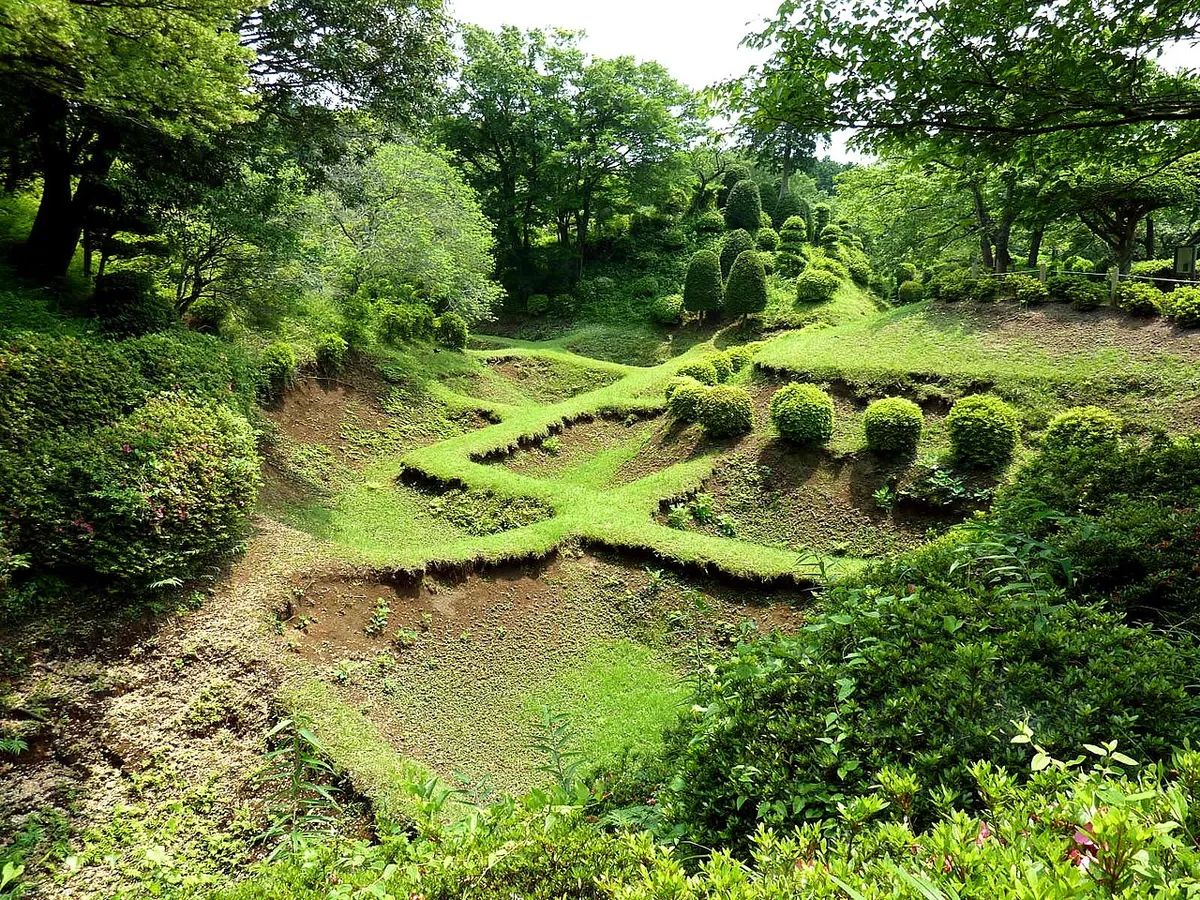
The castle with the waffle moats — Japan's most ingenious earthwork defense, where the Hojo clan's engineering genius met Hideyoshi's unstoppable force for half a day in 1590.

#40 — 100 Famous Castles Ruins
Yamanaka Castle (山中城)
Photo:Mocchy at Japanese Wikipedia/Wikimedia Commons/Public domain

Quick Facts

Quick Facts

Admission
Free Free
Hours
00:00 – 23:59
Nearest Station
Mishima Station (JR Tokaido Shinkansen / JR Tokaido Main Line)
Walk from Station
0 min walk

Bus also available

Time Needed
1.5–2 hours for the full ruins trail including shoji-bori and main compound

Completely free. A small museum pavilion at the entrance has nominal exhibits — no admission fee. Bring water and appropriate footwear for the trail terrain.

Defense Overview

Defense Overview

Why Yamanaka Castle was hard to attack

This castle is hard to attack because it combines high ground and difficult natural access with a controlled route inward.

An attacker would first have to fight the site itself before reaching the main defenses. They would have to cross water barriers or moat lines, approach through at least some constrained entry space, and face more defensive depth after the first line.

Overall score

88/100

Estimated range

82–94

Confidence

B

Usable estimate with some inference

This is a site-original comparison score for learning and comparison, not a reconstruction of one historical battle.

Radar view

Terrain 20/20 Entrance 19/20 Internal 14/20 Siege 16/20 Oversight 19/20
How this estimate was built+

This estimate combines broad terrain, approach, layout, and route-control signals. It is meant to explain the castle's defensive logic in plain English, not reconstruct a single historical attack.

Terrain Advantage

How much the terrain itself seems to help: height, slope, ridges, cliffs, water edges, and limited approach directions.

20/20

Entrance Defense

How awkward and dangerous the first entry looks: gates, bridge or moat crossings, chokepoints, and forced turns.

19/20

Internal Complexity

How hard it seems to keep pushing after entry: layered baileys, depth, compartmentalization, and repeated defensive lines.

14/20

Siege Endurance

A rough sense of long-hold potential: moats, water access, space, storage plausibility, and defensive staying power.

16/20

Strategic Oversight

How much the castle appears to command nearby roads, plains, rivers, basins, harbors, or town approaches.

19/20

Why Visit

Yamanaka Castle is one of Japan's genuinely unmissable free sites for anyone interested in military history or castle engineering. The shoji-bori (waffle-grid moat) sections are extraordinary — nothing else like them exists anywhere in Japanese castle history, and their visual impact is immediate even for visitors with no prior knowledge of Japanese castle design. The combination of spectacular earthworks, excellent preservation, Mt. Fuji views, and easy Shinkansen access from Tokyo makes Yamanaka the best value per hour of any castle in the Kanto/Chubu region. The half-day 1590 battle context adds stakes that purely peaceful castle parks cannot match.

Highlights

1

The Waffle-Grid Moats: Japan's Most Ingenious Earthwork

Yamanaka Castle contains Japan's most spectacular and unique earthwork feature: the 'shoji-bori' (障子堀, shoji-screen moats), named because they resemble the grid pattern of traditional Japanese sliding screen panels. Instead of a simple ditch, the moats are divided internally by perpendicular earthwork ridges into a regular grid of separate cells — like a giant waffle iron cut into the hillside. No other castle in Japan used this technique. The shoji-bori made the moats essentially uncrossable: any attacker who entered a cell was trapped between walls on three or four sides, unable to climb out or advance, while defenders above could target them at will.
2

Toyotomi Hideyoshi's First Assault

In March 1590, Yamanaka Castle was the first fortification attacked in Toyotomi Hideyoshi's massive campaign to destroy the Later Hojo clan and unify Japan. Hideyoshi personally led a force estimated at 70,000–100,000 troops against a garrison of approximately 4,000. Despite the extraordinary numerical disparity, the battle lasted half a day — the Hojo earthwork defenses, including the shoji-bori, extracted significant casualties from Hideyoshi's forces before the garrison was overwhelmed. The castle fell, but its defense became a benchmark for Hojo engineering capability.

3

Mt. Fuji's Defensive Moat

Yamanaka Castle sits on the old Tokaido road on the eastern approach to the Hakone mountain pass — the key route between eastern and western Japan. Mt. Fuji rises dramatically above the castle to the north, and on clear days the view of Fuji from the castle ruins is extraordinary. The castle was designed as a barrier fortress blocking the Tokaido — anyone traveling between Edo and Kyoto had to pass through or around it. It was Japan's last mountain gate before the Kanto Plain.

Structure Details

Visitor tip

Yamanaka Castle is one of the most rewarding free sites in Japan for anyone interested in castle architecture. The shoji-bori (waffle-grid moat) sections are visually spectacular and completely unlike anything at other Japanese castle ruins — even visitors with no castle knowledge can immediately see how extraordinary the grid pattern is. The ruins are well-maintained and clearly labeled (Japanese only, but the visual features are self-evident). Allow 1.5–2 hours for the full ruins trail, and go at the beginning or end of the day for the best Mt. Fuji views.

Castle type

Mountain castle

Mountain castle — built at 580 meters elevation on the ridgeline of the Hakone volcanic plateau, straddling the old Tokaido road with the mountain terrain as the primary defensive base

Layout type

Ladder layout

Tier-style — successive defensive compounds and moat systems following the ridge contours, designed to control passage along the Tokaido road below

Main tower

No main tower — Yamanaka Castle had no tenshu (main keep). Its defensive power lay entirely in the earthwork engineering, particularly the unique shoji-bori (waffle-grid) moat system. The ruins are among the best-preserved earthwork castle remains in Japan.

Stone walls

Earthen walls

Yamanaka Castle's earthwork remains are among the finest and best-preserved in Japan. The shoji-bori (waffle-grid moat) sections are particularly spectacular — meter-deep cells divided by perpendicular earthwork ridges covering large sections of the approach terrain. The earthworks have been carefully restored and interpreted with explanatory signs, making Yamanaka one of Japan's most accessible earthwork castle experiences despite the lack of any stone or wooden construction.

Moats

Multiple moat types across the site: standard horikiri (ridge-cut moats) blocking the ridge approaches, nidan-bori (two-tier moats) creating double barriers, and the unique shoji-bori (waffle-grid moats) that are found nowhere else in Japanese castle history. The moat systems collectively demonstrate the full range of Hojo earthwork defensive engineering.

Key defensive features

Shoji-bori (Waffle-Grid Moats)

The unique defensive innovation of Yamanaka Castle: moats divided internally by a regular grid of earthwork ridges, creating a pattern of individual cells like a waffle iron or shoji screen panel. Any attacker entering a cell was trapped — unable to climb the internal ridges, surrounded on multiple sides, exposed to fire from the raised walls above. The psychological effect of entering what appeared to be a simple moat and finding yourself in a maze of earthwork walls was reportedly terrifying. No other Japanese castle used this technique.

Tokaido Road Control

The castle straddled Japan's most important road — the Tokaido connecting the political center of Kyoto/Osaka with the Hojo heartland in Kanto. Any army advancing from west to east had to pass through the Hakone mountain pass immediately above Yamanaka, where the castle's fire could control the road. The castle was less a defensive refuge than an active road-blocking weapon.

Multiple Moat Type System

Yamanaka deploys horikiri (ridge-cut moats), nidan-bori (tiered double moats), and shoji-bori (waffle moats) in different areas for different tactical purposes — ridge approaches get horikiri, broad slope approaches get nidan-bori, and the critical assault sectors get shoji-bori. This differentiated use of moat types shows deliberate tactical engineering thinking rather than formulaic application of a single defense type.

Volcanic Terrain Integration

The castle exploits the volcanic landscape of the Hakone plateau — natural ravines, steep volcanic ridges, and the instability of volcanic soil for assault approaches. The combination of natural volcanic terrain and engineered earthworks created an environment where attackers could never be certain what was natural obstacle and what was designed trap.

The Story of Yamanaka Castle

Originally built 1560 / Hojo Ujiyasu
    1560

    The Later Hojo clan establishes a fortification at Yamanaka on the Tokaido road, recognizing the strategic value of controlling the eastern approach to the Hakone mountain pass — the gateway between the Kanto region and the rest of Japan.

    1580

    As Toyotomi Hideyoshi's power grows in western Japan and the threat of a major campaign against the Hojo becomes increasingly real, the clan massively expands Yamanaka Castle with the sophisticated earthwork systems visible today — including the unique shoji-bori (waffle-grid moat) that makes Yamanaka unique in Japanese castle history.

    1590

    March 29: Toyotomi Hideyoshi's army of 70,000–100,000 troops assaults Yamanaka Castle, defended by approximately 4,000 men under Hojo Ujikatu. After half a day of intense fighting in which the shoji-bori and earthwork defenses inflict significant casualties, the garrison is overwhelmed and killed. Yamanaka is the first castle to fall in Hideyoshi's Odawara campaign. The entire Hojo clan surrenders weeks later.

    1590

    After the Hojo defeat, Yamanaka Castle is abandoned. Tokugawa Ieyasu, assigned to the former Hojo territories, has no use for a castle on the Tokaido road when the threat of invasion has ended. The earthworks are left to the forest.

    1930

    Yamanaka Castle is designated a national historic site. The earthwork remains begin receiving academic attention and eventually conservation work.

    1970

    Mishima City begins systematic archaeological survey and restoration of the castle earthworks, eventually producing the well-maintained ruins trails and interpretive signs that make Yamanaka one of Japan's most accessible earthwork castle sites today.

Did You Know?

  • The shoji-bori (waffle-grid moat) at Yamanaka Castle has no known parallels in Japanese castle history — no other castle, before or after, used the internal grid subdivision of moat cells as a defensive technique. Castle scholars have debated whether the innovation came from a specific engineer, was developed through accumulated experience, or was a deliberate response to Hideyoshi's known siege tactics. The 1590 attack came before the technique could be tested and refined.
  • Toyotomi Hideyoshi's assault on Yamanaka Castle on March 29, 1590 is the subject of detailed records in several war chronicles — the accounts note significant casualties among Hideyoshi's forces despite the overwhelming disparity in numbers. The garrison commander Hojo Ujikatu reportedly died in the defense. The speed of the fall (half a day vs. months for some contemporary sieges) reflects Hideyoshi's tactical skill at overrunning earthwork defenses, not the defenses' inadequacy.
  • The old Tokaido road, which Yamanaka Castle was designed to block, is directly under modern National Route 1 where it passes the castle ruins — travelers on the modern highway are following exactly the same route that armies, merchants, and pilgrims have used for over 1,000 years. The castle earthworks are visible from the road.
  • On clear winter days, Mt. Fuji appears almost directly above Yamanaka Castle's main compound from certain viewing angles — a compositional coincidence that appears in numerous castle photography publications. The combination of earthwork ruins in the foreground, bare winter trees, and Fuji's perfect cone behind is one of the more striking landscape combinations in Japanese historical photography.

Score Breakdown

Tourism Score

D 45/100
  • Accessibility 9 /20
  • Foreign-Friendly 6 /20
  • Historical Value 15 /20
  • Visual Impact 9 /20
  • Facilities 6 /20

Defense Score

A 88/100
  • Terrain Advantage 20 /20
  • Entrance Defense 19 /20
  • Internal Complexity 14 /20
  • Siege Endurance 16 /20
  • Strategic Oversight 19 /20

Planning Your Visit

Best Time to Visit

Autumn (October–November) for foliage and morning mist in the earthwork moats — the combination creates the most photogenic conditions. Clear winter days (December–February) offer the best Mt. Fuji views. Spring cherry blossoms in April add color. Summer is manageable at 580 meters even when the Tokai Plain below is hot.

Time Needed

1.5–2 hours for the full ruins trail including shoji-bori and main compound

Insider Tip

The shoji-bori moat section is in the east compound area — follow the trail signs toward 'nishi-kuruwa' and 'shoji-bori' from the entrance. Stand at the top of the outer moat wall and look down into the grid cells: the waffle pattern is clearest from above, and the depth of the individual cells (a person standing inside cannot easily see over the internal ridge walls) immediately demonstrates why the technique was effective. Then walk down into the moat to experience it from the attacker's perspective — the sense of enclosure and exposure is visceral.

Map

Getting There

Nearest station: Mishima Station (JR Tokaido Shinkansen / JR Tokaido Main Line)
Walk from station: 0 min walk
Bus: Bus from Mishima Station (Tokai Bus, bound for Gotemba or Hakone) stops at Yamanaka-jo (Yamakura-jo Iriguchi) — approximately 25 minutes. Bus runs several times daily; confirm schedule before departure.
Parking: Free parking available at the castle ruins entrance on National Route 1. Mishima Station is a Shinkansen stop — excellent access from Tokyo (35 min), Nagoya, or Osaka.
Accessible with a JR Pass

Admission

Free

Completely free. A small museum pavilion at the entrance has nominal exhibits — no admission fee. Bring water and appropriate footwear for the trail terrain.

Opening Hours

Open00:00 – 23:59

Open year-round. The ruins are on the old Tokaido road at 580 meters elevation — morning mist in autumn and spring creates exceptional atmospheric conditions. Snow is possible November–March.

Facilities

  • – English guides
  • – Audio guide
  • – Wheelchair access
  • ✓ Restrooms
  • – Gift shop
  • – Food nearby

Nearby Castles

Featured in collections

FAQ

Frequently Asked Questions

How do I get to Yamanaka Castle?

The nearest station is Mishima Station (JR Tokaido Shinkansen / JR Tokaido Main Line). From there it is about 0 minutes on foot. Bus from Mishima Station (Tokai Bus, bound for Gotemba or Hakone) stops at Yamanaka-jo (Yamakura-jo Iriguchi) — approximately 25 minutes. Bus runs several times daily; confirm schedule before departure.

How much does Yamanaka Castle cost to enter?

Yamanaka Castle is free to enter.

Is Yamanaka Castle worth visiting?

Yamanaka Castle is one of Japan's genuinely unmissable free sites for anyone interested in military history or castle engineering. The shoji-bori (waffle-grid moat) sections are extraordinary — nothing else like them exists anywhere in Japanese castle history, and their visual impact is immediate even for visitors with no prior knowledge of Japanese castle design. The combination of spectacular earthworks, excellent preservation, Mt. Fuji views, and easy Shinkansen access from Tokyo makes Yamanaka the best value per hour of any castle in the Kanto/Chubu region. The half-day 1590 battle context adds stakes that purely peaceful castle parks cannot match.

What are the opening hours of Yamanaka Castle?

00:00 to 23:59.

How long should I spend at Yamanaka Castle?

Plan for about 1.5–2 hours for the full ruins trail including shoji-bori and main compound, depending on how closely you want to explore the grounds.