Murakami Castle

村上城·Murakami-jo

D Tourism Score 40/100
A Defense Score 86/100

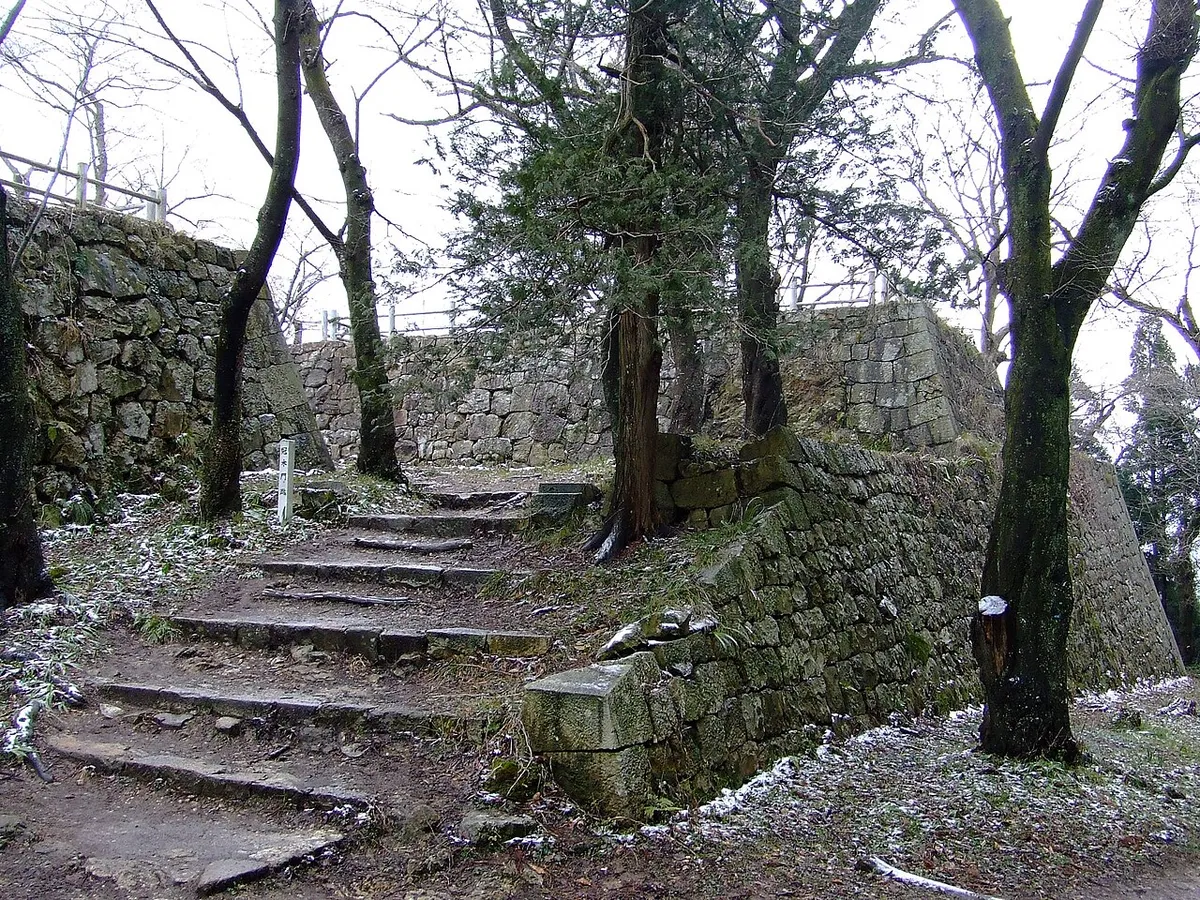
Beautiful mountain stone walls — overgrown, mossy, and utterly authentic — above one of the best-preserved castle towns in the Echigo region.

#131 — Continued 100 Castles Ruins
Murakami Castle (村上城)
Photo:No machine-readable author provided. Geomr~commonswiki assumed (based on copyright claims)./Wikimedia Commons/CC BY-SA 3.0

Quick Facts

Quick Facts

Admission
Free Free
Hours
00:00 – 23:59
Nearest Station
Murakami Station (JR Uetsu Main Line)
Walk from Station
25 min walk
Time Needed
2–2.5 hours including mountain hike and castle town walk

Castle ruins are freely accessible at all times. No admission fee. A small local history museum at the base has minimal charge.

Defense Overview

Defense Overview

Why Murakami Castle was hard to attack

This castle is hard to attack because it combines high ground and difficult natural access with a controlled route inward.

An attacker would first have to fight the site itself before reaching the main defenses. They would have to cross water barriers or moat lines and face more defensive depth after the first line.

Overall score

86/100

Estimated range

80–92

Confidence

B

Usable estimate with some inference

This is a site-original comparison score for learning and comparison, not a reconstruction of one historical battle.

Radar view

Terrain 19/20 Entrance 17/20 Internal 17/20 Siege 15/20 Oversight 18/20
How this estimate was built+

This estimate combines broad terrain, approach, layout, and route-control signals. It is meant to explain the castle's defensive logic in plain English, not reconstruct a single historical attack.

Terrain Advantage

How much the terrain itself seems to help: height, slope, ridges, cliffs, water edges, and limited approach directions.

19/20

Entrance Defense

How awkward and dangerous the first entry looks: gates, bridge or moat crossings, chokepoints, and forced turns.

17/20

Internal Complexity

How hard it seems to keep pushing after entry: layered baileys, depth, compartmentalization, and repeated defensive lines.

17/20

Siege Endurance

A rough sense of long-hold potential: moats, water access, space, storage plausibility, and defensive staying power.

15/20

Strategic Oversight

How much the castle appears to command nearby roads, plains, rivers, basins, harbors, or town approaches.

18/20

Why Visit

Murakami rewards visitors who seek genuine ruins over reconstructions. The stone walls climbing the forested mountain slopes have the kind of weathered beauty that takes centuries to develop, and no reconstruction can fake. The castle town below is independently worth exploring — preserved merchant streets, sake breweries, and the northernmost tea cultivation in Japan. Together, castle and town make Murakami one of the more satisfying off-the-beaten-path heritage stops in the Uetsu coastal region.

Highlights

1

Stone Walls on a Mountain — Without a Tower

Murakami Castle is celebrated among castle enthusiasts for something counterintuitive: its ruins are among the most beautiful in the Hokuriku-Echigo region precisely because there is nothing left but stone. The ishigaki (stone walls) ascending the mountain slopes in elegant geometric patterns, now overgrown with moss and framed by cedar forest, have a quality that concrete reconstructions can never replicate — the beauty of time and authenticity.
2

Gateway to the North — Control of the Uetsu Road

Murakami Castle commanded the Uetsu road — the coastal highway linking the Tohoku region to Echigo Province (modern Niigata). Whoever held Murakami held the strategic gateway between northeastern and northwestern Japan. During the Sengoku period, this made the castle a constant target of competing powers, including Uesugi Kenshin's forces to the south.

3

Murakami's Preserved Samurai Town

Below the castle mountain, Murakami has preserved one of the finest castle town (jokamachi) streetscapes in the Tohoku/Echigo region. Streets of traditional merchant and samurai houses, a sake brewery district, and the famous Murakami tea culture (the northernmost tea production area in Japan) combine with the castle ruins to make this a genuinely rich heritage destination.

Structure Details

Visitor tip

Prepare for a genuine mountain hike — the trail to the summit takes 20–30 minutes and is moderately steep. Wear appropriate footwear. The reward is beautiful stone walls draped in forest and views over the Sea of Japan coastal plain. No tower, no exhibits — this is a pure ruins experience for those who appreciate the aesthetic of time-worn stone in natural settings.

Castle type

Mountain castle

Mountain castle — built on the summit and slopes of Garan-yama (Mt. Garan), commanding views of the coastal Uetsu road and the Murakami basin below

Layout type

Linked compound layout

Compound style — multiple terraced compounds following the mountain's natural contours, with the honmaru at the summit

Main tower

Stone ruins only — no surviving wooden structures. The ishigaki (stone walls) ascending the mountain slopes survive in notably good condition and are the principal attraction of the site.

Stone walls

Natural stone stacking

The stone walls of Murakami Castle are among the most celebrated ruins in the Echigo region. Rising in terraced geometric patterns along the steep mountain slopes, built from local stone, and now draped in moss and surrounded by mature cedar, the walls have an organic beauty heightened by their completeness of ruin. No reconstruction distracts from the quality of the original masonry.

Key defensive features

Mountain Summit Position

The castle's summit position on Garan-yama provides 360-degree visibility over the surrounding coastal plain and the Sea of Japan. The steep approaches — particularly from the western and northern sides — make any assault extremely physically demanding.

Terraced Stone Wall System

The mountain slopes are covered in successive terraced stone walls, each requiring a separate breach. Attackers fighting uphill through multiple walls of stone under fire from defenders above faced an exhausting and costly climb.

Coastal and River Observation

The castle's hilltop position allows observation of both the Sea of Japan coastline and the Murakami River valley — giving defenders advance warning of approaching forces from any direction.

The Story of Murakami Castle

Originally built 1336 / Honjo clan (initial fortification)
Current form 1598 / Murakami Yoshiaki (major stone wall construction)
    1336

    The Honjo clan establishes a fortification on Garan-yama, asserting control over the strategic Uetsu coastal road through northern Echigo Province.

    1568

    Uesugi Kenshin incorporates Murakami into his domain after decades of conflict in Echigo. The castle becomes part of the Uesugi network of northern fortifications.

    1598

    Murakami Yoshiaki undertakes major stone wall construction, transforming the mountain fortification into a proper early-modern castle with sophisticated ishigaki. The stone walls visible today date primarily from this period.

    1618

    Under Tokugawa domain reorganization, Murakami becomes an important northeastern Echigo domain. The castle undergoes further modifications as a strategic monitoring point for the northern road.

    1871

    Domain abolition under the Meiji government leads to the castle's demolition. The mountain reverts to forest, preserving the stone walls in a natural state that has aged into scenic ruins.

Did You Know?

  • Murakami is Japan's northernmost tea production area — the local Murakami-cha (Murakami tea) has been cultivated since the 17th century and is a regional specialty entirely unknown outside the Niigata region. Tea fields visible from the road between the station and castle add an unexpected agricultural dimension to a castle town visit.
  • The castle town below Murakami preserves one of the finest jokamachi (castle town) streetscapes in the region, with traditional sake breweries, preserved merchant houses, and a distinctive local architecture. The town's preservation is partly due to its relative obscurity — it was never redeveloped because it was never heavily touristed.
  • Murakami is also famous for its traditional sake production and for a unique local craft: kisaké — a type of sake brewed with local mountain water. Several breweries in the castle town are still in operation after centuries of continuous production.

Score Breakdown

Tourism Score

D 40/100
  • Accessibility 7 /20
  • Foreign-Friendly 6 /20
  • Historical Value 12 /20
  • Visual Impact 10 /20
  • Facilities 5 /20

Defense Score

A 86/100
  • Terrain Advantage 19 /20
  • Entrance Defense 17 /20
  • Internal Complexity 17 /20
  • Siege Endurance 15 /20
  • Strategic Oversight 18 /20

Planning Your Visit

Best Time to Visit

May–June for green foliage setting off the grey stone walls. October–November for autumn colors surrounding the ruins. Avoid December–March when the mountain trail may be icy.

Time Needed

2–2.5 hours including mountain hike and castle town walk

Insider Tip

Combine the castle ruins with a walk through the preserved jokamachi streetscape below — the two together tell the complete story of a castle town, from mountain fortress to merchant community. Look for the local tea fields on the outskirts of town: seeing tea cultivation this far north is genuinely surprising.

Map

Getting There

Nearest station: Murakami Station (JR Uetsu Main Line)
Walk from station: 25 min walk
Parking: Parking available at the base of the mountain. A short trail climb of 20–30 minutes reaches the main summit compound.
Accessible with a JR Pass

Admission

Free

Castle ruins are freely accessible at all times. No admission fee. A small local history museum at the base has minimal charge.

Opening Hours

Open00:00 – 23:59

Ruins accessible at all times. The mountain trail to the summit may be slippery in winter. Best visited April–November.

Facilities

  • – English guides
  • – Audio guide
  • – Wheelchair access
  • – Restrooms
  • – Gift shop
  • ✓ Food nearby

Nearby Castles

Featured in collections

FAQ

Frequently Asked Questions

How do I get to Murakami Castle?

The nearest station is Murakami Station (JR Uetsu Main Line). From there it is about 25 minutes on foot.

How much does Murakami Castle cost to enter?

Murakami Castle is free to enter.

Is Murakami Castle worth visiting?

Murakami rewards visitors who seek genuine ruins over reconstructions. The stone walls climbing the forested mountain slopes have the kind of weathered beauty that takes centuries to develop, and no reconstruction can fake. The castle town below is independently worth exploring — preserved merchant streets, sake breweries, and the northernmost tea cultivation in Japan. Together, castle and town make Murakami one of the more satisfying off-the-beaten-path heritage stops in the Uetsu coastal region.

What are the opening hours of Murakami Castle?

00:00 to 23:59.

How long should I spend at Murakami Castle?

Plan for about 2–2.5 hours including mountain hike and castle town walk, depending on how closely you want to explore the grounds.