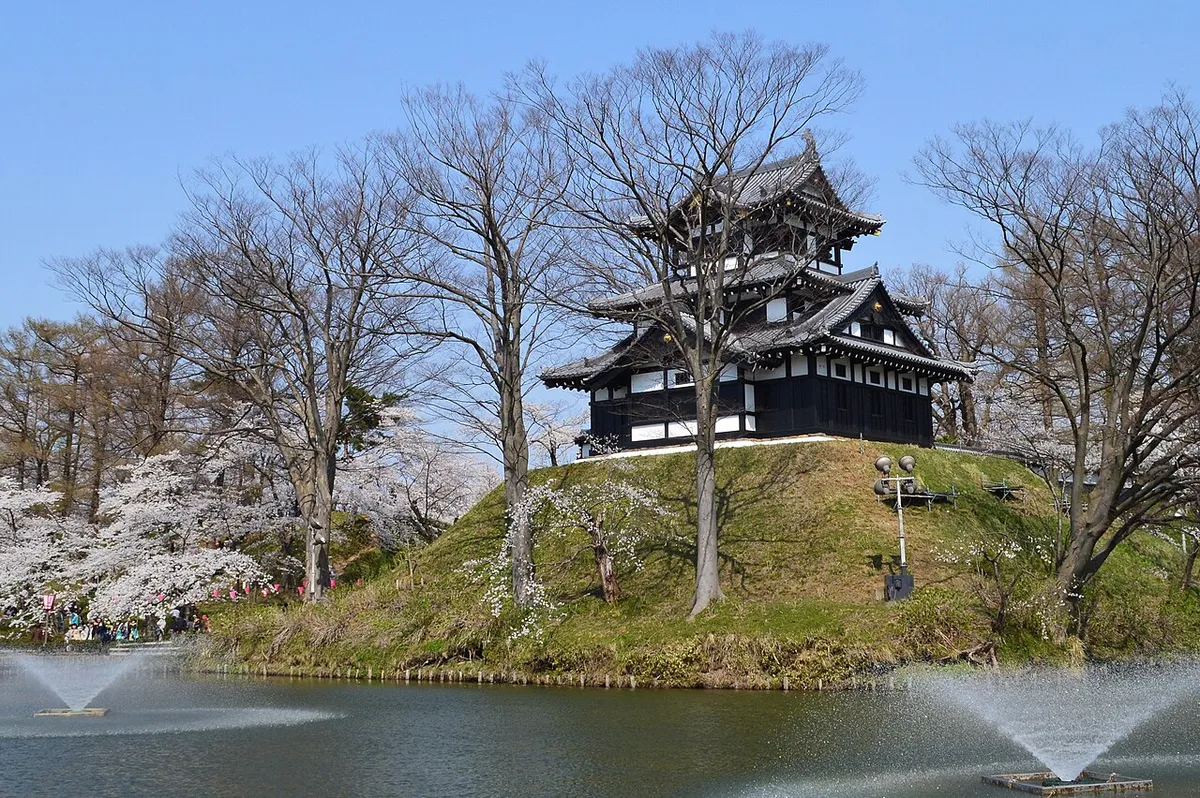
Takada Castle

高田城·Takada-jo

D Tourism Score 48/100
C Defense Score 66/100

No tower, flat defenses, and built in four months — but those moat-reflected cherry blossoms at night are among Japan's great seasonal spectacles.

#132 — Continued 100 Castles Reconstructed
Takada Castle (高田城)
Photo:Saigen Jiro/Wikimedia Commons/CC0

Quick Facts

Quick Facts

Admission
Free Free
Hours
00:00 – 23:59
Nearest Station
Takada Station (Echigo Tokimeki Railway Myoko Haneuma Line) or Joetsu-Myoko Station (Hokuriku Shinkansen)
Walk from Station
20 min walk

Bus also available

Time Needed
1–1.5 hours (2+ hours during blossom festival)

Castle grounds and the reconstructed three-story turret are freely accessible. The Joetsu City Museum of History and Culture (Rekishi Bunka Center) within the park may charge a separate admission for special exhibitions.

Defense Overview

Defense Overview

Why Takada Castle was hard to attack

This castle is hard to attack because it combines managed outer defenses on relatively level ground with enough defensive depth to slow attackers before the center.

An attacker would not simply arrive at the center on open flat ground. They would have to cross water barriers or moat lines and push through successive outer areas before the core.

Overall score

66/100

Estimated range

60–72

Confidence

A

Strong multi-source support

This is a site-original comparison score for learning and comparison, not a reconstruction of one historical battle.

Radar view

Terrain 10/20 Entrance 11/20 Internal 15/20 Siege 16/20 Oversight 14/20
How this estimate was built+

This estimate combines broad terrain, approach, layout, and route-control signals. It is meant to explain the castle's defensive logic in plain English, not reconstruct a single historical attack.

Terrain Advantage

How much the terrain itself seems to help: height, slope, ridges, cliffs, water edges, and limited approach directions.

10/20

Entrance Defense

How awkward and dangerous the first entry looks: gates, bridge or moat crossings, chokepoints, and forced turns.

11/20

Internal Complexity

How hard it seems to keep pushing after entry: layered baileys, depth, compartmentalization, and repeated defensive lines.

15/20

Siege Endurance

A rough sense of long-hold potential: moats, water access, space, storage plausibility, and defensive staying power.

16/20

Strategic Oversight

How much the castle appears to command nearby roads, plains, rivers, basins, harbors, or town approaches.

14/20

Why Visit

Takada Castle is primarily a park experience with historical context. The moat system is scenic year-round, but the cherry blossom festival in late April is the reason most visitors come — and it genuinely delivers. The reconstructed turret is modest but honest (it represents what actually existed). For travelers in the Joetsu/Myoko area, the castle park is a pleasant half-morning visit; it becomes a memorable experience timed to late April blossoms. The historical story of its four-month construction and the mysterious disgrace of its builder adds narrative interest.

Highlights

1

One of Japan's Top Three Night Cherry Blossom Venues

Takada Castle's wide moats and flat park are lined with approximately 4,000 cherry trees. During the Takada Castle Cherry Blossom Festival (late April), the blossoms are illuminated at night — reflected in the still water of the moats — creating one of Japan's most celebrated seasonal spectacles. The festival has been running since the Meiji period and draws visitors from across Japan specifically for the nighttime moat reflection of lit blossoms.
2

Built in Just 4 Months — Tokugawa Engineering at Scale

Takada Castle was constructed in 1614 in an astonishing four months, mobilized by Tokugawa Ieyasu's son-in-law Matsudaira Tadateru as a base for controlling Echigo Province. Twenty feudal lords contributed labor and materials simultaneously in a forced construction project that demonstrates the Tokugawa regime's ability to command resources across the entire country. The speed of construction explains the castle's relatively simple defensive design — function over complexity.

3

A Reconstruction That Admits It Is One

Takada's reconstructed three-story turret (built in 1993) is honest about its nature — the original castle never had a main tower at all. A turret (yagura) was the closest thing to a tower at Takada, and the reconstruction faithfully represents this historical reality. This forthrightness — reconstructing what actually existed rather than inventing a tower — is comparatively rare and historically more honest than many other castle reconstructions.

Structure Details

Visitor tip

Takada Castle is best experienced as a park rather than a castle. The reconstructed turret is small and modest — the main visual attraction is the moat system and the cherry trees that line it. Come for the seasonal atmosphere (especially spring blossoms or autumn foliage) and the pleasant park walk around the moats. The historical interest is moderate; the aesthetic pleasure, especially in blossom season, is high.

Castle type

Flatland castle

Flatland castle — built entirely on flat terrain in the Echigo plain, with wide moats as the primary defense. No natural elevation whatsoever.

Layout type

Concentric layout

Enclosure style — concentric rings of moats surrounding the main compound, typical of flatland castle design in Echigo plain

Main tower

Concrete reconstruction of the three-story turret (1993) — the original Takada Castle never possessed a main tower (tenshu). The largest structure was a three-story yagura (turret). The 1993 reconstruction faithfully represents a turret rather than inventing a non-existent tower.

3 floors

Stone walls

Earthen walls

Takada Castle was defined by its moats rather than its walls. Earth embankments lined the inner edges of the water moats, topped with wooden defensive structures. The flat Echigo plain provided no natural stone resources for massive ishigaki construction, and the four-month construction timeline precluded elaborate stonework.

Moats

Three concentric water moats — fed by the local river network — surrounded the castle grounds. The inner moat is well-preserved and is the scenic centerpiece of Takada Park, famous for its cherry blossom reflections. The middle and outer moat traces are partially visible in the park landscape.

Key defensive features

Wide Water Moats

The three-ring moat system, fed by the abundant water of the Echigo plain's river network, was the castle's primary defensive feature. Wide, deep moats on flat terrain require substantial bridging equipment to cross, and any crossing was fully exposed to defensive fire.

Strategic Road Control

Takada's position on the Echigo plain controlled the key road connections between Shinano Province (modern Nagano) to the south and the Japan Sea coastal routes to the north — the strategic reason for its rapid construction rather than its defensive engineering.

The Story of Takada Castle

Originally built 1614 / Matsudaira Tadateru (Tokugawa Ieyasu's sixth son)
Current form 1993 / Joetsu City (concrete turret reconstruction)
    1614

    Matsudaira Tadateru — Tokugawa Ieyasu's sixth son and son-in-law of Date Masamune — mobilizes 20 feudal lords to construct Takada Castle in just four months. The unprecedented construction speed reflects the Tokugawa regime's ability to command national resources. The castle establishes Tokugawa control over Echigo Province.

    1616

    Matsudaira Tadateru is suddenly stripped of his domain by his father Ieyasu and older brother Hidetada on unspecified charges — one of the most dramatic and still-unexplained sudden demotions of the early Edo period. He lives under house arrest for 70 years until his death.

    1870

    The new Meiji government uses Takada as a military base during the Boshin War's final stages. The castle transitions to military use, and over subsequent decades the wooden structures deteriorate and are removed.

    1879

    The Takada Garrison is established on the castle grounds — a major military installation that occupies the site through the entire Meiji, Taisho, and early Showa periods. The garrison's presence simultaneously preserves the moat layout and prevents civilian heritage development.

    1993

    Joetsu City completes the reconstruction of the three-story turret in concrete, creating the current landmark. The park around the moats is developed as Takada Park, and the cherry blossom festival is revived as a major regional event.

Did You Know?

  • The Takada Cherry Blossom Festival claims to be one of Japan's three great night cherry blossom viewing events, alongside Hirosaki (Aomori) and the Maruyama Park illuminations (Kyoto). The 4,000 cherry trees were reportedly planted by soldiers of the Takada Garrison in 1878 — a military unit's gift to the city that has become the site's most celebrated seasonal feature.
  • Matsudaira Tadateru, who built the castle in 1614, lived under house arrest from 1616 until his death in 1683 — a total of 67 years confined, the longest political detention of any Tokugawa-era high-ranking figure. The reasons for his sudden disgrace remain debated by historians.
  • Takada Castle's construction in four months required the simultaneous labor of workers from 20 different feudal domains — a logistics exercise that prefigured the Tokugawa shogunate's later sankin-kotai (alternate attendance) system, which similarly mobilized domain resources for central authority purposes.

Score Breakdown

Tourism Score

D 48/100
  • Accessibility 10 /20
  • Foreign-Friendly 8 /20
  • Historical Value 12 /20
  • Visual Impact 12 /20
  • Facilities 6 /20

Defense Score

C 66/100
  • Terrain Advantage 10 /20
  • Entrance Defense 11 /20
  • Internal Complexity 15 /20
  • Siege Endurance 16 /20
  • Strategic Oversight 14 /20

Planning Your Visit

Best Time to Visit

Late April for the cherry blossom festival — this is when Takada delivers its best experience, with illuminated blossoms reflected in the moats after dark. Avoid the specific festival peak weekends if crowds are a concern; mid-week during blossom season is still beautiful with fewer visitors.

Time Needed

1–1.5 hours (2+ hours during blossom festival)

Insider Tip

The night blossom viewing is the point of Takada Castle — don't just visit in the daytime and leave. Stay for the illuminations after dark if you visit during the festival period. The moat reflections of lit blossoms are genuinely beautiful and unlike the daytime experience of the same place.

Map

Getting There

Nearest station: Takada Station (Echigo Tokimeki Railway Myoko Haneuma Line) or Joetsu-Myoko Station (Hokuriku Shinkansen)
Walk from station: 20 min walk
Bus: City buses connect Joetsu-Myoko Station and Takada Station to the castle park area. During the cherry blossom festival, special shuttle buses operate.
Parking: Large free parking areas within Takada Park. Ample except during the cherry blossom festival peak weekends.

Admission

Free

Castle grounds and the reconstructed three-story turret are freely accessible. The Joetsu City Museum of History and Culture (Rekishi Bunka Center) within the park may charge a separate admission for special exhibitions.

Opening Hours

Open00:00 – 23:59

Park and outer grounds accessible at all times. The reconstructed turret interior has seasonal opening hours — typically 09:00–17:00, closed in winter. Famous for night cherry blossom viewing (Takada Castle Cherry Blossom Festival, one of Japan's top three night blossom events, late April).

Facilities

  • – English guides
  • – Audio guide
  • ✓ Wheelchair access
  • ✓ Restrooms
  • – Gift shop
  • ✓ Food nearby

Nearby Castles

Featured in collections

FAQ

Frequently Asked Questions

How do I get to Takada Castle?

The nearest station is Takada Station (Echigo Tokimeki Railway Myoko Haneuma Line) or Joetsu-Myoko Station (Hokuriku Shinkansen). From there it is about 20 minutes on foot. City buses connect Joetsu-Myoko Station and Takada Station to the castle park area. During the cherry blossom festival, special shuttle buses operate.

How much does Takada Castle cost to enter?

Takada Castle is free to enter.

Is Takada Castle worth visiting?

Takada Castle is primarily a park experience with historical context. The moat system is scenic year-round, but the cherry blossom festival in late April is the reason most visitors come — and it genuinely delivers. The reconstructed turret is modest but honest (it represents what actually existed). For travelers in the Joetsu/Myoko area, the castle park is a pleasant half-morning visit; it becomes a memorable experience timed to late April blossoms. The historical story of its four-month construction and the mysterious disgrace of its builder adds narrative interest.

What are the opening hours of Takada Castle?

00:00 to 23:59.

How long should I spend at Takada Castle?

Plan for about 1–1.5 hours (2+ hours during blossom festival), depending on how closely you want to explore the grounds.