Mino-Kaneyama Castle

美濃金山城·Mino-Kaneyama-jo

F Tourism Score 35/100
A Defense Score 86/100

Mori Nagayoshi's mountain stronghold and birthplace of Fukushima Masanori — well-preserved Sengoku stone walls in the Kiso Valley forest.

#143 — Continued 100 Castles Ruins
Mino-Kaneyama Castle (美濃金山城)
Photo:ペ有家音/Wikimedia Commons/CC0

Quick Facts

Quick Facts

Admission
Free Free
Hours
00:00 – 23:59
Nearest Station
Mino-Ota Station (JR Chuo Main Line / JR Taita Line)
Walk from Station
40 min walk
Time Needed
1.5 to 2 hours including the mountain walk

Entirely free. The castle ruins are on a public mountain park. The Kaneyama Castle Museum in the town below is separately ticketed but optional for the ruins visit.

Defense Overview

Defense Overview

Why Mino-Kaneyama Castle was hard to attack

This castle is hard to attack because it combines high ground and difficult natural access with enough defensive depth to slow attackers before the center.

An attacker would first have to fight the site itself before reaching the main defenses. They would have to cross water barriers or moat lines and push through successive outer areas before the core.

Overall score

86/100

Estimated range

80–92

Confidence

B

Usable estimate with some inference

This is a site-original comparison score for learning and comparison, not a reconstruction of one historical battle.

Radar view

Terrain 19/20 Entrance 17/20 Internal 16/20 Siege 16/20 Oversight 18/20
How this estimate was built+

This estimate combines broad terrain, approach, layout, and route-control signals. It is meant to explain the castle's defensive logic in plain English, not reconstruct a single historical attack.

Terrain Advantage

How much the terrain itself seems to help: height, slope, ridges, cliffs, water edges, and limited approach directions.

19/20

Entrance Defense

How awkward and dangerous the first entry looks: gates, bridge or moat crossings, chokepoints, and forced turns.

17/20

Internal Complexity

How hard it seems to keep pushing after entry: layered baileys, depth, compartmentalization, and repeated defensive lines.

16/20

Siege Endurance

A rough sense of long-hold potential: moats, water access, space, storage plausibility, and defensive staying power.

16/20

Strategic Oversight

How much the castle appears to command nearby roads, plains, rivers, basins, harbors, or town approaches.

18/20

Why Visit

Mino-Kaneyama is a destination for committed castle and Sengoku history enthusiasts rather than casual visitors. The ruins are genuine and well-preserved, the biographical connections (Fukushima Masanori, Mori Nagayoshi) give the site real historical weight, and the mountain forest setting is pleasant. It pairs naturally with Naegi Castle 30 minutes away by car — both are free mountain castle ruins in Gifu with excellent Sengoku credentials.

Highlights

1

The Birthplace of Fukushima Masanori

Mino-Kaneyama Castle was the birthplace of Fukushima Masanori, one of the most celebrated generals of the Sengoku and early Edo periods. Born into the castle in 1561, Fukushima served Toyotomi Hideyoshi from childhood, fought at the Battle of Shizugatake (one of the Seven Spears of Shizugatake), commanded at the Korean campaigns, and distinguished himself at Sekigahara fighting for Tokugawa Ieyasu. His personal valor — combined with his politically turbulent career under the early Tokugawa — makes him one of the most compelling biographical subjects of the era.
2

Mori Nagayoshi and the Castle's Sengoku Heyday

The castle was built by Mori Nagayoshi, one of Nobunaga's most ferocious generals — a figure so violent in battle he was called 'Demon Nagayoshi' (Oni Musashi). Nagayoshi's castle at Kaneyama controlled the strategic Kiso River valley approach, and his exploits in Nobunaga's campaigns made the castle famous. His death at the siege of Ueda in 1584 ended the Mori clan's control of Kaneyama and began the castle's transition through various lords.

3

Stone Walls in the Kiso River Forest

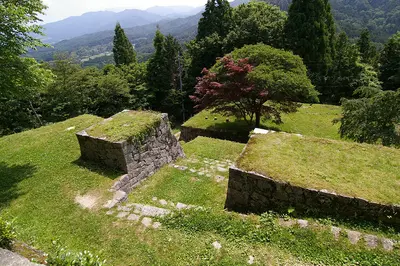
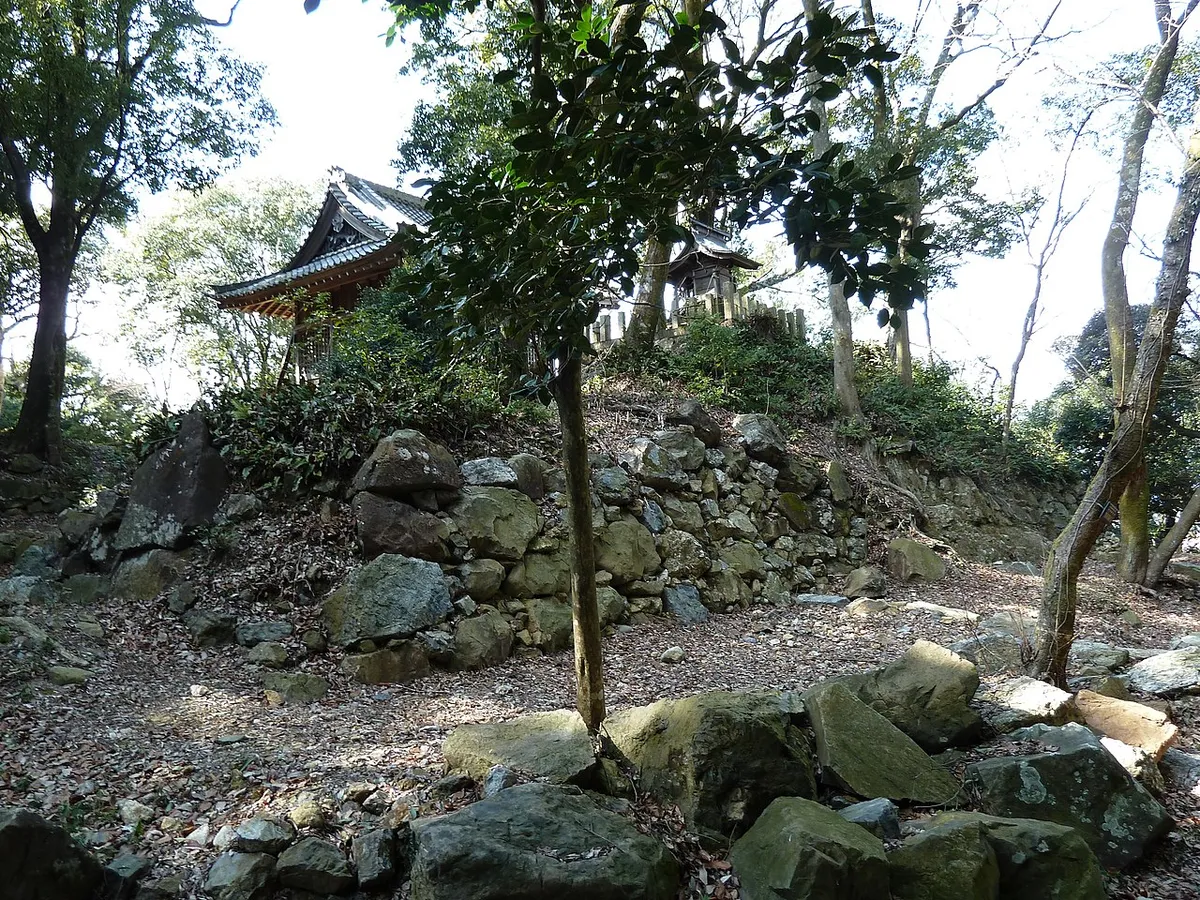
Mino-Kaneyama Castle's stone walls survive in remarkable condition given the site's obscurity. The approach through forested mountain paths opens onto well-preserved ishigaki stone walls built in the late 16th-century style, with the main compound walls reaching substantial height on the forested summit. For castle historians, the walls represent an almost untouched Sengoku-era construction that has escaped both postwar reconstruction and heavy tourist development.

Structure Details

Visitor tip

Mino-Kaneyama is a specialist castle destination — best appreciated by visitors with a strong interest in Sengoku history or stone wall construction. The walk to the summit is rewarding in itself through forest scenery, and the stone walls at the top are well-preserved. Combine with nearby Naegi Castle (30 minutes by car) for a full Gifu mountain castles day.

Castle type

Mountain castle

Mountain castle — built on Kaneyama (Gold Mountain), controlling the Kiso River valley approach through central Gifu Prefecture

Layout type

Linked compound layout

Compound style — multiple compounds arranged along the forested mountain ridge, with the main compound at the highest point

Main tower

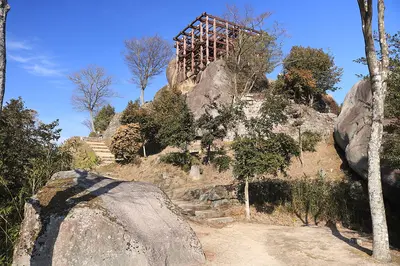
Ruins — no keep survives. Stone walls, compound platforms, and earthworks remain on the forested summit ridge. The ruins are maintained as a historical park.

Stone walls

Natural stone stacking

The surviving stone walls of Mino-Kaneyama are a good example of late Sengoku-period construction — less refined than Edo-era castle walls but solidly built and well-preserved in the forested mountain environment. The main compound walls are the most substantial, with significant height preserved on multiple faces.

Key defensive features

Kiso River Valley Control Position

The castle's mountain position overlooked the Kiso River valley — a critical route through the Chubu mountains. Any army moving through the valley would be visible from the castle's summit, and the garrison could harry or block valley movement.

Forested Mountain Approach

The heavily forested mountain approaches slowed any attacking force considerably and masked the defenders' true numbers. The single maintained path to the summit was the only practical approach, making large-formation attacks impractical.

The Story of Mino-Kaneyama Castle

Originally built 1537 / Toki clan (initial fort); Mori Yoshinari (major construction)
Current form 1565 / Mori Yoshinari and Mori Nagayoshi (castle expansion)
    1537

    An initial fortification is established at Kaneyama by the Toki clan, controlling the mountain approach above the Kiso River. The site's strategic value in controlling valley routes is recognized from the outset.

    1565

    Mori Yoshinari, one of Oda Nobunaga's most trusted generals, takes control of Kaneyama and begins significant expansion of the castle. Yoshinari transforms it from a simple mountain fort into a proper yamajiro with stone walls and multiple compounds.

    1570

    Mori Yoshinari is killed at the Battle of Anegawa — one of Nobunaga's major victories against the Asakura-Azai alliance. His son Nagayoshi (later called 'Demon Nagayoshi') inherits the castle and continues his father's legacy as a fierce Nobunaga general.

    1561

    Fukushima Masanori is born at Kaneyama Castle, son of a relative of the Mori clan. His birth here, at one of the key Nobunaga strongholds in Mino Province, sets the stage for a life at the center of Sengoku military culture.

    1600

    After Sekigahara, Kaneyama domain is reorganized under Tokugawa control and eventually the castle is abandoned as part of the one-castle-per-domain policy. The mountain site is left to the forest.

In Pop Culture

TV

NHK Taiga dramas featuring Fukushima Masanori

Fukushima Masanori appears in multiple NHK historical dramas about Toyotomi Hideyoshi and the Sekigahara period. His birthplace at Kaneyama is occasionally referenced in historical drama context.

Did You Know?

  • Mori Nagayoshi earned his nickname 'Oni Musashi' (Demon of Musashi) — though from Mino, not Musashi — for his terrifying effectiveness in battle. Contemporary accounts describe him as a berserker figure whose personal fighting style was as aggressive as it was effective. He died at the siege of Ueda Castle in 1584, fighting for Nobunaga's successor Hideyoshi.
  • Fukushima Masanori's career trajectory from Kaneyama Castle to becoming one of the Seven Spears of Shizugatake and then a major Sekigahara figure represents one of the complete arcs of Sengoku social mobility — from castle retainer's family to domain lord, entirely through military excellence.
  • The castle's name 'Kaneyama' (Gold Mountain) likely refers to either gold deposits in the area — common in Gifu's mining history — or to the gold-colored foliage of the mountain in autumn. No gold mining at the castle site has been historically documented, making the autumn foliage explanation slightly more plausible.

Score Breakdown

Tourism Score

F 35/100
  • Accessibility 5 /20
  • Foreign-Friendly 5 /20
  • Historical Value 11 /20
  • Visual Impact 9 /20
  • Facilities 5 /20

Defense Score

A 86/100
  • Terrain Advantage 19 /20
  • Entrance Defense 17 /20
  • Internal Complexity 16 /20
  • Siege Endurance 16 /20
  • Strategic Oversight 18 /20

Planning Your Visit

Best Time to Visit

April for cherry blossoms. October–November for autumn foliage. Avoid mid-winter when the mountain paths may be icy.

Time Needed

1.5 to 2 hours including the mountain walk

Insider Tip

The Kaneyama Castle Museum in Minokamo City below the mountain provides the best English-language context for the castle's history and its connection to Fukushima Masanori. Visit the museum first, then the mountain ruins for the most informed experience.

Map

Getting There

Nearest station: Mino-Ota Station (JR Chuo Main Line / JR Taita Line)
Walk from station: 40 min walk
Parking: Free parking at the trailhead parking area at the base of the castle mountain.
Accessible with a JR Pass

Admission

Free

Entirely free. The castle ruins are on a public mountain park. The Kaneyama Castle Museum in the town below is separately ticketed but optional for the ruins visit.

Opening Hours

Open00:00 – 23:59

The ruins are open at all times. Trail to the summit takes approximately 30 minutes from the trailhead. The path may be slippery in wet or icy conditions — winter visits require care.

Facilities

  • – English guides
  • – Audio guide
  • – Wheelchair access
  • ✓ Restrooms
  • – Gift shop
  • – Food nearby

Nearby Castles

Featured in collections

FAQ

Frequently Asked Questions

How do I get to Mino-Kaneyama Castle?

The nearest station is Mino-Ota Station (JR Chuo Main Line / JR Taita Line). From there it is about 40 minutes on foot.

How much does Mino-Kaneyama Castle cost to enter?

Mino-Kaneyama Castle is free to enter.

Is Mino-Kaneyama Castle worth visiting?

Mino-Kaneyama is a destination for committed castle and Sengoku history enthusiasts rather than casual visitors. The ruins are genuine and well-preserved, the biographical connections (Fukushima Masanori, Mori Nagayoshi) give the site real historical weight, and the mountain forest setting is pleasant. It pairs naturally with Naegi Castle 30 minutes away by car — both are free mountain castle ruins in Gifu with excellent Sengoku credentials.

What are the opening hours of Mino-Kaneyama Castle?

00:00 to 23:59.

How long should I spend at Mino-Kaneyama Castle?

Plan for about 1.5 to 2 hours including the mountain walk, depending on how closely you want to explore the grounds.