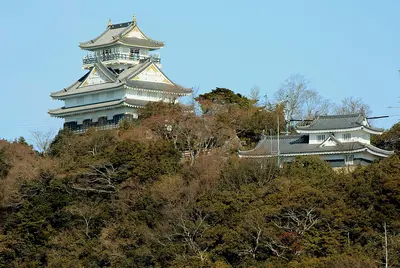
Naegi Castle

苗木城·Naegi-jo

D Tourism Score 42/100
A Defense Score 88/100

The castle on a boulder — Japan's most dramatic integration of natural granite and human fortification, floating above the Kiso River gorge.

#142 — Continued 100 Castles Ruins
Naegi Castle (苗木城)
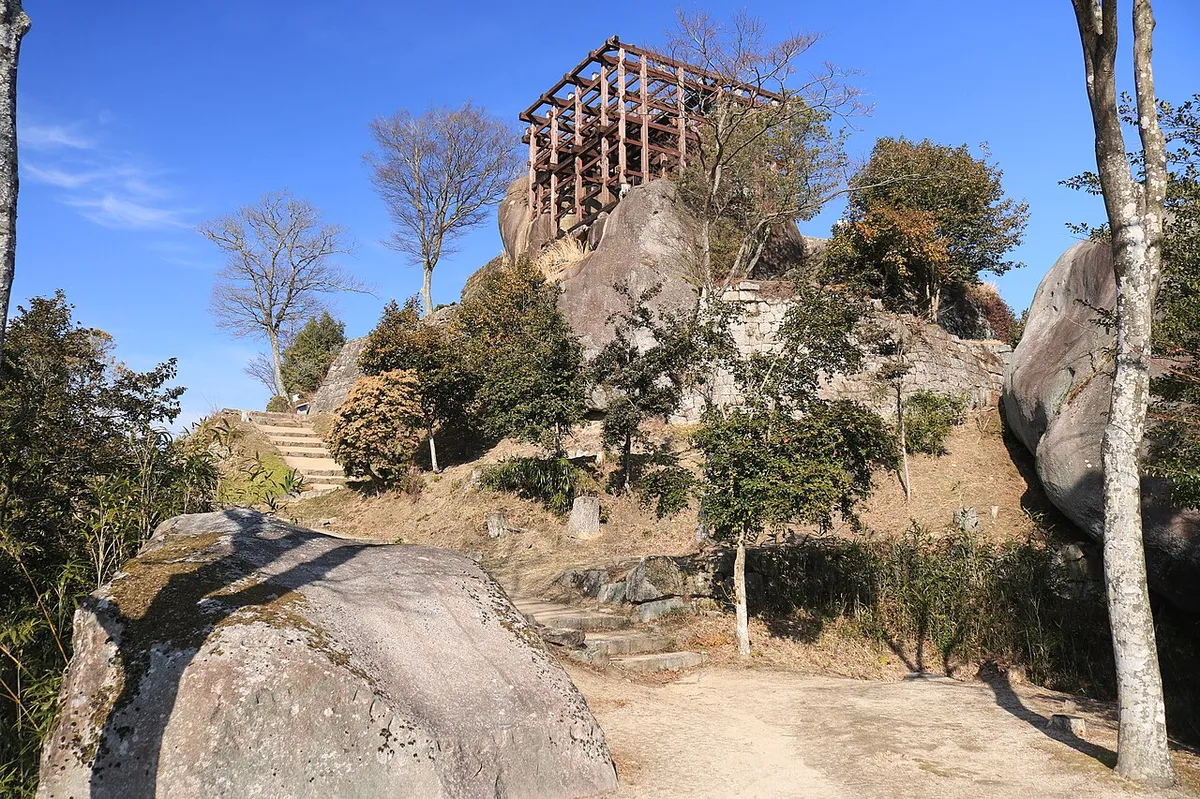
Photo:Alpsdake/Wikimedia Commons/CC BY-SA 4.0

Quick Facts

Quick Facts

Admission
Free Free
Hours
00:00 – 23:59
Nearest Station
Nakatsugawa Station (JR Chuo Main Line)
Walk from Station
45 min walk

Bus also available

Time Needed
1.5 to 2 hours

Entirely free to visit. The Naegi Castle Ruins Visitor Center at the base charges no admission. Parking is also free.

Defense Overview

Defense Overview

Why Naegi Castle was hard to attack

This castle is hard to attack because it combines high ground and difficult natural access with a controlled route inward.

An attacker would first have to fight the site itself before reaching the main defenses. They would have to cross water barriers or moat lines, approach through at least some constrained entry space, and face more defensive depth after the first line.

Overall score

88/100

Estimated range

82–94

Confidence

B

Usable estimate with some inference

This is a site-original comparison score for learning and comparison, not a reconstruction of one historical battle.

Radar view

Terrain 19/20 Entrance 18/20 Internal 17/20 Siege 16/20 Oversight 18/20
How this estimate was built+

This estimate combines broad terrain, approach, layout, and route-control signals. It is meant to explain the castle's defensive logic in plain English, not reconstruct a single historical attack.

Terrain Advantage

How much the terrain itself seems to help: height, slope, ridges, cliffs, water edges, and limited approach directions.

19/20

Entrance Defense

How awkward and dangerous the first entry looks: gates, bridge or moat crossings, chokepoints, and forced turns.

18/20

Internal Complexity

How hard it seems to keep pushing after entry: layered baileys, depth, compartmentalization, and repeated defensive lines.

17/20

Siege Endurance

A rough sense of long-hold potential: moats, water access, space, storage plausibility, and defensive staying power.

16/20

Strategic Oversight

How much the castle appears to command nearby roads, plains, rivers, basins, harbors, or town approaches.

18/20

Why Visit

Naegi Castle offers something no other castle in Japan provides: a keep built directly on a natural granite boulder, with stone walls merging seamlessly into the surrounding rock face, high above a river gorge. The sea-of-clouds photographs that have circulated internationally only hint at the on-site experience of standing on the boulder platform with the gorge dropping away hundreds of metres below. It is entirely free, the ruins are authentic and well-preserved, and the walk up through the rock-and-wall landscape is itself an architectural experience. For ruinists and photographers, Naegi is among the top five castle sites in Japan.

Highlights

1

The Castle Built on a Boulder

Naegi Castle is Japan's most dramatic example of castle construction integrated with natural rock. The keep was built directly on top of a massive natural granite boulder — the rock IS the castle's foundation. Stone walls rise from the natural rock surface, with the timber tenshu perched atop the boulder at the summit. The result is a castle that appears to grow organically from the cliff face, indistinguishable from the mountain itself in silhouette. No artificial fortification in Japan integrates nature and construction more completely.
2

The Observation Platform and the Sea of Clouds

A wooden observation platform has been reconstructed on the summit boulder, roughly replicating the footprint of the original keep. From this platform, the panorama takes in the Kiso River gorge far below, the surrounding Kiso Mountains, and on autumn mornings, an extraordinary phenomenon: the fog fills the valleys while the castle summit rises above it in clear sunlight — the classic 'sea of clouds' (unkai) effect that has made Naegi one of Japan's most photographed castle ruins.

3

The Torii Clan's Untouched Castle

Naegi was the seat of the Torii clan — not the famous Torii Mototada of Fushimi, but a different branch — through the entire Edo period without ever being besieged or significantly damaged. The result is a set of ruins that reflect genuine historical use rather than battle damage or post-Meiji demolition. The stone walls, rock integrations, and compound layouts are substantially as left when the domain was dissolved in 1871, giving castle historians unusually intact evidence of how a small mountain castle functioned in its final form.

Structure Details

Visitor tip

The walk from the car park to the summit takes approximately 20 minutes through increasingly dramatic rock-and-wall scenery. The path is well-maintained but involves some steep sections on natural rock — wear appropriate footwear. The summit observation platform is the payoff: the view from the granite boulder down into the Kiso River gorge, with stone walls dropping away on all sides, is one of the most impressive experiences at any Japanese castle ruin. Visit on an autumn morning if possible for the sea-of-clouds effect.

Castle type

Mountain castle

Mountain castle — built on a dramatic granite outcrop above the Kiso River gorge, with the keep erected directly on a massive natural boulder at the summit

Layout type

Linked compound layout

Compound style — multiple terraced compounds integrated with natural rock outcrops, ascending to the boulder summit

Main tower

Ruins — the wooden tenshu no longer exists, but the massive natural granite boulder on which it stood survives, along with the stone wall sections built around and against the rock face. A modern wooden observation platform replicates the tenshu footprint.

Stone walls

Natural stone stacking

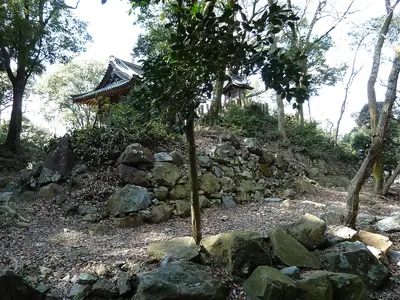
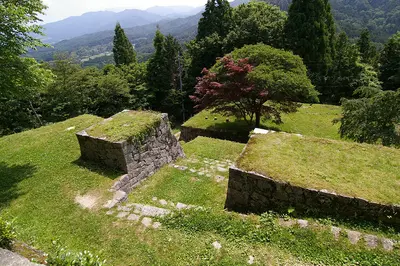
The stone walls of Naegi are inseparable from the natural rock they are built around. In many sections, walls begin at ground level but merge seamlessly with the natural granite outcrops — it is often impossible to tell where the natural rock ends and the constructed wall begins. The result is a defensive system of remarkable strength, since undermining is physically impossible and the natural rock forms a continuous barrier that human construction merely extends.

Key defensive features

The Granite Boulder Foundation

The central defensive feature of Naegi Castle is the massive natural granite boulder on which the keep stood. The boulder's sheer rock faces are effectively unscalable without climbing equipment, and the natural elevation above the surrounding compounds made the keep position nearly unassailable even after an attacker had breached the lower compounds.

Kiso River Gorge Natural Moat

The Kiso River runs far below the castle's east face — a natural gorge hundreds of metres deep that made any eastern approach essentially impossible. Attackers were restricted to the narrow western approach path.

Integrated Rock-Wall Defense System

The combination of natural rock outcrops and constructed stone walls creates a defense system with no clear seam between natural and artificial barriers. Attackers could not simply focus on the 'wall' sections — every cliff face and boulder was also a defensive element.

The Story of Naegi Castle

Originally built 1526 / Toru clan (Toru Masanori, attributed)
Current form 1639 / Torii clan (major reconstruction and expansion)
    1526

    The Toru clan establishes a mountain castle on the granite outcrop above the Kiso River. The natural defensive advantage of the boulder formation is immediately recognized and forms the basis of all subsequent construction.

    1584

    Following the power shifts after Oda Nobunaga's death, the castle changes hands multiple times in the Sengoku turbulence of the Kiso Valley region. The strategic importance of the Kiso Road (Nakasendo route) below the castle increases its value.

    1600

    After Sekigahara, the Torii clan is awarded Naegi domain as a reward for service to the Tokugawa cause. The Torii family begins an extended expansion and refinement of the castle structures, integrating stone walls with the natural rock in the distinctive Naegi style.

    1639

    The Torii clan completes the main phase of castle construction. The keep, built directly on the summit granite boulder, and the integrated rock-wall compound system are completed in their final form.

    1871

    The Meiji government dissolves the Naegi domain. The castle structures are dismantled over subsequent years, leaving the stone walls and boulder foundation. The natural setting preserves the ruins in good condition as the site is far from urban development.

In Pop Culture

other

Japanese photography and travel media

Naegi Castle's sea-of-clouds autumn photographs have circulated widely on Japanese and international social media platforms, significantly increasing visitor numbers to what was previously a little-known ruin. The castle is now a recognized photogenic destination in autumn castle photography.

Did You Know?

  • The wooden observation platform at the summit was constructed based on historical records showing the keep's footprint on the boulder — it deliberately uses untreated wood and traditional joinery to represent the keep's approximate scale and position without claiming to be a reconstruction. It is an example of 'honest interpretation' of a ruin rather than the concrete reconstructions that replaced so many Japanese castle keeps in the 1950s-70s.
  • Naegi Castle's sea-of-clouds phenomenon occurs most reliably in October and November on mornings following rain, when temperature differences between valley and ridgeline create fog that fills the Kiso River gorge while the castle summit remains in clear air. The ideal time to arrive is sunrise, when the light is best and the fog has not yet dispersed.
  • The Kiso River below Naegi Castle is one of Japan's three great rapid rivers (Nihon san dai kyuryu) — along with the Fuji River and the Mogami River. The combined effect of the cliff-face castle and the rushing river gorge below creates one of the most dramatic natural settings of any Japanese castle site.

Score Breakdown

Tourism Score

D 42/100
  • Accessibility 6 /20
  • Foreign-Friendly 7 /20
  • Historical Value 10 /20
  • Visual Impact 14 /20
  • Facilities 5 /20

Defense Score

A 88/100
  • Terrain Advantage 19 /20
  • Entrance Defense 18 /20
  • Internal Complexity 17 /20
  • Siege Endurance 16 /20
  • Strategic Oversight 18 /20

Planning Your Visit

Best Time to Visit

October to November for autumn color and sea-of-clouds fog effects — arrive at sunrise for the best light and before the fog disperses. Spring (April) for cherry blossoms against the stone walls. Weekdays to avoid the increasing weekend crowds drawn by social media photography.

Time Needed

1.5 to 2 hours

Insider Tip

Check the weather forecast the night before — the sea-of-clouds effect requires specific conditions: clear overnight skies following rain, with a significant temperature drop by morning. Local weather apps in Japan sometimes predict fog conditions specifically. If conditions are right, arrive at or before sunrise and bring warm layers — the summit is exposed and cold in autumn mornings.

Map

Getting There

Nearest station: Nakatsugawa Station (JR Chuo Main Line)
Walk from station: 45 min walk
Bus: Buses run from Nakatsugawa Station to the castle trailhead parking area. Service is infrequent — check the local schedule. Taxi from the station is practical and inexpensive. Driving is recommended.
Parking: Free parking at the designated castle car park, approximately 10 minutes walk from the castle ruins. A second parking area is closer but accessed by a narrow road.
Accessible with a JR Pass

Admission

Free

Entirely free to visit. The Naegi Castle Ruins Visitor Center at the base charges no admission. Parking is also free.

Opening Hours

Open00:00 – 23:59

The ruins are open at all times. The visitor center at the base is open 9:00–17:00 (closed certain Mondays and year-end). Note: fog conditions in autumn (October–November mornings) can create spectacular 'sea of clouds' effects — early morning visits in this season are highly recommended.

Facilities

  • – English guides
  • – Audio guide
  • – Wheelchair access
  • ✓ Restrooms
  • ✓ Gift shop
  • – Food nearby

Nearby Castles

Featured in collections

FAQ

Frequently Asked Questions

How do I get to Naegi Castle?

The nearest station is Nakatsugawa Station (JR Chuo Main Line). From there it is about 45 minutes on foot. Buses run from Nakatsugawa Station to the castle trailhead parking area. Service is infrequent — check the local schedule. Taxi from the station is practical and inexpensive. Driving is recommended.

How much does Naegi Castle cost to enter?

Naegi Castle is free to enter.

Is Naegi Castle worth visiting?

Naegi Castle offers something no other castle in Japan provides: a keep built directly on a natural granite boulder, with stone walls merging seamlessly into the surrounding rock face, high above a river gorge. The sea-of-clouds photographs that have circulated internationally only hint at the on-site experience of standing on the boulder platform with the gorge dropping away hundreds of metres below. It is entirely free, the ruins are authentic and well-preserved, and the walk up through the rock-and-wall landscape is itself an architectural experience. For ruinists and photographers, Naegi is among the top five castle sites in Japan.

What are the opening hours of Naegi Castle?

00:00 to 23:59.

How long should I spend at Naegi Castle?

Plan for about 1.5 to 2 hours, depending on how closely you want to explore the grounds.